At a glance
Australia's AI build so far has been about buildings and power. The next stage is the network that links them, because AI work is spreading across many sites rather than sitting in one.
Big campuses for building AI models are heading to regional areas with spare power, including Zerra's 1.44GW application at Kogan in Queensland and Firmus's 2.7GW across two South Australian sites. The work of answering questions with those models is moving into city data centres, close to users.
Telstra has laid 8,500km of new fibre between capitals and names Google as its largest customer on it. Vocus is spending A$500 million on a new Sydney to Melbourne route and on 24 September 2026 announced a 4,000km Brisbane to Darwin route.
Software that lets customers switch those links on and off from a screen is attracting buyers. US carrier Lumen paid US$475 million for one such company in July 2026, and Brisbane's Megaport has sold the service since 2013.
For three years the Australian AI infrastructure story has been told in megawatts: who has the power, who has the land, who has the planning approval. Power and land still decide where the big campuses go. What has changed is that AI work no longer sits in one building. It is being split across regional campuses where the power is, city data centres where the users are, and the clouds in between, and every piece of it has to talk to every other piece. Vocus's plan for a 4,000km Brisbane to Darwin route, announced on 24 September 2026, is Vocus's second new long-distance route since 30 June. The connections between Australia's data centres are becoming as valuable as the data centres, and Telstra, Vocus and Megaport are each spending against that.
The clearest statement of the idea came from the United States. In an opinion piece in the trade title Fierce Network on 22 September 2026, telecommunications columnist Stephen Saunders described how Lumen Technologies, the US fibre carrier, sold its home broadband business to AT&T for US$5.75 billion and spent US$475 million on Alkira, a company whose software lets a business run its whole network across several clouds from one screen. Lumen chief executive Kate Johnson told him "the physical network is table stakes", and Saunders writes that she wants Lumen to become "the nervous system for the AI economy".
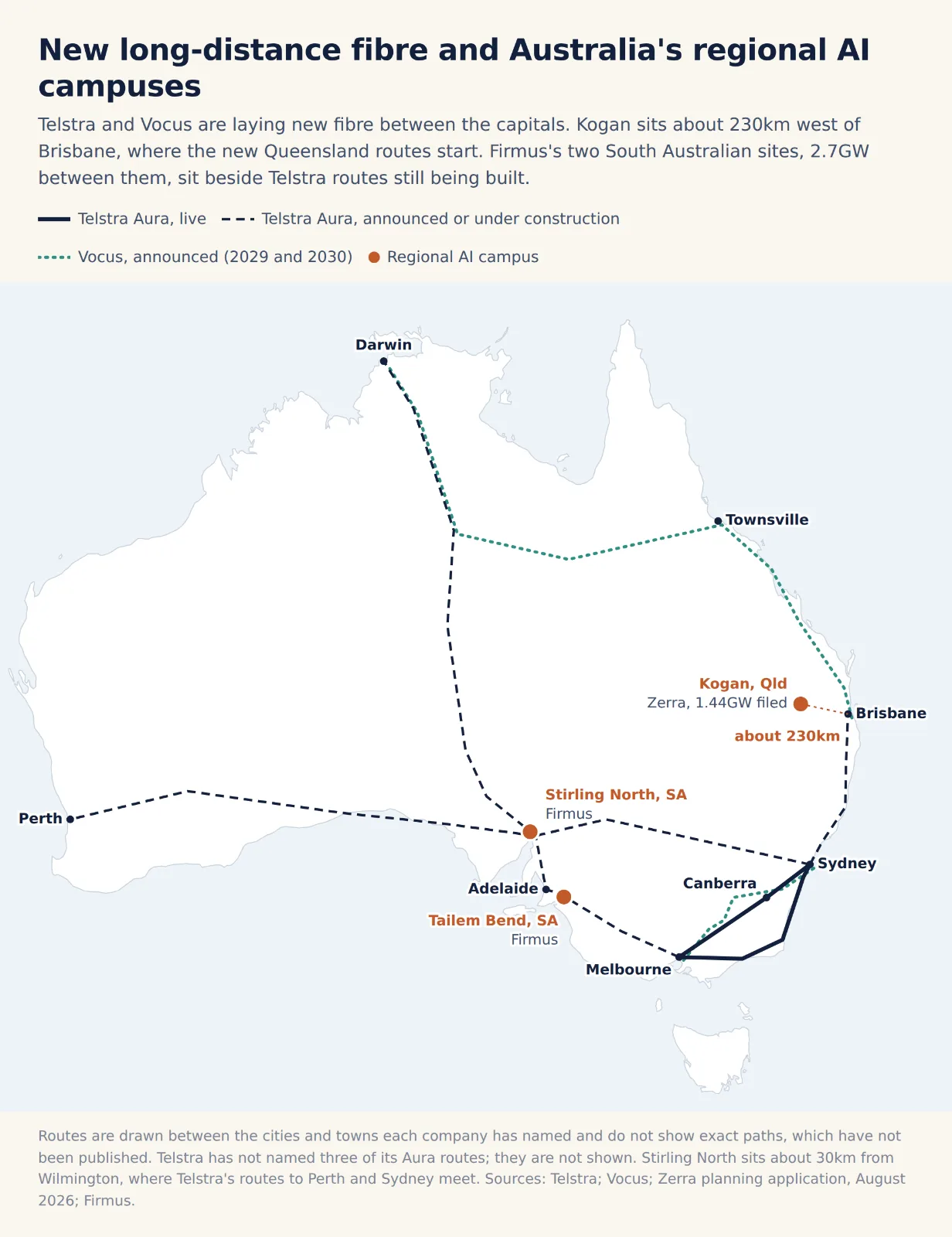
AI work is splitting between regional campuses and city data centres
There are two jobs in AI and they want different places. Megaport chief executive Michael Reid set the split out in his company's August 2026 annual report: "Training creates an AI model. Inference is what happens every time that model is asked to answer a question, create an image, write some code, or perform a task."
Building a model needs a vast amount of power in one place for months. That is why AI data centres on a gigawatt scale are being planned away from the capitals. Zerra has filed for 1.44GW at Kogan, about 230km west of Brisbane, and Firmus, the Australian AI infrastructure company, plans 2.7GW across Tailem Bend and Stirling North in South Australia. A gigawatt is a thousand megawatts. Kogan on its own would be close to the roughly 1.6GW of data centre capacity operating across Australia, the figure in a report Mandala prepared for industry body Data Centres Australia in August 2026.
Answering questions happens millions of times a day, and the closer the chips are to the person asking, the faster the answer comes back. That pulls the work into the city data centres that house the clouds, and into smaller data centres placed closer to users. Reid's line is that this "is therefore not only a compute challenge. It is also a network and storage challenge."
The result is that a single AI service now runs in several places at once, and depends on the fibre between them. A model built at a regional campus has to be shipped to every city where it will be used, its answers have to reach users, and the data feeding it has to arrive from wherever the customer keeps it.
Telstra and Vocus are relaying the fibre between capitals
Australia's carriers are laying new long-distance fibre for this traffic. Telstra had 8,500km of its new Aura fibre in the ground and six routes ready for service at its result on 13 August 2026, out of about 14,000km it has committed to build. On the results call Steven Worrall, who runs Telstra's infrastructure business, said Google was "now becoming our single largest client on Aura", after a June 2026 agreement that swapped Telstra land fibre for capacity on Google's subsea cables. AWS, Microsoft and Firmus also hold long-term contracts on its network, and Worrall told analysts Telstra is now fielding a new kind of request, a "gigawatt level type demand".
Vocus is building a second set of routes. On 30 June 2026 it announced a A$500 million Sydney to Melbourne route, laid in ducts so more cable can be pulled through later without digging again, due in 2029. On 24 September 2026 it added a 4,000km route from Brisbane through Townsville to Darwin, due in 2030. Vocus expects AI to drive 85% to 95% of demand for long-distance fibre, and says Australia "currently lacks sufficient terrestrial and subsea networks to enable existing and future AI workloads".
Subsea, SUBCO's SMAP cable began carrying traffic between Sydney, Melbourne, Adelaide and Perth in June 2026, and Firmus is underwriting a SUBCO cable from northern Tasmania to the mainland, due in the second quarter of 2027, to serve its campuses there.
Builder | Route | Status |
|---|---|---|
Telstra (Aura) | About 14,000km between capitals | 8,500km built, six routes live, August 2026 |
Vocus | Sydney to Melbourne, in ducts | A$500m, due 2029 |
Vocus | Brisbane to Townsville to Darwin, 4,000km | Due 2030 |
SUBCO (SMAP) | Sydney, Melbourne, Adelaide and Perth by sea | In service June 2026 |
SUBCO, underwritten by Firmus (Bernacchi-1) | Tasmania to the mainland | Due second quarter of 2027 |
Source: Telstra FY26 results, 13 August 2026; Vocus announcements, 30 June and 24 September 2026; SUBCO; Firmus.
Kogan sits about 230km west of Brisbane, where the new Queensland routes from Telstra and Vocus start, and no new route has been announced towards it. Firmus's two South Australian sites are closer to the build. Stirling North is about 30km from Wilmington, the South Australian junction Telstra has named for its routes to Perth and Sydney, and Tailem Bend sits between Adelaide and Melbourne, where Telstra has a route under construction. Neither Zerra nor Firmus has named a fibre partner for these campuses.
Lumen paid US$475 million for the kind of service Megaport has sold since 2013
AI customers want to open a private link between a training campus, a city data centre and a cloud in minutes, change its size, and shut it down, without phoning a carrier and waiting weeks.
That service has an Australian origin. Bevan Slattery, who had founded NEXTDC, launched Megaport in Sydney, Melbourne and Brisbane in July 2013, selling private connections to Amazon, Microsoft and Google that a customer could order from a website. It now reaches 1,138 data centres worldwide and earned A$312.2 million in FY26, 63% of it in the Americas. NEXTDC runs its own version, AXON, inside its buildings, and Equinix sells one called Fabric in its 18 Australian sites.
Lumen has followed the same path in the US. It kept its long-distance fibre, sold nearly US$13 billion of capacity on it to cloud and AI companies, named Anthropic as a customer at its February 2026 investor day, and bought Alkira so those customers can run the links themselves.
Megaport has gone a step further and now sells the chips at the end of its links as well. Since June 2026 it has raised A$827.3 million and signed A$978.6 million of new AI contracts to put NVIDIA chips in the data centres its network reaches, so customers can run AI models close to users and send the answers over Megaport's connections.
Where does Australia's AI network go from here?
Kogan, Tailem Bend and Stirling North have no fibre deal on the record. A campus at Kogan or Tailem Bend can secure power and planning approval, but its value to an AI customer depends on how quickly a model built there can reach users in Sydney, Melbourne and Brisbane.
We expect the first named fibre contract for one of Australia's regional AI campuses to be signed with Telstra or Vocus before the end of 2027, because they are the two carriers building long-distance land routes, and Telstra has said it is fielding gigawatt-scale requests. That contract will also show whether the carrier or the campus developer pays for the route.
What to watch
A fibre partner for Kogan or South Australia. Zerra and Firmus have published power and capacity for their regional campuses, but not who will connect them.
Telstra's unnamed Aura routes. Telstra has six routes ready for service and has launched three by name: Sydney to Melbourne, Sydney to Canberra and Canberra to Melbourne. Where the rest run says where Telstra expects the AI traffic to go.
Where Megaport's chips go. Megaport has signed ten AI contracts since June 2026, all with US-based customers, and has not said whether any of the hardware will sit in an Australian data centre.
A Vocus customer list. Vocus named no customer in either of its 2026 route announcements. Its first named buyer will show whether the same few cloud companies are paying for every new route.