At a glance
Google, AWS, Firmus and Microsoft have signed long-term contracts on the fibre and subsea capacity Telstra sells between data centres.
Aura, the national fibre network Telstra has been laying since 2023, is 8,500km built of a planned 14,000km.
Telstra still expects a mid-teens return and about nine years to earn back the A$1.8 billion, the same targets it set in 2023.
The bill rose A$200 million in a year, which Telstra puts down to inflation and project costs.
Telstra has named three of the six routes now open, so where the next capacity lands is still unknown.
Aura's budget has risen A$200 million since last year
Telstra reported its full-year results on 13 August 2026 and named the companies buying capacity on the fibre it is laying between Australia's data centres. Google, AWS, Firmus and Microsoft are all on long-term contracts, and the bill for building it has gone up.
Telstra sells distance. Before a data centre can sell anything it pays for two kinds of connection, one to the grid and one to the rest of the world, and the second comes in three parts: a fibre route to another capital city, a share of the 15 subsea cables that leave Australia, and a connection into the customer's own building. Operators buy all three from someone else. Telstra sells all three at national scale, and its customer list now reads Google, AWS, Microsoft and Firmus.
Since 2023 Telstra has been laying that fibre under the name Aura, a national network carrying traffic between the capital cities. It expects a mid-teens internal rate of return and a cash payback of about nine years on total strategic investment of about A$1.8 billion covering Aura and its Viasat satellite partnership through to FY28.
Telstra has published that same mid-teens return and that same nine-year payback since its 2023 investor day, and it repeated both on 13 August. The capital behind them has moved. The envelope has risen from about A$1.6 billion, with about 61% of the route map in the ground, so the build now has to earn the same return on 12.5% more money.
Four cloud and AI companies have signed long-term contracts
Chief executive Vicki Brady named the customers on the results call. Long-term contracts across the Aura Network, the subsea cables or the long-haul fibre have been signed by Google, AWS, Firmus and Microsoft, with Microsoft the foundation partner on Aura. Brady said the Aura sales pipeline had "increased significantly over the last six months".
Telstra matched Microsoft to Aura and has detailed the Google arrangement separately. It has said nothing about which assets AWS and Firmus took, or on what terms, and no contract values have been published for any of the four.
Firmus is the one name on that list building AI factories in Australia. It is a neocloud, a company that sells GPU computing to other businesses, and it is running its own infrastructure programme in Tasmania at the same time as buying from Telstra, including a subsea route to the mainland with SUBCO, the same builder behind the SMAP HyperCable system.
Google's fibre swap put Telstra on three Pacific cables
The only one of those four relationships disclosed in any detail was announced in early June 2026, and the two companies paid each other in capacity, with no cash disclosed on either side.
Google took dark fibre on Aura, meaning unlit strands it lights with its own equipment and controls end to end. Telstra took fibre pairs on three Google subsea systems: Tabua, which links Australia to the United States and Fiji from the Sunshine Coast with a Sydney landing; Proa, which connects Japan to Guam and the Northern Mariana Islands; and Bulikula, which connects Guam, the Northern Marianas, Hawaii, Fiji and French Polynesia.
Telstra will own and operate a fibre pair on Bulikula's core trunk, which gives an Australian carrier its own capacity on a route it previously bought from others. Neither company disclosed a value or the form the capacity takes. The full terms sit in the Google and Telstra fibre and subsea swap.
Aura reaches 8,500km as the budget rises A$200 million
Telstra has more than 8,500km of fibre in the ground against a route map of about 14,000km, and six routes ready for service. It has named three. Sydney to Melbourne on the coastal path via Canberra opened in October 2025 across 1,200km at up to 83.6Tbps. Sydney to Melbourne on the central path via Canberra, and Sydney to Perth connecting to Adelaide, both opened in June 2026. Telstra has not named the other three.
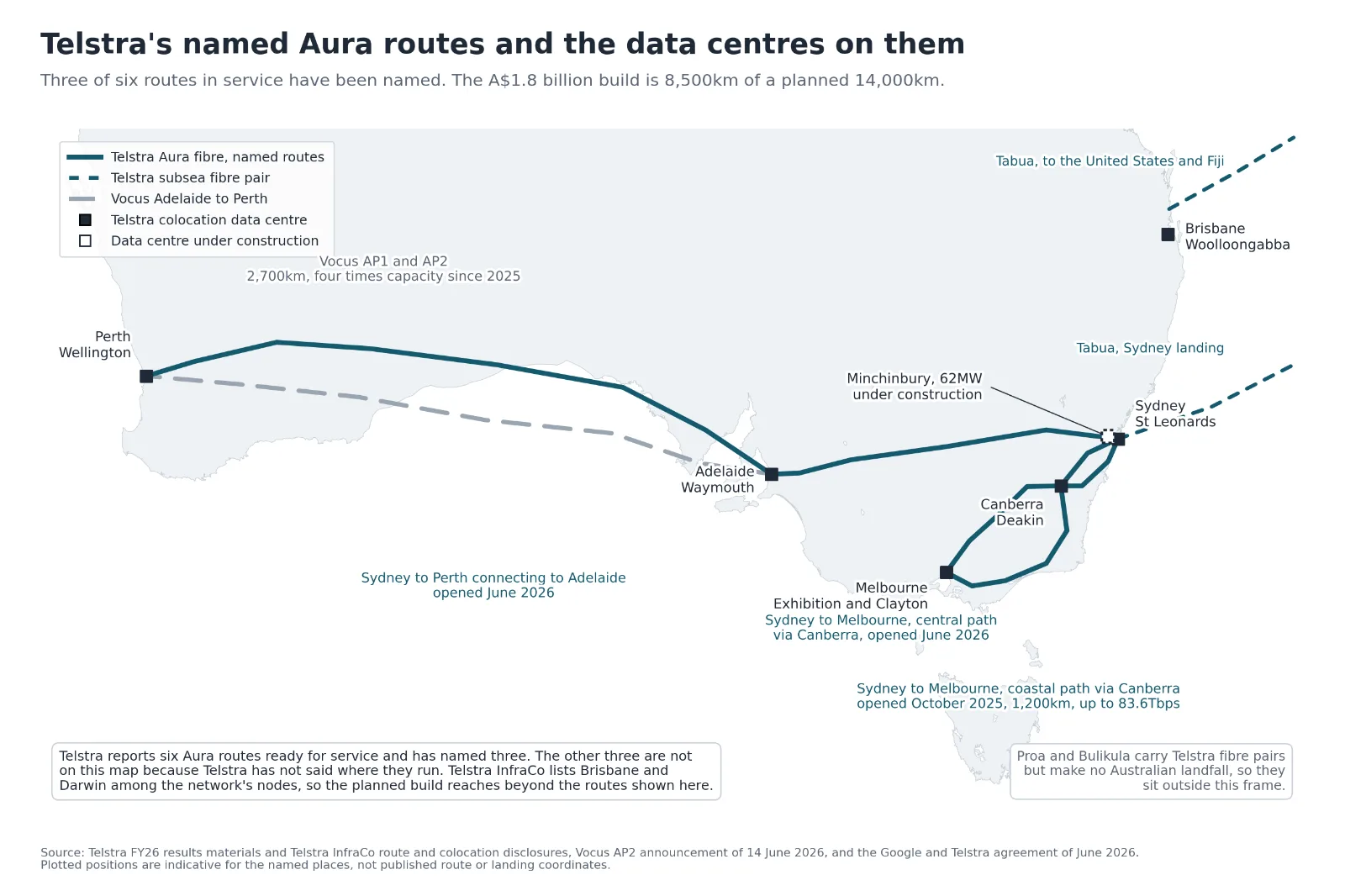
Getting there costs more than Telstra said it would. The budget covering Aura and the Viasat satellite partnership rose from A$1.6 billion to about A$1.8 billion across FY23 to FY28, an increase Telstra attributes to inflation and project-specific factors. The extra A$200 million was added with about 61% of the route map in the ground.
InfraCo Fixed, which holds the ducts, exchanges and fixed network, earned A$1,837 million after lease costs on income of A$2,779 million, up 3.3% on the earnings line. Amplitel, the towers business, earned A$323 million on income of A$487 million, up 3.9%. Across the group, total income fell 0.9% to A$23.4 billion, the postpaid handheld base finished the year 7,000 lower, and Telstra shares fell about 4% on results day to close near A$4.80.
Vocus holds 50,000km of fibre after buying TPG's network
Vocus bought TPG Telecom's enterprise, government and wholesale fixed business and its fibre assets for A$5.25 billion, completing on 31 July 2025, and picked up more than 50,000km of owned fibre and about 15,000km of submarine cable with it. That gives Australia a second company holding long-haul, subsea and access fibre together.
AP2 went live with native 400Gbps services on 14 June 2026, taking Adelaide to Perth corridor capacity to four times its pre-2025 level across a 2,700km dual-route platform. That corridor carries the same inter-capital traffic Telstra has now priced at a nine-year payback. Telstra's three named routes all run east or west from Sydney, while the corridor into Melbourne's western growth areas stays thinner than the pipeline there suggests. Victoria's own new international capacity is arriving separately, through the Tasman Ring cable landing at Torquay.
Telstra put fibre, subsea and seven data centres in one unit
Telstra reorganised around this position on 27 May 2026, announcing that Telstra InfraCo, Telstra International and Field Services would run as one unit under Steven Worrall, chief executive of Telstra Digital Infrastructure. Worrall ran Microsoft in Australia and New Zealand before joining Telstra InfraCo as chief executive in September 2025. The restructure carried a net reduction of about 111 roles, one step in a smaller workforce Telstra has signalled through to 2030.
Telstra InfraCo also runs seven colocation data centres open to any carrier: Wellington in Western Australia, Waymouth in South Australia, Exhibition and Clayton in Victoria, Deakin in the ACT, St Leonards in New South Wales and Woolloongabba in Queensland. St Leonards carries four generators at 5.7MW each in an N+1 configuration and three meet-me rooms in separate buildings, and the estate supports direct-to-chip and immersion cooling for high-density racks.
Telstra is also a partner in a 62MW data centre at Minchinbury in Western Sydney, contributing land and connectivity alongside Starwood Capital Group and Doma Infrastructure Group, which carry the financing and the build. Construction was due to begin in early 2026 against a target of first service in early 2028. Telstra's FY26 market release makes no mention of data centres, and no capex figure for them was disclosed.
Asset | Scale at 13 August 2026 | Status |
|---|---|---|
Aura intercity fibre | More than 8,500km of about 14,000km | Six routes ready for service |
Subsea | Fibre pairs on Tabua, Proa and Bulikula | Announced through the Google agreement |
Eight completed in FY26 | Operating | |
Colocation data centres | Seven sites across five states and the ACT | Operating |
Minchinbury joint venture | 62MW IT load, Western Sydney | First service targeted early 2028 |
Source: Telstra FY26 results materials, Telstra InfraCo disclosures, and the Starwood Capital Group, Doma Infrastructure Group and Telstra InfraCo announcement of 13 November 2025.
What to watch
The three unnamed routes. Telstra reports six routes ready for service and has published details for three. The remaining city pairs determine whether the next tranche of Aura capacity lands where the connection queue is heaviest.
FY27 strategic investment of A$0.2 billion to A$0.3 billion. That is the final stretch of the A$1.8 billion budget. A second increase would push the payback out beyond nine years.
What AWS and Firmus bought. Telstra named both without describing the assets or the terms. Disclosure from either side would give the market a second reference point on what this capacity costs.
Resilience spending after 8 July. Telstra's mobile network failed for 8.8 million customers on 8 July 2026, eight days after the balance date, and the Senate Environment and Communications References Committee took evidence on 17 July. Brady said on the results call that Telstra had taken full accountability. FY27 guidance of A$3.35 billion to A$3.65 billion in business-as-usual capex holds no separate line for what that work will cost.