At a glance
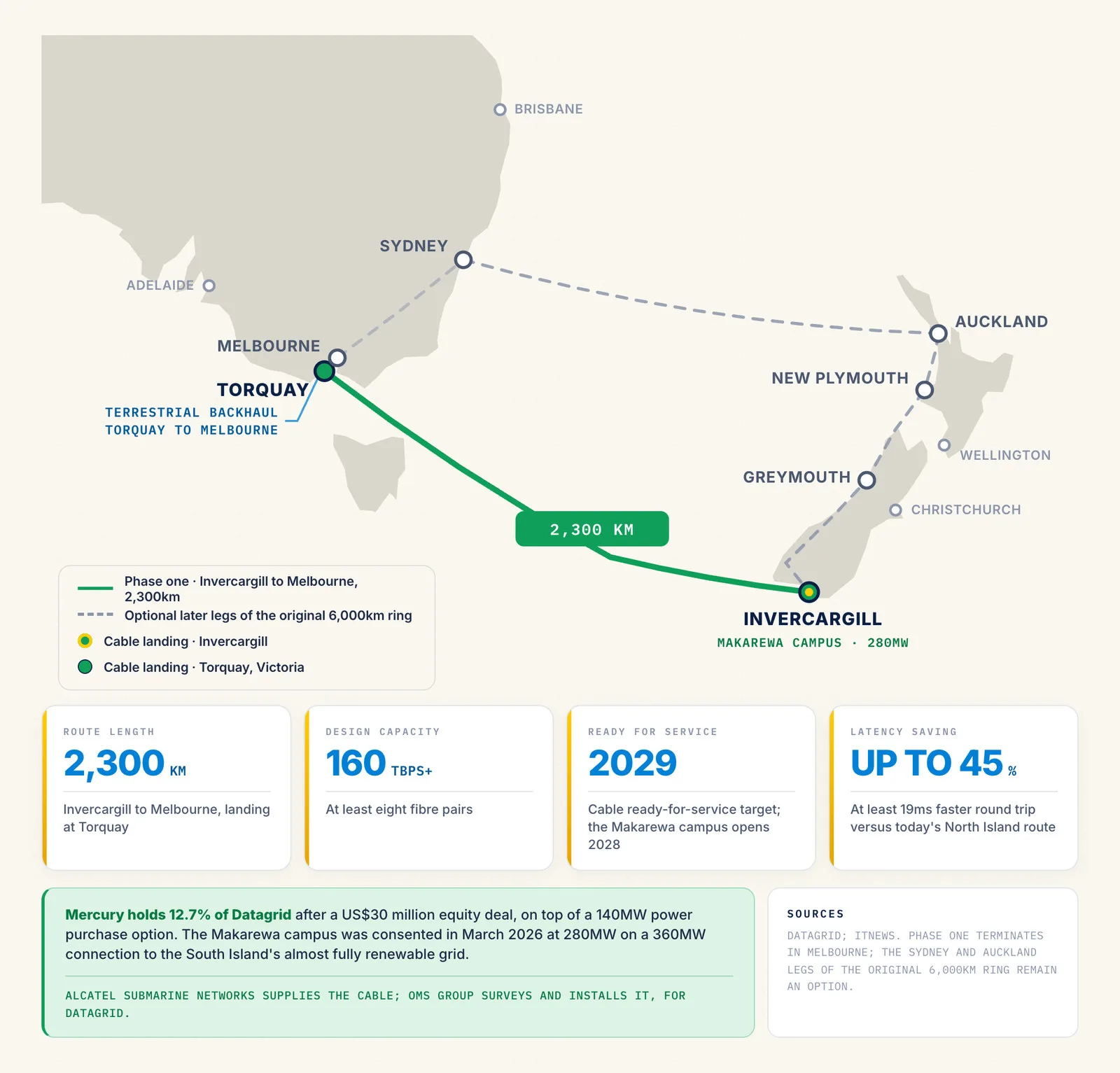
A 2,300km Invercargill to Melbourne cable is under contract, announced 31 July, with Alcatel Submarine Networks supplying the system and OMS Group surveying and laying it.
The Australian end lands at Torquay, where SUBCO is landing its SMAP hypercable, with terrestrial backhaul into Melbourne.
The cable carries at least eight fibre pairs, a design capacity of at least 160 terabits per second, and a ready-for-service target of 2029.
Datagrid's Makarewa campus, initial design 280MW, anchors the route, with Mercury holding 12.7% of the developer after a US$30 million equity deal.
Phase one stops at Melbourne, with the Sydney and Auckland legs of the original 6,000km ring remaining an option.
The Tasman Ring joins SMAP at Torquay
Melbourne is getting the Australian end of New Zealand’s next international cable. Datagrid, the developer of a hyperscale AI campus in Southland, announced a supply and installation contract on 31 July with Alcatel Submarine Networks, which will supply the Tasman Ring Network, and Malaysia’s OMS Group, which will survey the 2,300km route and lay the cable. “The cable will land in Torquay, where other submarine cables have recently landed. From there, a terrestrial backhaul will extend the cable to Melbourne,” Datagrid head of connectivity Pierre Goiffon told iTnews, naming a ready-for-service target of 2029.
Torquay is the landing SUBCO chose for SMAP, its Sydney to Perth hypercable, and the Tasman Ring now joins it there. A trans-Tasman route into Victoria adds to the subsea commitments gathering at Australia’s south-east corner, after Firmus and SUBCO announced Bernacchi-1 to Tasmania. An international path that terminates in Melbourne rather than Sydney is a supply-side addition, arriving as four new campuses push Melbourne’s data centre pipeline.
Mercury part-owns the 280MW campus behind the cable
Datagrid's pitch is South Island renewable power sold across the Tasman as compute, carried on its own cable. The campus at Makarewa, north of Invercargill, was consented in March 2026 at an initial design of 280MW on a 360MW connection to the almost fully renewable South Island grid, and Mercury took 12.7% of the developer in July on top of a 140MW power purchase option. Datagrid chief executive Rémi Galasso puts the latency saving to Australia at up to 45% against today's detour through the North Island; Goiffon counts it as at least 19 milliseconds round trip.
Sharon AI signed New Zealand's largest AI cloud contract this month, US$1.32 billion over five years, and New Zealand's data centre market is being built to sell compute offshore. Our NZ edition has the South Island end of the Tasman Ring contract. On current targets Makarewa opens in 2028 and the cable follows in 2029, with Datagrid's final investment decision on the campus expected before the end of 2026.
What to watch
The marine survey is the first physical work on the route, with OMS Group deploying an uncrewed long-range survey vessel across the 2,300km path. The option over the ring's Sydney and Auckland legs would give the system a second Australian landing, at Sydney, if exercised. New Zealand's government is separately drafting data centre investment principles, with Economic Growth Minister Nicola Willis and DPMC directed to develop them on 27 July. A contract value remains undisclosed, and the 2029 ready-for-service target now sits alongside SMAP and Bernacchi-1 in the queue of subsea capacity reaching south-east Australia this decade.