
NVIDIA's Marc Hamilton says nations should own their AI infrastructure
By Winston Su, Editor · · Add us as a preferred source on Google

At a glance
NVIDIA's Marc Hamilton says nations should not outsource AI infrastructure, comparing it with a country's electricity grid.
He says control means knowing how to build and run AI systems, not only keeping data onshore.
Hamilton expects AI inference to spread to smaller sites near users, from factories to mobile phone towers.
Hamilton says the buildout needs more tradespeople, and NVIDIA is working with the industry on modular builds made in factories.
Australia's GovAI service already offers NVIDIA's Nemotron models, and the Department of Finance says every model in its chat service must be hosted onshore.
NVIDIA's Marc Hamilton says countries should treat AI as national infrastructure and keep control of it at home. Hamilton, NVIDIA's Vice President of Solutions Architecture and Engineering, made the case on the Pacific Telecommunications Council's podcast Digging Into the Future, which the council published on 29 October 2026.
"Because AI is infrastructure, it's important we believe for nations not to outsource their infrastructure," Hamilton told host William Barney. "What nation says I'm going to outsource my electric grid?"
Australia's GovAI service already offers NVIDIA's own Nemotron models, under a rule that every model in its chat service is hosted onshore. NVIDIA's chips already run in Australian AI data centres, including Sharon AI's GPU cluster at NEXTDC M3 in Melbourne.
Control means the know-how as well as the data, Hamilton argues
Keeping data in the country is only "one step", Hamilton said. "You want to have the knowledge of how do you build cloud infrastructure? How do you build inference infrastructure?"
He said a company or a country that puts its own skills into an AI model it can only run offshore is in a weak position. "That AI model can only run in another country and only someone in another country knows how to build that model. That's not a great business proposition for a company or for a country."
Hamilton said organisations will take open models as a base and add their own data to them, and named NVIDIA's Nemotron as the company's own open large language model. Australia's GovAI service, the AI platform for the Australian Public Service, added NVIDIA's Nemotron in July. The Department of Finance says every model used by the GovAI chat service must be hosted onshore.
NVIDIA told analysts it earned more than US$30 billion in its year to January 2026 from selling AI computing to governments and national companies, which it calls sovereign AI. NVIDIA named eight Australian partners in September to expand land, power and shell capacity for up to 2GW of AI factories by 2027, a ceiling that counts some capacity outside Australia. Its AI Made in AU map of the local industry names 75 organisations.
Australian AI clouds sell onshore capacity on the same case. SCX.ai has run AI models at Equinix's SY5 data centre in Sydney since January 2026, on SambaNova chips rather than GPUs. It said on 27 October it had joined SpaceX's Grok partner network, alongside a partnership with US security firm F5 for walled-off AI computing for regulated industries. Sharon AI sells NVIDIA GPU capacity from NEXTDC M3 in Melbourne and lists Equinix SY3 and SY5 in Sydney.
NVIDIA expects inference to spread to smaller sites near users
Inference is the work of running a trained AI model to answer requests, as opposed to training it. "You're absolutely going to see inference spread," Hamilton said. Inference can run "all the way down to that cell phone base station".
Where the work goes depends on how fast it needs an answer. A chatbot reply that takes a few seconds anyway can be served at a regional level, Hamilton said. Robots in a factory need near real-time answers, so "we think every factory will have a token factory, an inference factory set up next to it," Hamilton said. "It may be in a shipping container in the parking lot."
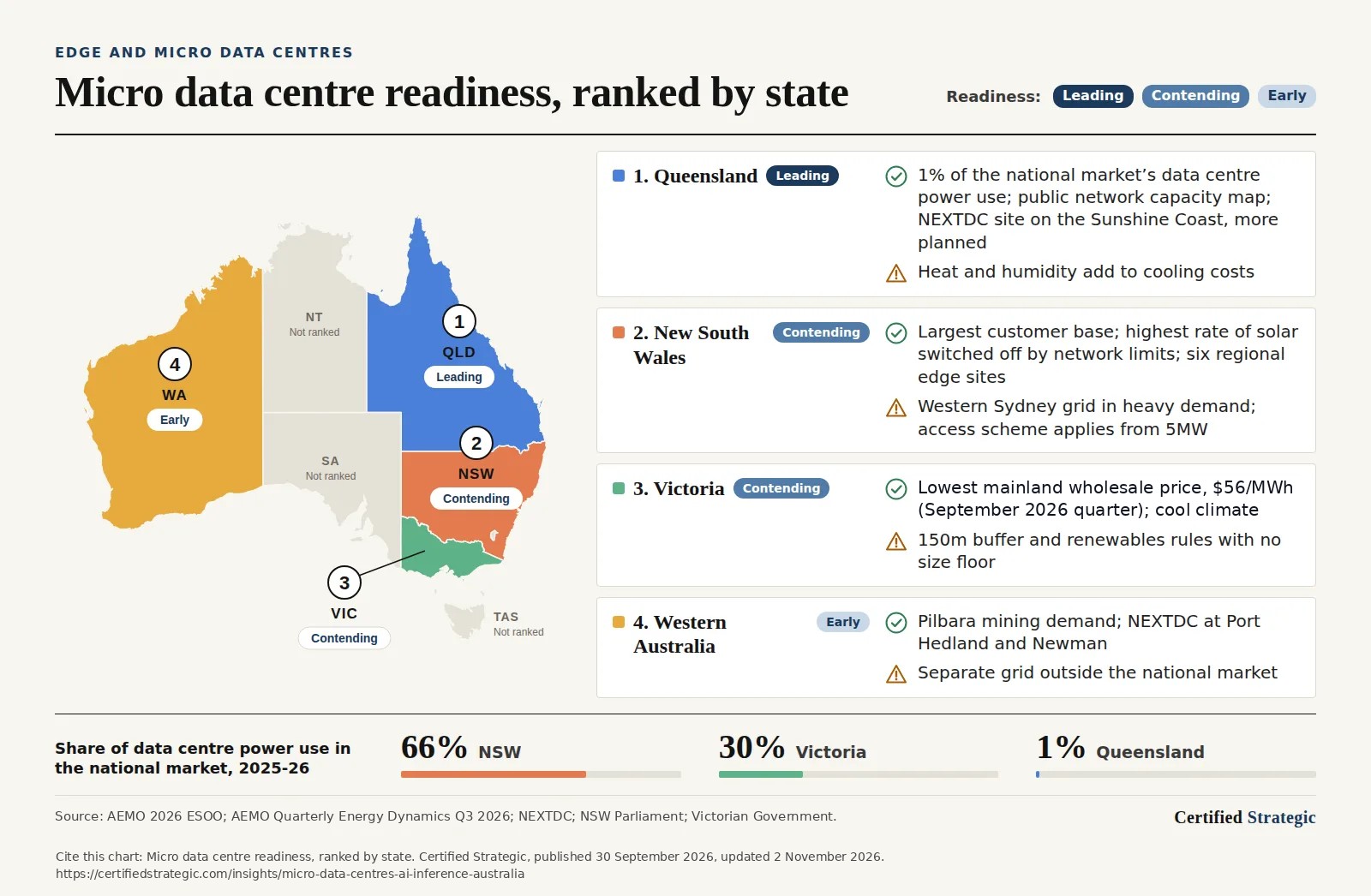
Work that can wait is "going to naturally go places where you have renewable energy, lower cost of energy", he said. Both kinds of site are in view for Australia. Micro data centres of up to 20MW near users and spare grid capacity are back in demand. Gigawatt campuses such as Project Ares in the Northern Territory are proposed with their own power supply.
SCX.ai chief executive David Keane made a similar point on inference in our video interview, recorded on 28 October. "You use existing buildings. So we're not waiting for new buildings. We're not waiting for power allocation," Keane said.
Australia needs 13,000 more data centre trades workers by 2030
"One of the limitations is just trades people needed to build that land power shell," Hamilton said. A hyperscaler building a gigawatt campus can hire whole construction and electrical companies, he said. A 10 or 20MW site may not be "big enough to get the plumbers moving in", in a town where there may not be enough hotel rooms.
Australia is already short of those trades. Data centres account for 13,000 of the 72,000 extra electrical and mechanical trades workers Australia needs by 2030, according to Powering Skills Organisation, the body that plans training for those trades. Jobs and Skills Australia's 2026 shortage list, released in October, still rates electricians, air conditioning and refrigeration technicians and data cablers in shortage nationally. Its 2025 list had rated all three in shortage in every state and territory.
Employers filled 57 per cent of vacancies in shortage occupations in 2025-26, against 78 per cent in other occupations, Jobs and Skills Australia's report says. Vacancies in shortage occupations lasted 10.6 weeks on average, against 7.8 weeks. Nine occupations in the electrotechnology and telecommunications trades group have been rated short in every list since 2021. Mechanical engineers moved into national shortage in 2026, and they help design a data centre's cooling and building services. Construction project managers are now rated short only in regional areas.
NVIDIA is working with the data centre industry on modular builds that move as much electrical and plumbing work as possible into factories, Hamilton said. NVIDIA launched DSX POD on 21 October 2026. It is a complete AI factory, built and tested on a production line and shipped in a container.
What to watch
GovAI's model list. The Department of Finance has added three model families since July, and its chat service can only use models hosted onshore.
DSX POD in Australia. NVIDIA's factory-built AI pods would test Hamilton's case that modular builds ease the need for on-site trades.
Keep reading the market
Get The Strategic Brief in your inbox every Thursday.
The leading Australian data centre and AI infrastructure newsletter.
Your Next Read
Sharon AI's 100MW target: where the extra 30 to 50MW lands across NEXTDC's network

NEXTDC's A$2.2 Billion Capital Plan and Sharon AI: What the Raise Means for Australia's Neocloud Tenant Base

Sharon AI's Sovereign GPU Cluster at NEXTDC M3: A Neo Cloud Deep Dive
Latest Headlines
Outback AI data centre drops 2028 start as NT EPA orders EIS
2 Nov 2026Stockland's Brooklyn data centre tops Victoria's A$5bn queue
2 Nov 2026Equinix opens a Sydney test room for liquid-cooled AI chips
31 Oct 2026Bomb threat halts Tungkillo 1.2GW data centre meetings
31 Oct 2026Alphabet loses nearly US$500bn as AI spending climbs
31 Oct 2026
Interested in reaching this audience? Advertise with us.