
Apprentice ratio proposed for data centre construction
By Winston Su, Editor · · Add us as a preferred source on Google

At a glance
The Electrical Trades Union and electrical contractors' body NECA want data centre developers to take on one apprentice for every three trade workers during construction, and want the rule in the National AI Framework.
On figures from the Powering Skills Organisation, the federally funded body that plans training for the energy trades, that ratio means about 6,500 apprentices in the energy trades on data centre construction sites by 2030.
Australia had 45,780 electrician apprentices in training at 31 March 2026, and electrician starts reached a quarterly record of 6,870.
New South Wales asks for one apprentice to every four tradespeople on its own construction contracts, and sets no ratio for data centres.
Data Centres Australia called quotas "a very blunt tool" and said higher data centre wages are drawing more workers into the sector.
Data centre developers would host apprentices under a joint proposal from the Electrical Trades Union (ETU) and the National Electrical and Communications Association (NECA), the industry body for electrical contractors, reported by the ABC on 25 November 2026. Developers would act as "anchor host employers", taking on first- and second-year apprentices at one for every three trade workers while a data centre is built, and would help fund extra TAFE and vocational training places through a levy. The two groups want the requirements included in the government's National AI Framework, which is expected before parliament in 2027. The groups are making the case while electricians are in shortage in every state and territory and Oxford Economics expects Australia to be the fastest-growing of 25 data centre construction markets through to 2028.
Applied to the Powering Skills Organisation's estimate of the data centre construction workforce, one apprentice for every three trade workers comes to about 6,500 energy trades apprentices on data centre sites by 2030, against 45,780 electrician apprentices in training across Australia at 31 March 2026.
The ETU and NECA want developers to host first- and second-year apprentices
NECA education and careers lead Gideon Perrott said data centres would get their workforce either by creating additional training places or by "winning a bidding war". ETU national secretary Michael Wright called the boom a "singular opportunity" to guarantee apprenticeship places and grow the number of electricians over the long term.
NECA chief executive Stewart Joyce said contractors spend time and money training apprentices only to lose them to higher-paying data centre jobs, which draws labour away from infrastructure and housing projects. In a supplementary submission to the Senate inquiry into AI and data centres in August 2026, NECA recommended workforce development plans and proportionate contributions to training capacity from data centre proponents. It also asked the Commonwealth and the states to find ways to recognise an employer's training investment when an apprentice moves, citing South Australia's transfer fee as one model. The same submission says a hyperscale data centre can need roughly 100 to 250 electricians and apprentices at peak, and that electrical contracting businesses train about 71 per cent of the country's electrician apprentices. The joint proposal with the ETU goes further than the submission, with a fixed ratio and a levy.
Data centre builds would need about 6,500 apprentices by 2030
The Powering Skills Organisation, the federally funded body that plans training for the energy trades, estimates data centres employed more than 15,000 electricians, refrigeration mechanics and other energy trades workers in 2024. It expects data centres to need about 28,000 by 2030. The organisation derives its data centre estimate from a ratio of 15 construction workers to every operations job, and its table puts 26,000 of the 28,000 on construction sites.
One apprentice for every three trade workers makes apprentices a quarter of each crew. On the organisation's 2030 table, 26,000 energy trades workers would be on data centre construction, and about 6,500 of them would be apprentices. Those figures assume the organisation's headcount includes apprentices. If the headcount is qualified workers only, the ratio would mean about 8,700 apprentices by 2030.
Data centre energy trades workers | 2024 | 2030 |
|---|---|---|
All, Powering Skills Organisation estimate | More than 15,000 | 28,000 |
On construction, Powering Skills Organisation table | 14,000 | 26,000 |
Apprentices at one for every three trade workers | 3,500 | About 6,500 |
Source: Powering Skills Organisation, 2026 Targeted Workforce Update, August 2026. Apprentice row applies the ETU and NECA ratio.
The National Centre for Vocational Education Research recorded 45,780 electrician apprentices in training at 31 March 2026, so 6,500 is about one in seven of them, although the Powering Skills Organisation figure also covers refrigeration mechanics and other energy trades. Electrician apprentice starts reached a quarterly record of 6,870 in the March 2026 quarter, up 19 per cent on a year earlier.
Electrician apprentices work across housing, energy and infrastructure. The Powering Skills Organisation expects Australia to need about 72,000 more electrical and energy trades workers by 2030. Clean energy accounts for 42,000 of them, housing for 17,000 and data centres for 13,000. The proposal asks developers to train apprentices on top of that pool.
Government building projects carry lower apprentice targets
New South Wales sets a target of one apprentice for every four tradespeople on its own government construction contracts. For data centres, the state lists training support among the principles in its data centre planning guidelines, with no ratio attached, and commits to assessing projects that meet those principles in "no longer than 75 days in state government hands".
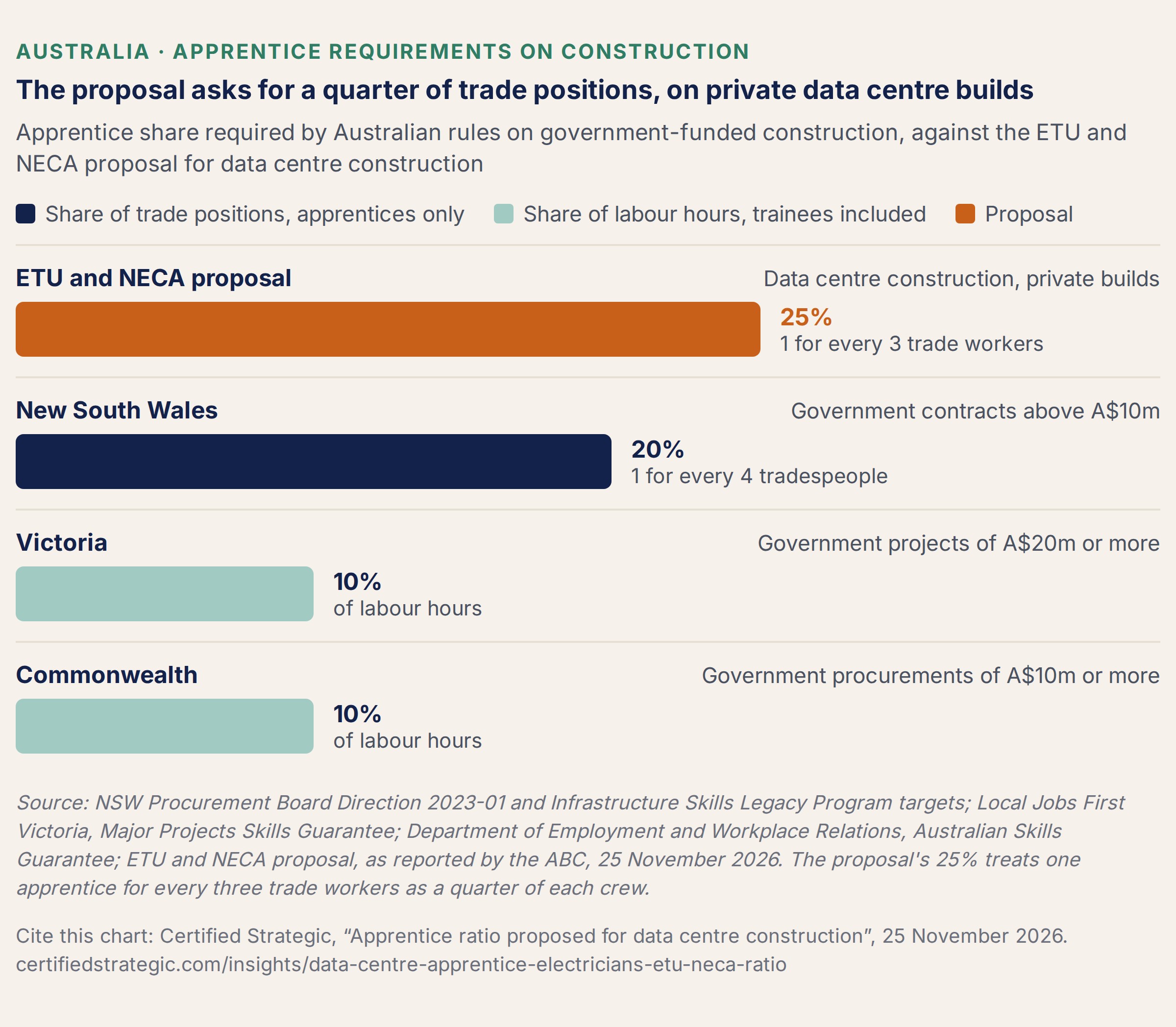
The ETU and NECA want apprentices in a quarter of trade positions, against a fifth under NSW's procurement direction, and on privately funded projects. Victoria and the Commonwealth set 10 per cent of labour hours on their own projects, and count trainees alongside apprentices.
Quotas are "a very blunt tool", says Data Centres Australia
Belinda Dennett, chief executive of industry body Data Centres Australia, told the ABC the electrician shortage is an economy-wide problem, "not a data centre problem", and that the higher wages data centres pay are drawing more workers into the sector. "We have a role there and we embrace it, but quotas are a very blunt tool," she said. "A quota does not necessarily mean more people."
In Canberra, Skills and Training Minister Andrew Giles said the government is investing in skills, training and apprenticeships across housing, clean energy, infrastructure and emerging industries including data centres. Parliament's cross-party AI committee tabled its report on 24 November 2026. It said "consideration must be given" to local jobs, apprenticeships, skills and training where data centres are built. It also noted shortages in the electrical and building trades. A draft of the National AI Framework released earlier in 2026 said data centre projects should make a "meaningful contribution" to expanding Australia's workforce.
What to watch
The framework bill. The National AI Framework legislation is expected in 2027, and its training requirement will either carry a number or keep the draft's "meaningful contribution" wording.
The levy. The rate will decide what the proposal costs developers, and the detail will show whether the money funds TAFE and vocational places in the states where data centres are built.
The next apprentice figures. The National Centre for Vocational Education Research's June 2026 quarter release will show whether electrician starts hold at record levels.
Apprentice turnover. The Powering Skills Organisation is studying how often apprentices leave the businesses that trained them, with results due by the middle of 2027.
Keep reading the market
Get The Strategic Brief in your inbox every Thursday.
The leading Australian data centre and AI infrastructure newsletter.
Your Next Read

Data centres are 13,000 of Australia's 72,000 trades gap

Australia's job statistics have no box for data centre workers
Firmus' Benmax deal more than doubles its workforce to 340
Latest Headlines
NT pitches itself as Australia's data centre gateway to Asia
25 Nov 2026350MW Mulwala data centre planned on solar farm land
25 Nov 2026ByteDance plans $15bn data centre in regional Victoria
25 Nov 2026Southern Cross Electrical wins A$120m in data centre and Metro work
24 Nov 2026Hunter Horizon Park data centre pairs 300MW with a battery
24 Nov 2026
Interested in reaching this audience? Advertise with us.