At a glance
CDC's proposed Hume Campus 3 in Canberra needs a full environmental impact statement before it can proceed, the ACT's Conservator of Flora and Fauna has ruled.
Preliminary site plans show four data centres with 24 data halls and a combined capacity of 576MW.
At 576MW, the campus is more than twice the 240MW across CDC's existing and approved Canberra campuses.
The ruling centres on 30 large trees on the 12-hectare site, most with hollows used by threatened birds including the Gang-gang Cockatoo.
CDC says the project remains at an early stage and its details will be refined as planning and environmental work continues.
CDC Data Centres will need a full environmental impact statement for Hume Campus 3, a proposed four-building data centre campus in Canberra's south. The ACT Conservator of Flora and Fauna Bren Burkevics rejected the application for an environmental significance opinion on the project. The opinion is the ACT planning check that decides whether a proposal can go ahead without that fuller assessment. The Conservator found the development is likely to have a significant environmental impact.
The ruling turns on 30 large trees on the site, which the proposal would clear in full. A CDC spokesperson told W.Media the project "remains at an early stage" and that "project details will continue to be refined as this work progresses".
Four data centres and 24 data halls on 12 hectares in Hume
The application describes four data centres holding 24 data halls, the secured rooms that house the servers, with emergency generators on site and vehicle access. Preliminary site plans put the combined capacity at 576MW. A future substation and water and sewer connections would also be needed.
The site is Block 28 Section 23 Hume, about 12 hectares of undeveloped land zoned for general industry. The Monaro Highway and the Hume industrial precinct run along its southern side, with rural land to the east and north. Hume is where CDC opened its first data centre, HU1, in 2008, and its Hume One and Hume Two campuses both sit in the suburb.
Hume Campus 3 is more than twice CDC's existing and approved Canberra capacity
CDC's Canberra campus page lists three operating campuses and a fourth, Beard, under construction. The ACT approved CDC's Beard 2 building on 29 September 2026.
Campus | Capacity | Status |
|---|---|---|
Hume One | 21MW | Operating |
Hume Two | 51MW | Operating |
Fyshwick | 45MW | Operating |
Beard 1 | 39MW | Under construction |
Beard 2 | 84MW | Approved 29 September 2026 |
Hume Campus 3 | 576MW | Proposed |
Source: CDC Canberra campus page; ACT development application register for Beard 2; ACT environmental significance opinion ESO 202600027 for Hume Campus 3.
The five campuses and buildings above Hume Campus 3 in the table come to 240MW, and Hume Campus 3 on its own would be more than twice that.
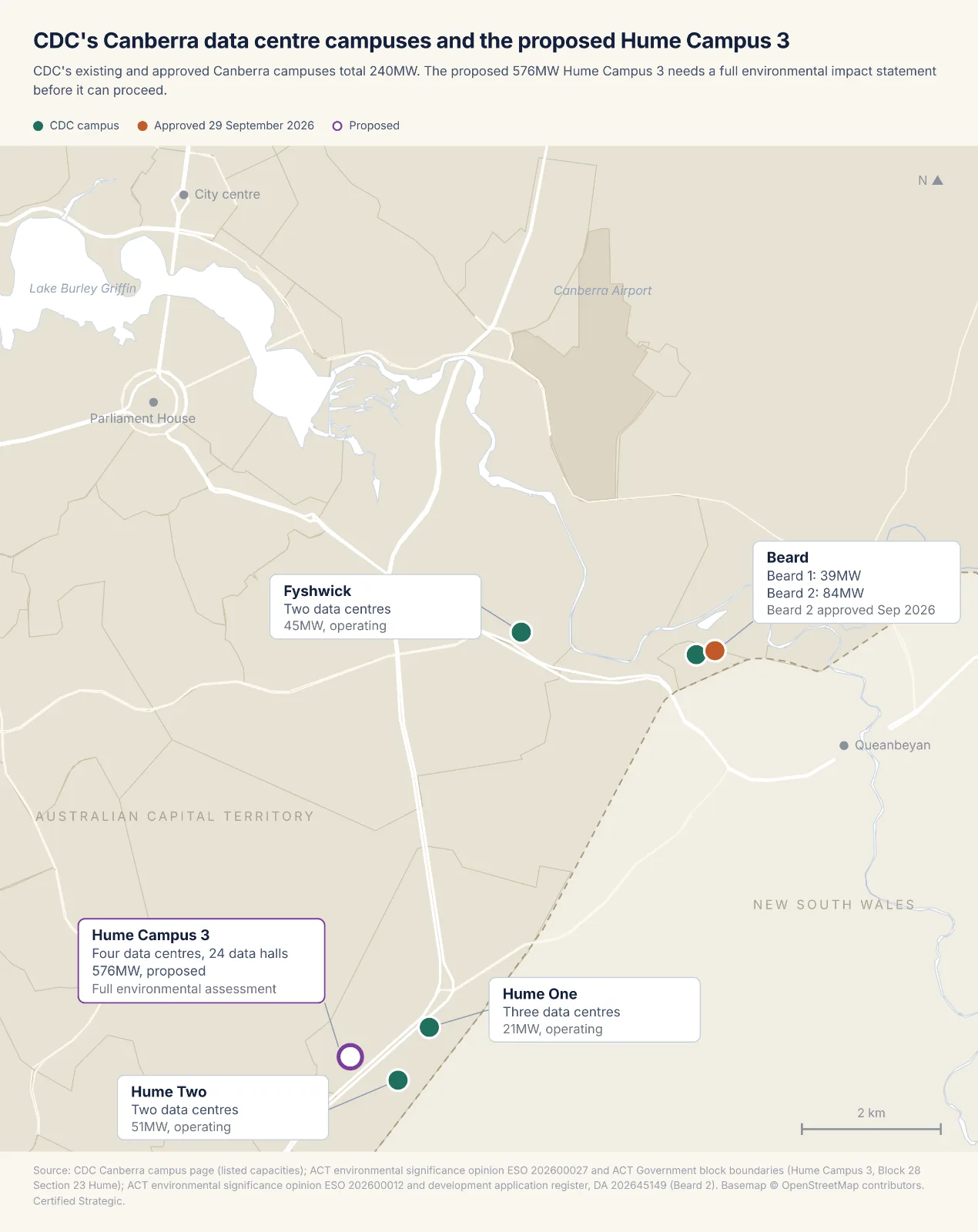
Beard 2 went through the same first step. Its environmental significance opinion, issued on 13 May 2026, found it did not need a full environmental impact statement, and the ACT approved the building four and a half months later.
The Conservator asks for most of the mature trees to be kept
The Conservator describes the site's core value as its 30 large remnant trees, many of which likely pre-date the establishment of Canberra. The proposal would clear all 30, including at least 27 mature native trees with trunks more than 50 centimetres across. Most carry hollows, which the opinion says provide important habitat for two threatened birds, the Gang-gang Cockatoo and the Superb Parrot.
The opinion also maps connected habitat for grassland reptiles across the centre of the block. A Striped Legless Lizard, a threatened species, was recorded in October 2025 on the neighbouring block, within 100 metres of the boundary. With no survey data for Block 28, the Conservator assumed the lizard is present. Because the species involved are protected under national law, the opinion recommends a referral under the Environment Protection and Biodiversity Conservation Act, the Australian Government's main environment law.
For the environmental impact statement, the Conservator lists a design that keeps a large majority of the mature native trees, a measure of every tree hollow to rank its value as a nest site, and surveys for the lizard and two other threatened species. It also asks for a full bushfire assessment, with the fire protection zones around the buildings kept inside the site boundary. The opinion says the proponent should be prepared for a reduced development footprint or scope of works if it continues.
Separately, the ACT Heritage Council assessed cultural heritage on Hume Campus 3 and found the development justifiable, with conditions including a heritage approval application before salvage excavation of the remaining part of a recorded Aboriginal site.
The Eastern Broadacre assessment returns to the Australian Government in 2026-27
The site sits inside the Eastern Broadacre Strategic Assessment, which looks at how industrial development would affect protected species and grasslands from the Majura Valley to Hume. It identifies the site as a development area. Its final draft is scheduled to go back to the Australian Government in 2026-27.
The Conservator sets out two paths. If CDC lodges an environmental impact statement before the strategic assessment is finalised, it must include a suitable offset, meaning habitat protected elsewhere to balance what is cleared. If it waits, the final design and land use must be consistent with the finalised assessment.
The ACT set out its position on data centres on 26 August 2026 and aims to release a draft Data Centre Framework in early 2027. CDC chief executive Greg Boorer welcomed the framework the same day, saying certainty around planning, infrastructure and sustainability expectations "will support responsible industry growth". The ACT is one of several states and territories setting out a data centre policy.
What to watch
CDC's next step on Hume Campus 3. The project can proceed through an environmental impact statement, and the Conservator has flagged that the footprint or scope may need to shrink.
The federal referral. The Conservator recommends referring the project under the national environment law because of the threatened species involved.
The Eastern Broadacre timetable. The final draft is due back with the Australian Government in 2026-27, and whether CDC lodges before or after it is finalised decides whether an offset is needed.
The ACT's draft framework. Due in early 2027, it is to set out proposed locations, assessment criteria and sustainability requirements for data centres in the territory.