At a glance
CDC's Beard 2 is an 84MW, three-storey data centre proposed beside its first Beard building on a 47,644 square metre block in Canberra's east.
The A$200 million application, reported on 9 September 2026, covers 12 data halls and was open for public comment until 18 September 2026.
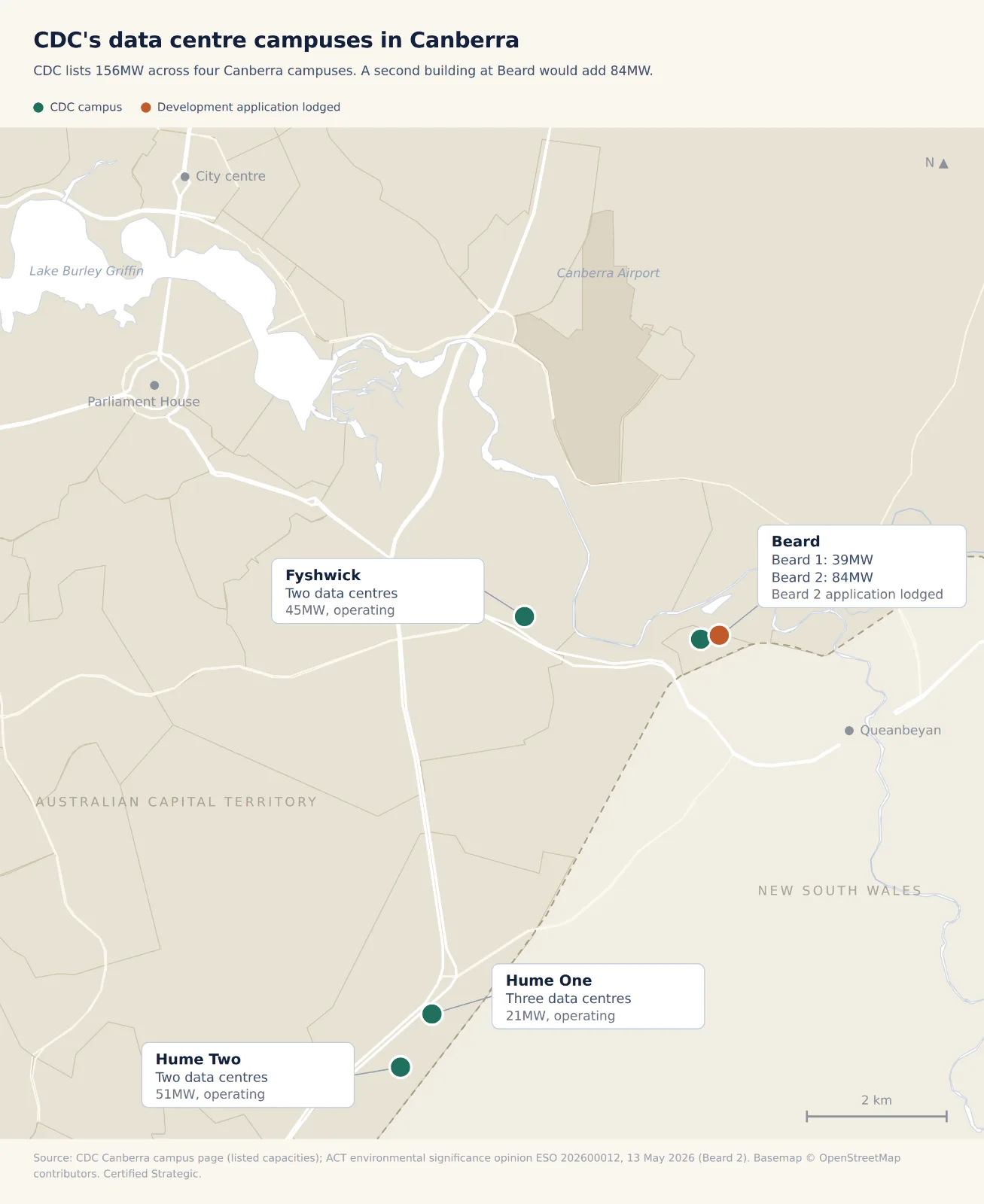
CDC's Canberra campus page lists 156MW across its four campuses, and Beard 2 would take that listed total to 240MW.
ACT Chief Minister Andrew Barr says data centres are assessed under the existing planning system, with a draft Data Centre Framework planned for early 2027.
Before Beard 2 operates, the ACT's environmental opinion requires the project to file its expected water use and evidence of engagement with water utility Icon Water.
CDC Data Centres has lodged a development application for Beard 2, a data centre at Beard on Canberra's eastern edge that at 84MW would be larger than any of CDC's existing Canberra campuses on the company's own figures. The Canberra news site Region Canberra reported the proposal on 9 September 2026: an A$200 million, three-storey building on the same 47,644 square metre block as the first Beard building. It would hold 12 data halls, the secured rooms that house the servers.
The environmental significance opinion the ACT issued for the block on 13 May 2026 describes "12 data halls with a total capacity of 84 MW", with emergency on-site generators of up to 20MW for backup.
The ACT set out its position on data centres on 26 August 2026 and aims to release a draft Data Centre Framework, its rules on where data centres can go and what they must meet, in early 2027. Until then, ACT Chief Minister Andrew Barr has said, data centres are assessed through the existing planning system in the same way as other developments.
Beard 2 passed its environmental screening in May 2026
An environmental significance opinion is the ACT planning step that decides whether a proposal needs a full environmental impact statement. The opinion for the Beard block found the works unlikely to cause a significant adverse environmental impact, subject to conditions, so the development application went in without a full impact statement. The opinion also records that the proposal does not involve vegetation clearing.
The opinion covers "the commencement of Stage 2 development on the site": the building, access roads, parking, landscaping, earthworks and a proposed substation of about 3,830 square metres, which Region Canberra places at the southern end of the block. Region Canberra reported that the application adds 23 parking spaces, taking the campus to 58, and expects 54 employees on site at any one time across both buildings.
Beard 2 would take CDC's listed Canberra capacity to 240MW
Campus | Capacity | Status |
|---|---|---|
Hume One | 21MW | Operating, three data centres |
Hume Two | 51MW | Operating, two data centres |
Fyshwick | 45MW | Operating, two data centres |
Beard 1 | 39MW | First stage, 10 data halls |
Beard 2 | 84MW | Development application lodged |
Source: CDC Canberra campus page for the capacities of Hume, Fyshwick and Beard 1; Region Canberra for Beard 1's data halls; ACT environmental significance opinion ESO 202600012 for Beard 2.
The four campus figures on CDC's Canberra campus page total 156MW, and 240MW with Beard 2. The same page gives a headline figure of 250MW-plus for Canberra. The guide to Australia's new data centre capacity from 2026 to 2030 lists projects by year once they carry a target date, and Beard 2 joins it when CDC sets one.
The ACT Government estimates Canberra has 15 data centres, eight of them CDC's, the ABC reported on 23 August 2026. CDC was founded in Canberra in 2007 and says its operations maintain around 230 jobs across the ACT. A spokesperson said, in comments reported by Region Canberra, that CDC was focused on supporting customers "across government, national critical infrastructure organisations and their mission-critical partners". Chief executive Greg Boorer said in CDC's statement on the ACT framework that CDC supports a framework that recognises the value of digital infrastructure "while ensuring development occurs in the right locations and to the highest environmental standards".
Barr wants data centres to help build new renewable energy
The ACT's 26 August 2026 statement supports national requirements for data centres to offset additional electricity demand through investment in new renewable generation, and bars data centres from Canberra's residential neighbourhoods. "Every major proposal should demonstrate how it strengthens Canberra's energy system and contributes to the clean energy transition," Barr said. "We want data centres that help build new renewable energy, not simply consume existing capacity." Region Canberra reported that Barr named growing demand for artificial intelligence, cloud computing and cyber security services as a major opportunity for Canberra.
The statement says any future centre will be expected to demonstrate best-practice water efficiency and minimise its impact on water supply and wastewater infrastructure, and it makes water security a core consideration of the framework. Barr said in comments reported by the ABC that the national scheme, the data centre standards the federal government announced in July 2026, "would be catching up with where the ACT is at".
Since 2020 the ACT has matched all of its electricity use with renewable generation bought under long-term contracts awarded through government-run auctions, and most of that generation is outside the territory. Barr has said new large energy users should bring a renewable energy solution with them. With the 26 August statement, the ACT joins the states and territories with a stated data centre policy.
Water use figures are required before Beard 2 operates
Region Canberra reported that CDC builds with a water-efficient closed-loop cooling system and uses 100 per cent renewable electricity by default. The ACT's Utilities Technical Regulator raised water use in its advice on the environmental opinion, noting that data centres can use substantial water for cooling even when designed to be water efficient. The proposal states it involves no environmentally significant water extraction or consumption, and the regulator asked for an expected water use figure, which the opinion's conditions require before operations start.
The opinion carries a condition: before operations start, the applicant must provide details of expected water use, associated infrastructure, and evidence of engagement with Icon Water, the ACT's water and sewerage utility. Another condition requires the backup generators to be designed and operated to manage air emissions, noise, fuel storage, spill risk and fire risk.
Data centre water is under review in New South Wales as well, where Premier Chris Minns has asked IPART, the NSW Independent Pricing and Regulatory Tribunal, to look at how data centres pay for water.
What to watch
The ACT's decision on Beard 2. Public comment closed on 18 September 2026, and a decision on the application is the next step.
The ACT's early 2027 draft framework. The draft is to set out proposed locations, assessment criteria, sustainability requirements and infrastructure expectations for data centres in the territory.
Beard 2's water filing. Its expected water use has to be on file with the ACT before operations start.