
Firmus wins approval for 26MW AI research lab at Wesley Vale
By Winston Su, Editor · · Add us as a preferred source on Google

At a glance
Firmus will convert an existing warehouse at the former Wesley Vale pulp mill in north-west Tasmania into a 26MW AI research facility, approved by Latrobe Council staff.
The lab will test how AI computing can respond to grid conditions, and how batteries could reduce reliance on diesel generators.
Outgoing Mayor Peter Freshney says Tasmania's planning scheme needs work, while Planning Minister Kerry Vincent says it is "entirely appropriate" for developers to rely on the planning system.
Firmus's AI factory at 174 and 226 Mill Road, about 26MW growing to about 52MW, is with the state, and Firmus has until 15 December 2026 to lodge its major project proposal.
Bell Bay, St Leonards and Wesley Vale give Firmus about 430MW planned in northern Tasmania, and Hydro Tasmania expects to decide on Firmus's request for about 444MW of supply by the end of 2026.
Latrobe Council has approved a 26MW AI research and development facility for Firmus at Wesley Vale in north-west Tasmania, the ABC reported on 4 November 2026. The Australian company, one of the neocloud providers in Australia, will convert an existing warehouse at the former Wesley Vale pulp mill into a facility for AI computing and for research into alternative power sources during interruptions. Because the facility fit the appropriate use class under the planning scheme, council staff approved it without a council vote and the general manager formalised the permit.
Firmus's larger AI factory on the same site is with the state government, the ABC reported. Latrobe councillors voted unanimously on 7 September 2026 to ask the planning minister to declare it a major project, which would move the decision from the council to a state panel.
Council staff have cleared Firmus to build a 26MW AI research facility at Wesley Vale, while the AI factory of up to 52MW beside it waits on the state.
Firmus will test grid-responsive AI computing at Wesley Vale
Firmus co-founder Jonathan Levee, its principal engineer for research and development, said the facility "will allow Tasmanian engineers to test novel operating strategies for AI infrastructure and help solve a challenge facing the industry globally". "Building on software we developed and patented in Tasmania, we're exploring how AI computing can be more flexible and respond to electricity grid conditions," he said. Firmus is also exploring "how technologies such as batteries could help reduce reliance on diesel generators", he said.
Firmus expects about 70 jobs during construction and 20 ongoing roles once the facility is running. It plans dry cooling for most of the year, with "little or no water required for cooling under typical operating conditions". It estimates the facility will use about 224,000 litres of cooling water a year, mostly rainwater collected on site, subject to final design and operation conditions.
Latrobe councillors asked the state to assess Firmus's 52MW AI factory
Firmus's AI factory application to Latrobe Council was advertised for public submissions in August 2026, w.media reported on 26 August 2026. The site at 174 and 226 Mill Road is in the Mill Park industrial precinct, zoned General Industrial, next to the Wesley Vale substation of state-owned network business TasNetworks.
Firmus's project page gives "an initial stage of approximately 26 MW, growing to maximum approximately 52 MW of capacity", or 23MW for the computing equipment itself (the critical IT load), growing to about 46MW. Firmus is investing in upgrades to the substation to support a future 26MW connection. Until those works are complete, its electricity use would be managed under agreed operating conditions, including cutting demand when the network needs it.
The council also asked for the Environment Protection Authority to assess the project. Firmus has until 15 December 2026 to lodge a complete major project proposal, which the minister needs to decide whether the project qualifies for that pathway, The Urban Developer reported on 19 October 2026. If the minister decides against a declaration, the application returns to the council.
Mayor Peter Freshney calls for work on Tasmania's planning scheme
Outgoing Latrobe Mayor Peter Freshney said the research facility fit the appropriate use class, with no discretionary matters for the council to weigh, so staff could approve it without a councillor vote or public advertising. "There were no discretions to be considered, and if there had been, then yes, it would have come to council, and it would have undertaken the normal process and been advertised," he told ABC Radio Hobart.
He said the approval highlighted the constraints of a planning scheme written before AI data centres arrived. "It doesn't provide a rigorous and robust assessment of these emerging technology development applications," Freshney said. "We're still strongly of the view that there needs to be some work put into the planning scheme to allow councils, acting as planning authorities, to adequately and appropriately assess these applications."
The unconfirmed minutes of Latrobe Council's October 2026 meeting record several community questions about the research facility, covering the building's footprint and location, how it would be powered, its planned diesel generator use, and the council's capacity to assess the project's scale and complexity.
Planning Minister Kerry Vincent defends the council approval
Planning and Housing Minister Kerry Vincent defended the approval. "It is entirely appropriate for developers to rely on the planning system when determining where to invest, and for local planning authorities to remain true to that system when assessing applications," he said. "The planning system shouldn't be politicised in the process."
He pointed to the government's draft expectations for data centres and AI infrastructure, published on 7 September 2026. The draft asks developers to support new renewable generation, pay their share of network and connection costs and forecast their water use. The expectations have no legal force and say these developments should continue to be assessed through Tasmania's existing planning system. Consultation closed on 12 October 2026.
Tasmania's AI data centre inquiry, set up by a parliamentary committee in August, is examining whether that system recognises the specific impacts of AI and data facility development.
Firmus has about 430MW planned across three Tasmanian sites
Wesley Vale is the smallest of the three AI factories Firmus is developing itself in northern Tasmania. St Leonards and Bell Bay have council approval, and St Leonards, due to open in early 2027, will be the first of the three to join the operating data centres in Australia.
Site | Capacity | Planning status |
|---|---|---|
St Leonards, Launceston | 90MW | Approved September 2025; due to start operating in early 2027 |
Bell Bay, George Town | 288MW | Approved 25 August 2026; appeals lodged with the state tribunal |
Wesley Vale, Latrobe | About 26MW, growing to about 52MW | Major project declaration requested 7 September 2026; proposal due 15 December 2026 |
Source: City of Launceston, George Town Council, Latrobe Council, Firmus, w.media, The Urban Developer, ABC News, September 2025 to November 2026.
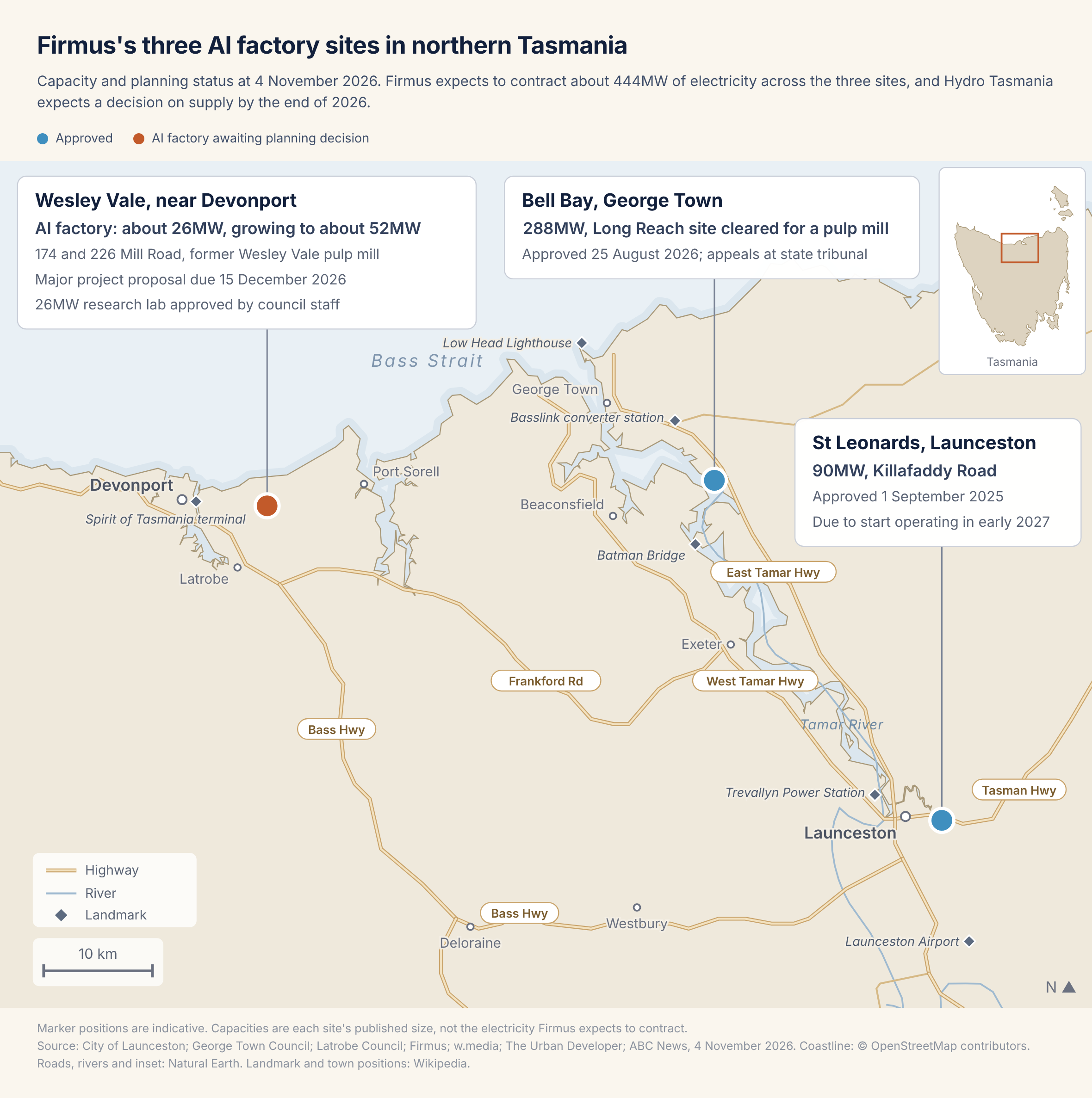
Firmus told the inquiry it expects to contract about 444MW of electricity across the three sites at full build. Hydro Tasmania, the state-owned generator Firmus has asked to supply it, told the same inquiry it is assessing the request, and has said it expects to decide by the end of 2026.
What to watch
The major project decision. Vincent decides whether to declare the Wesley Vale AI factory a major project, which would send it to a panel of the Tasmanian Planning Commission. Firmus's major project proposal is due by 15 December 2026.
Hydro Tasmania's answer. Its decision on the 444MW request sets how much of the three-site programme the state-owned generator will supply.
The inquiry report. The committee will report on whether Tasmania's planning system recognises the impacts of AI data centres, the question Freshney has raised.
Keep reading the market
Get The Strategic Brief in your inbox every Thursday.
The leading Australian data centre and AI infrastructure newsletter.
Your Next Read

Firmus puts its Tasmanian power need at 444MW in inquiry submission

What Firmus's pulled IPO means for Tasmania and Maas Group

CDC ends its 1.6GW rollout with Firmus at 42MW in Melbourne
Latest Headlines
Goodman and Digital Realty seek 9.9% of NEXTDC at A$9.50
4 Nov 2026Power bills top Australians' data centre worries, poll finds
4 Nov 2026Victoria's A$5bn data centre queue goes on ice for the election
3 Nov 2026NEXTDC's M3 Melbourne delay catches UBS on A$1.1bn notes
2 Nov 2026GreenSquareDC plans 94MW Norwest data centre expansion by 2028
2 Nov 2026
Interested in reaching this audience? Advertise with us.