At a glance
Firmus announced on 8 September that OpenAI will contract dedicated compute from two of its AI factories in Malaysia. It has not disclosed the locations, the value, the capacity or when the sites open.
Customers have now committed to more than 900MW, up from 155MW in April, a rise of almost six times in five months.
The first data centre Firmus owns opens at Launceston in 2027. The Melbourne and Singapore sites it runs are leased from other operators.
The Financial Review reports institutional investors are still arguing about escrow ahead of a float valued at A$15.5 billion or more.
Latrobe Council voted on 7 September to ask Tasmania's planning minister to declare Firmus' 52MW Wesley Vale proposal a major project.
Australian AI infrastructure company Firmus announced on 8 September 2026 that OpenAI will contract dedicated AI compute from two of its Malaysian sites as anchor customer. OpenAI is the third buyer Firmus has put a name to, and the announcement comes in the week the company starts investor meetings for its ASX float.
Firmus counts more than 900MW of customer commitments with OpenAI added, up from 155MW in April. It reaches that figure before opening a data centre of its own. The Melbourne and Singapore sites it runs are leased from other operators, and the Launceston build in northern Tasmania opens in 2027. The Australian Financial Review reported on 8 September that institutional investors remain unconvinced, with escrow the concern they keep raising.
Two Malaysian sites, state and partner undisclosed
The release describes a multi-year strategic partnership under which OpenAI will contract dedicated capacity from two Firmus AI Factory sites in Malaysia. Reuters, carried by Investing.com, called it a multi-year deal. Firmus declined to comment on the contract value, and told the Financial Review it would not say when the Malaysian sites would start operating or how much power they would draw. OpenAI did not immediately respond to Reuters.
Tim Rosenfield, Firmus co-founder and co-chief executive, said the partnership "marks the moment Asia-Pacific becomes a producer of intelligence, not just a consumer of it". Sachin Katti, OpenAI's vice president of compute strategy, said: "These new data centers in Malaysia will help us serve growing demand for OpenAI's products across the region and around the world."
Neither the release nor the coverage in Reuters, TechNode Global or Business Today Malaysia names a state or a local partner. Malaysia is the fourth country in the portfolio, after Australia, Singapore and Indonesia. Wood Mackenzie forecasts South-East Asia's data centre pipeline will more than triple to 9.4GW by 2035, from 2.8GW.
Firmus manufactures and prefabricates the HyperCube in regional New South Wales. Benmax builds it at Queanbeyan, and Firmus signed a binding agreement in August to buy Benmax's fabrication, design and projects businesses for A$300 million. The Malaysian sites will run NVIDIA Vera Rubin NVL72 rack-scale systems on the NVIDIA DSX platform, integrated with that module. Firmus was one of two Australian companies in NVIDIA's Vera Rubin cohort announced in June.
From 155MW to 900MW in five months
Contracted capacity is the maximum power a customer signs up to use. Firmus put its total across all customers at more than 900MW on 8 September. The Financial Review put the same figure at 155MW in April, so the book has grown almost six times in five months.
Firmus reports the 900MW as one number for the whole company. It has not said how the total splits between customers or sites, and the release does not list the seven AI factories it says the portfolio spans. Two of the seven are operating, in Australia and Singapore, and Firmus says the other five are due to be ready for service within 24 months, a portfolio-wide target rather than a Malaysian date.
The 2 March Melbourne contract covers about 18,400 NVIDIA GB300 GPUs for a buyer it describes as a leading global technology company. The Batam campus in Indonesia is forecast at 360MW and sized at up to 170,000 GPUs. The three Tasmanian projects have a combined capacity of 424MW on the Financial Review's count. The Malaysian sites are unsized, and the multi-year agreement with inference platform Fireworks AI, announced in August for an Asia-based cloud region, carries no capacity figure.
NVIDIA, the earliest customer Firmus named, is also its chip supplier and a shareholder. It signed up as an anchor customer of Project Southgate in October 2025, in a joint announcement with CDC and Firmus. Fireworks AI followed in August. The Financial Review reported on 30 June that Meta was Firmus' first major client, with rights to capacity at Australian sites, and Firmus has never confirmed it.
Firmus opens its first data centre in 2027
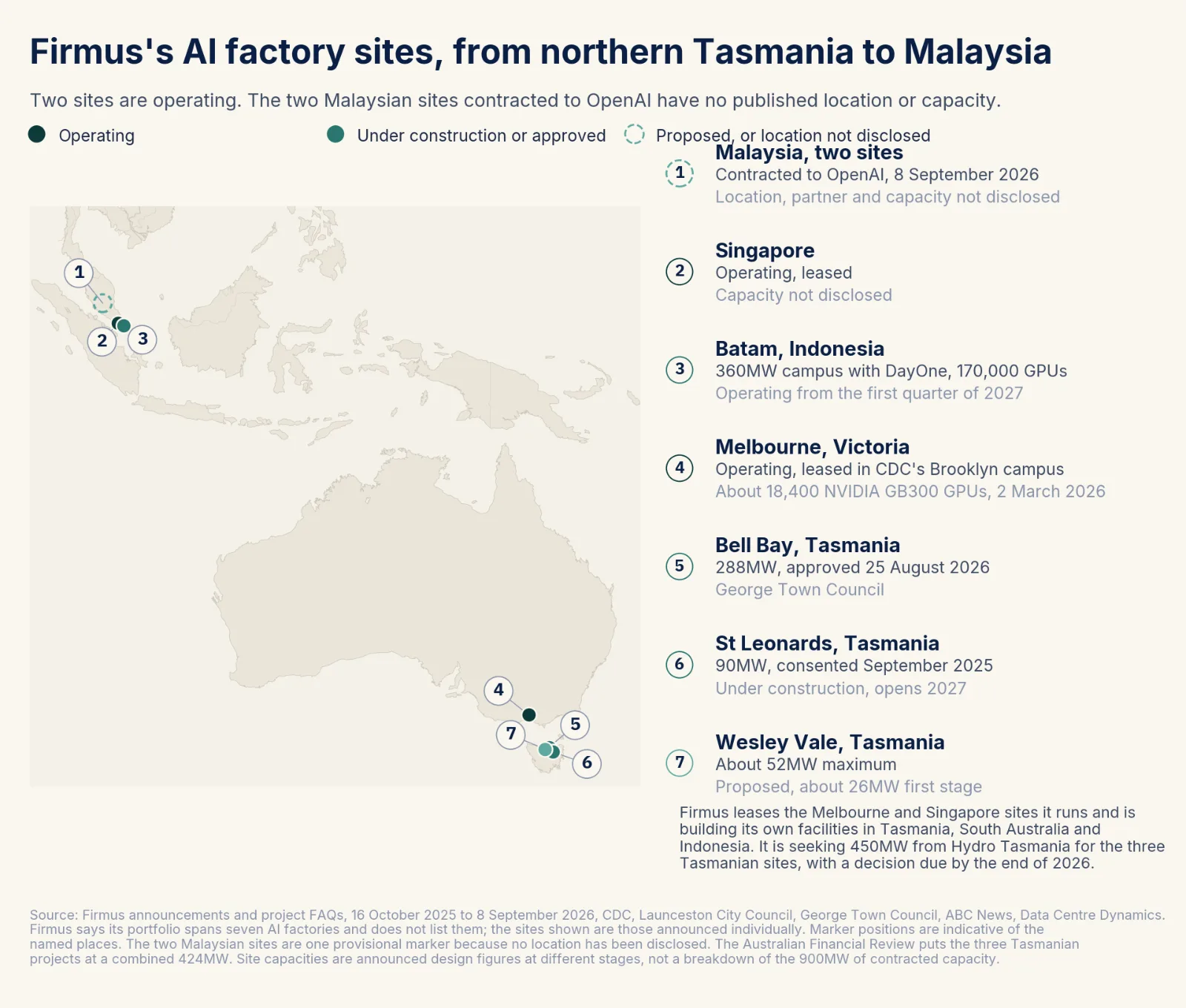
Firmus leases data centre space in Melbourne and Singapore and is building its own facilities in Tasmania, South Australia and Indonesia. The Melbourne cluster sits in the Brooklyn campus of CDC, one of the largest operators of data centres in Australia. Firmus said in August that the cluster had been handed over and was running a customer's models.
The Launceston build is the first data centre Firmus will own in Australia, and it opens in 2027. St Leonards was consented by Launceston City Council in September 2025 and is under construction. The company gave mid-2026 at approval and has carried late 2026 since. George Town Council approved the 288MW Bell Bay proposal on 25 August. No Tasmanian megawatts are operating.
Latrobe Council held a special meeting on 7 September and voted unanimously to ask the state planning minister to declare Firmus' 52MW Wesley Vale proposal a major project. It will also write to the environment minister, asking the Environment Protection Authority to assess it. Councillor Gerrad Wicks said the Tasmanian planning scheme was "too outdated to adequately assess AI data centre developments". A Tasmanian parliamentary inquiry is already examining whether the state's planning rules are sufficient.
Firmus is seeking a direct 450MW agreement from Hydro Tasmania to supply all three Tasmanian sites, and that decision is due by the end of 2026.
Investors are asking who can sell on day one
The Financial Review reported on 30 June that Firmus wanted to open its offer late in the September quarter and list in the final quarter of 2026. Three things had to be done first: financing for Batam, customers for Batam, and firmer plans for a third Australian site. Bloomberg, citing the Financial Review, reported on 8 September that investor meetings are starting.
The Financial Review reported on 8 September that the OpenAI deal is not substantial enough to win over sceptical investors, and named escrow as the concern. Escrow is the lock-up that stops existing holders selling straight after a float. The head of one Australian financial services group, who asked not to be named, told the paper the structure of the offer was still an issue, with "any number of domestic and global institutions who seem to be well in the money who are free to sell on day one". The person added: "I'm just not sure how you convince the next buyer that they're not going to be hit by a wave of selling." Shaun Weick, portfolio manager at Firmus investor Wilson Asset Management, expects some form of escrow but said 20 to 30 per cent of holdings could trade from the first day. Co-founders Oliver Curtis and Tim Rosenfield are understood to be committing to long-term escrow. Escrow is voluntary, and a Morgans spokeswoman said the details would be in the prospectus.
The float would value Firmus at A$15.5 billion or more. Firmus said in its 7 August release that its US$2 billion equity round took the post-money valuation above US$10.5 billion. Coatue and NVIDIA followed on, Blackstone took equity for the first time after leading February's debt facility, and Jane Street joined them. Other early holders include Ellerston Capital and MAAS Group. Bank of America, Morgan Stanley, JPMorgan and Morgans are among the bankers.
OpenAI works with many developers. In Australia it has partnered with NEXTDC to design, build and operate the Eastern Creek S7 campus, where it will be an initial tenant, under a December 2025 memorandum of understanding. The first phase is due in the second half of 2027. OpenAI Australia has announced no contracted Australian site. Several other large Australian contracts signed this year name no counterparty either. CDC's 555MW agreement is with an unnamed United States investment-grade customer, and Sharon AI's US$1.32 billion contract is with an unnamed global AI lab.
Firmus proposes an Australian AI Access Program
Alongside the OpenAI partnership, Firmus said it intends to establish an Australian AI Access Program for eligible researchers and organisations applying AI to science, education, agriculture, energy efficiency and climate resilience. The release gives no capacity, budget, start date or selection process. Firmus has run an arrangement of this shape before: it partnered with AI Singapore in March 2025 to give that programme's researchers access to Singapore-based H200 GPUs.
Expectation 5 of the Australian government's national data centre expectations, published in March 2026, asks hyperscalers and neoclouds to open compute to Australian researchers, start-ups and not-for-profits on favourable terms. The Firmus release does not cite it. Firmus is the first Australian neocloud Certified Strategic has recorded answering Expectation 5 with a named program. Andrew Charlton, the Assistant Minister for Science, Technology and the Digital Economy, pointed to that expectation in his 18 August Crawford lecture. He said Australian AI spending could reach A$20 billion to A$40 billion a year within a decade.
What to watch
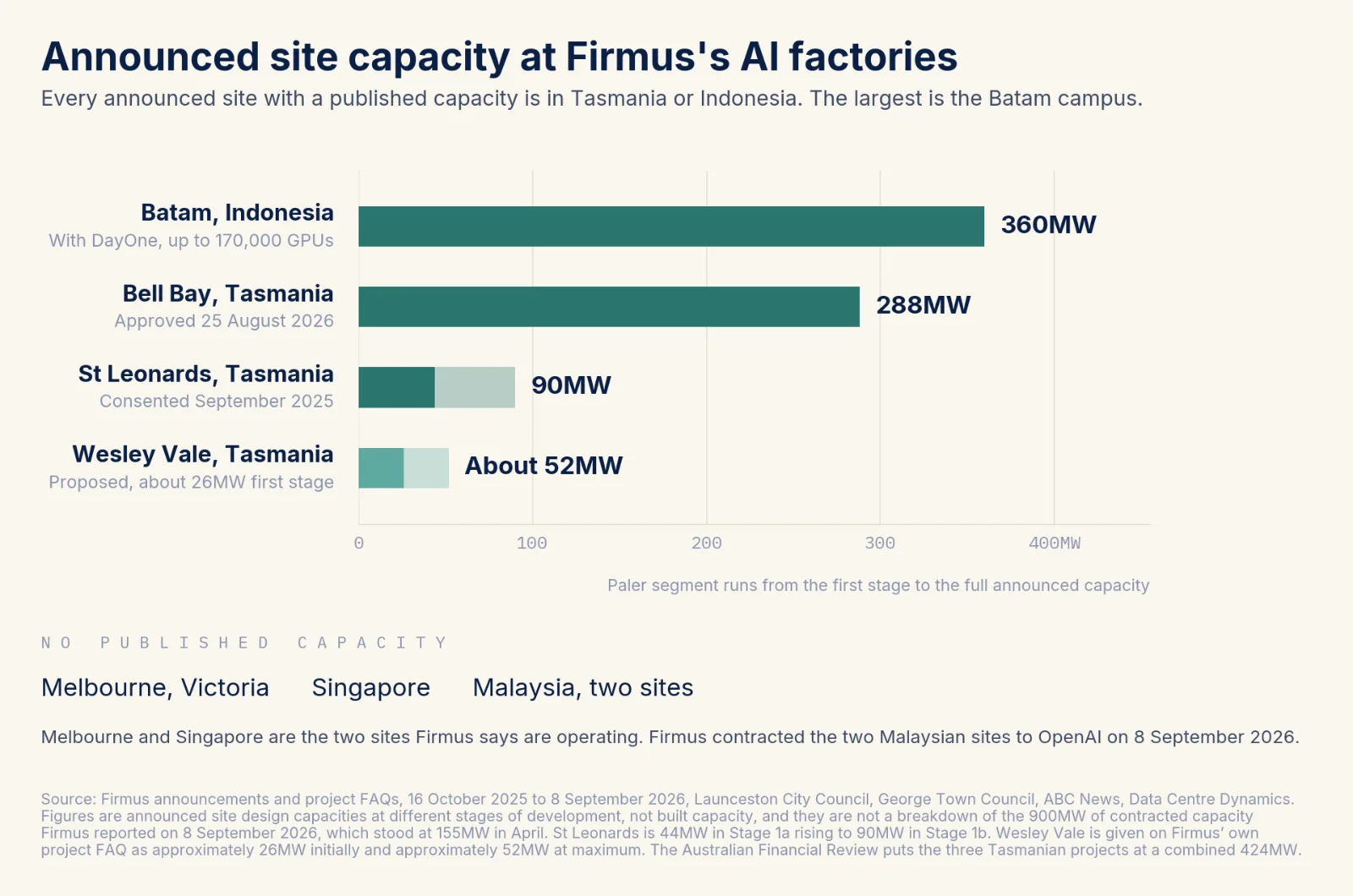
A prospectus, if lodged, would split the 900MW by customer, term and site, set out the escrow terms the market is asking about, and show whether the Batam campus has a buyer. Launceston is due to open in 2027, which is when Firmus delivers a building rather than a contract. Tasmania's planning minister decides whether Wesley Vale becomes a major project, and Hydro Tasmania decides on the 450MW request by the end of 2026. The Malaysian state and any local partner should surface in a planning or grid application. And the published terms of the Australian AI Access Program will set the benchmark other neocloud providers in Australia are measured against under Expectation 5.