
Canberra data centres could anchor ACT grid investment
By Winston Su, Editor · · Add us as a preferred source on Google
Updated 6 August 2026
At a glance
TBH, a project controls consultancy in Canberra since 1990, says the ACT's data centres could anchor investment in substations, renewable hubs, batteries and grid firming.
Generators sited in the ACT supplied about 3.4% of the electricity delivered under the Territory's large-scale renewable contracts in the March 2026 quarter.
AEMO pays large loads three ways, and one of them asks nothing to be switched off: it pays a site to consume more at midday, when rooftop solar floods the grid.
Baringa names on-site batteries, cooling and shiftable workloads as ways to provide grid services without touching customer compute, which is the objection operators have raised.
Australia switched off and wasted about 7.2TWh of wind and utility solar in 2025 against 4.3TWh in 2024, and Baringa finds midday data centre load consumes renewables that would otherwise be lost.
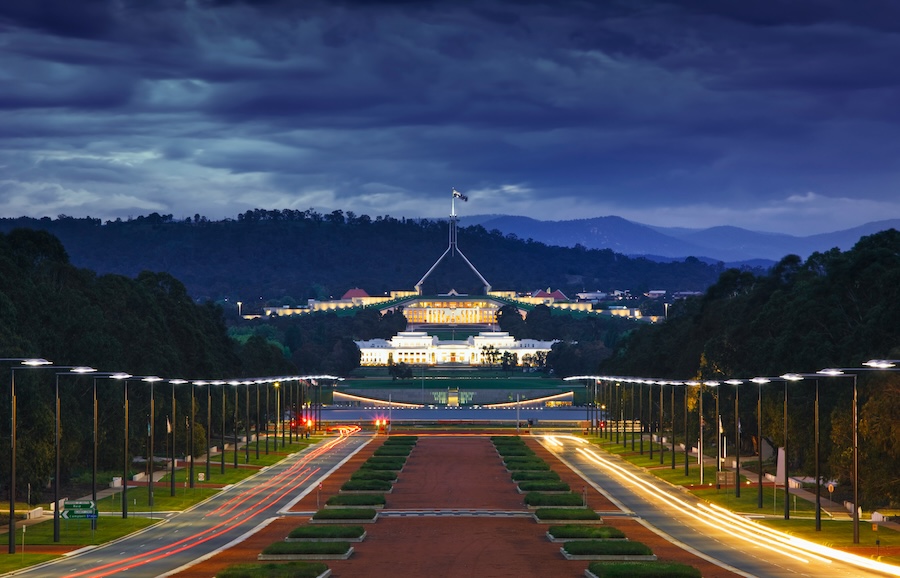
TBH says Canberra data centres could anchor the ACT's grid
TBH, formally Tracey Brunstrom & Hammond, is a privately owned project controls consultancy founded in Australia in 1965. It has held a Canberra office since 1990, works the delivery side of Sydney Metro, Marinus Link and TransGrid's project portfolio, and says it has advised on more than 100 hyperscale data centre projects across Asia-Pacific since 2010, Telstra's Defence data centre programme and AirTrunk among them. On 13 July it published The Infrastructure Behind Canberra's Digital Future, naming four conditions on the city's data centre growth: land and location, energy resilience, water, cooling and heat reuse, and planning and approvals certainty.
Rob Hammond, its managing director until 2021, now leads the firm's data centre work. Large facilities need "industrial land with high-voltage electricity, fibre connectivity, water infrastructure, secure access and separation from surrounding uses", he told Inside Construction, a combination getting harder to find as logistics, urban growth and industrial expansion compete for Hume, Mitchell, Beard and Fyshwick.
Travis Harvey, the firm's Canberra-based director, named the ACT's constraints as "limited local generation, dependence on interconnected infrastructure and increasing grid congestion risk", then proposed inverting them. "A precinct-scale approach could turn that challenge on its head," Harvey said. "Rather than being treated purely as additional load, data centres could help anchor investment in substations, renewable energy hubs, battery storage and grid firming infrastructure that benefits the whole network."
TBH wants power, water, cooling and connectivity designed together across a precinct rather than negotiated project by project, an argument it has already published for global, Southeast Asian and Victorian markets before applying it to Canberra. Operators would get clearer pathways for staged expansion and potentially lower capital exposure through shared infrastructure, and the ACT Government "a clearer framework for guiding data centre investment toward locations where land, power, water and community outcomes can be planned together". The report carries no capacity or cost figures.
The ACT contracts most of its clean power from other states
Canberra has run on 100% renewable electricity since 1 January 2020, contracting large wind and solar farms through reverse auctions and keeping the renewable certificates those farms generate rather than making the power locally. On the ACT Government's January to March 2026 payment tables, the generators sited in the ACT at Royalla, Mugga Lane, Williamsdale and Majura Solarshare supplied 19,427MWh of the 572,459MWh delivered under those contracts, about 3.4%. The rest came from wind farms in South Australia, New South Wales and Victoria.
The ACT sits inside the National Electricity Market's New South Wales region and draws power through four high-voltage entry points at Canberra, Stockdill, Williamsdale and Queanbeyan, the last of which is in NSW. Evoenergy runs the local network. Its Annual Planning Report 2025 reports a rising number of very large connection enquiries, data centres and batteries among them, creating "new dynamics to management of capacity headroom on parts of the subtransmission network". Evoenergy adds that commercial and industrial growth is centred on Hume and Fyshwick, "with a significant proportion focused on large relatively stable loads as required, for example, data centres". The Territory's own 250MW Williamsdale battery, begun in November 2024 against an expected completion of early 2026, was still listed as under construction at 27 March 2026 with no revised date.
ACT Chief Minister Andrew Barr set the Territory's position four months before the TBH report, saying the ACT "can work with data centre operators around their energy needs, essentially requiring any new large energy users to bring with them a renewable energy solution as part of their data centre proposition", in remarks reported by Region Canberra on 16 March 2026. Prime Minister Anthony Albanese said on 15 July that new standards would carry "a legal obligation to underwrite their own new power supply, pay their full share of connection costs so energy bills are not impacted, reduce power when needed to strengthen the grid, and be as water efficient as possible", as covered in our analysis of the AI plan's faster-approvals promise. National Cabinet considers the approach in August.
AEMO pays large loads three different ways
AEMO runs three mechanisms that pay a large load for flexibility, and the differences between them decide how a data centre can take part.
Mechanism | What it asks of a load | What it pays |
|---|---|---|
Wholesale Demand Response Mechanism | Use less power when instructed | The spot price on power it did not use, minus a rebate to its retailer. Nothing for being available |
Minimum System Load tender | Use more power at midday, when rooftop solar floods the grid | Fixed payments through trial stages, then a call-out rate the provider bids plus an energy payment tracking the spot price. Type 2 services start 14 September 2026 |
Reliability and Emergency Reserve Trader | Contract to cut load in an emergency, in blocks of at least 10MW held for at least 30 minutes | Long-notice contracts pay for being available. Short-notice contracts pay only if the load is actually called |
Source: AEMO tender documents, guidelines and quarterly reports, 2025 and 2026.
AEMO paid availability on long-notice reserve contracts at A$675 per MW a day in New South Wales and A$1,418 in South Australia across the March 2025 billing weeks, and activated none of it. AEMO's CY2025 report records 177.5MW registered under the demand response mechanism at 31 December 2025 rising to 343MW by publication on 29 June 2026, held between two providers, called 93 times in 2025 and delivering 417MWh.
Data Centres Australia and Equinix rule out cutting power
Demand response, the first of those three, pays a site to use less power on instruction. Australian operators say that is the one thing they cannot sell, because their customers are buying uninterrupted service. Data Centres Australia chief executive Belinda Dennett has written that cloud and AI inferencing workloads "require continuous availability" and "cannot be curtailed during peaks". A customer waiting on a model's answer cannot be put in a queue while the grid recovers.
Equinix told The Energy in May 2025 that it does not take part because it does not control what its customers run. Its only remaining lever would be switching a site onto backup generators, which means burning diesel to relieve a grid problem, and which local air quality regulations prevent in some places.
AEMO has to measure a reduction before it can pay for one, and that is where a facility with an erratic load would be caught out. Because nobody can meter power that was never used, AEMO estimates what a site would otherwise have drawn and pays for the difference, which means a provider must nominate a baseline method from a register of eight and prove the load is predictable enough to model against. Australian data centres would clear that comfortably, with the Oxford Economics study AEMO commissioned finding load factors averaging 70% to 85% from FY22 to FY25, meaning these sites draw close to their maximum most of the time. Their consumption is steady enough to measure. What keeps them out is the customer contract, exactly as Dennett and Equinix describe it.
On-site storage answers the objection
A meter records a reduction whether the servers slowed down or a battery took over. Baringa's report for the Clean Energy Finance Corporation lists what a facility can offer without touching a customer workload: backup generators, uninterruptible power supply batteries, turning down cooling, and shifting flexible IT tasks. A site that discharges a battery during an event keeps every server running at full load while its draw from the grid falls. Cooling can coast for a short window on the thermal mass of a large building. Training runs can be paused and resumed in a way a live query cannot.
That puts the emergency reserve route back within reach as well, and it is the one mechanism of the three that pays a load simply for being available rather than for being called. It asks for blocks of at least 10MW sustained for at least 30 minutes, which is a battery sizing question rather than a compute question.
Operators are moving that way for their own reasons. AirTrunk is building battery storage at its SYD2 campus in Western Sydney and has a large-scale battery planned beside SYD3, and its energy and utility lead Sabooh Whitelaw told The Energy the company already looks at load shifting across its data centres. Firmus has gone furthest on paper, committing to cut consumption for up to 220 hours a year when wholesale prices pass agreed thresholds. A battery bought for backup that also earns in a reserve market is the anchoring TBH describes, at the scale of a single site rather than a precinct.
No Australian data centre has publicly contracted a battery into any of these markets yet, and until the AEMC moves on a rule change pending since April 2022, campuses spread across several grid connection points remain ineligible for the demand response route whatever hardware they install.
Absorbing wasted solar asks nothing to be switched off
One route needs no hardware and no negotiation over uptime at all. AEMO's Minimum System Load tender pays a site to consume more at midday, and its November 2025 tender document lists data centres by name as an example of the load flexibility it wants. Nothing is turned off. A facility runs harder in the hours when power is abundant.
Australia is throwing away a great deal of clean power in those hours. When the grid cannot absorb what the wind and solar fleet is making, generators are switched off and the energy is simply lost, which the industry calls curtailment. AEMO's fourth-quarter 2025 market report recorded wind and grid-scale solar switched off for economic reasons at an average of 1,312MW, the highest quarterly figure on record and roughly double a year earlier, with South Australian solar offloaded at 59% of what was available. Across 2025 the fleet lost about 7.2TWh that way, against 4.3TWh in 2024.
Baringa finds that "additional data centre load during the middle of the day leads to the consumption of renewable generation that would have otherwise been curtailed", worth 1.4TWh in New South Wales alone by 2030. Siting adds supply as well as absorbing it, with Baringa estimating that 200MW of data centre load on the right part of the network may unlock a further 90MW of solar and 170MW of wind.
New supply is the condition the benefit depends on
Baringa puts emissions across the National Electricity Market about 14% higher without additional renewable capacity, and finds roughly 3.2GW of new capacity beyond what is already expected eliminates that increase and roughly halves forecast price rises. Absorbing wasted solar delivers that benefit only where new generation arrives with the load.
Governments have written the condition into policy. The Australian Government's March expectations ask developers to "secure new and additional clean energy generation and/or storage to offset demand", and AEMO's own plan finds that "additional demand increases the need for generation and storage and further strengthens the value of transmission". TBH's precinct model is the same trade in capital form, where a campus underwrites substations and firming the wider network then uses.
The Climate Council both argue operators' renewable claims rest too heavily on certificates from plants that already exist. GreenPoint Energy's Koolunga battery is the counter-example, reaching financial close off the back of the Firmus supply deal. IREN's 800MW Bundey campus announced a connection agreement with no generation or storage attached.
The AEMC assessed the demand response mechanism's dispatch benefits at about A$1.4 million a year across the whole market, which is immaterial against a hyperscale facility's earnings. The 7.2TWh Australia wasted last year is the number carrying the argument.
What to watch
National Cabinet considers the Australian Government's data centre standards in August, and the drafting will show whether "reduce power when needed" becomes a measurable obligation or a statement of intent. The Enel X rule change, pending for four years, decides whether multi-connection campuses can join the demand response market at all. Minimum System Load Type 2 services start on 14 September, and whether any data centre is among the providers is the first real test of the midday route. In Canberra, the Williamsdale battery's completion date has been unpublished since March.
Keep reading the market
Get The Strategic Brief in your inbox every Thursday.
The Australian data centre week, every figure sourced.
Your Next Read
Australian super funds buy data centres that are already running

Anthropic pledges tens of millions per site, Dalby included

Anthropic rules out data centre NDAs and local tax breaks
Latest Headlines
Four predictions for Australia as NVIDIA puts AI factories in containers
26 Oct 2026NEXTDC renews its board and Scroggie forgoes FY27 bonuses
26 Oct 2026Anthropic in talks for a second US$45bn Nscale deal
23 Oct 2026Data centre construction costs: how Australia compares with Asia
23 Oct 2026NVIDIA says DSX POD can deploy AI factories in 14 days
22 Oct 2026
Interested in reaching this audience? Advertise with us.