At a glance
Amazon won approval on 14 September 2026 for a A$2.17 billion data centre at Glendenning, on a Blacktown block it has owned since December 2022.
Three five-storey buildings hold 193.6MW of computing power on a 10.4-hectare site, to be delivered in three stages.
Blacktown City Council's submission raised the view from nearby homes and a heritage item at Rooty Hill, and the department assessed both before approving.
The site has 97 diesel generators for backup, and the application puts water demand at 49.05 million litres a year.
Endeavour Energy, the electricity network for western Sydney, is still reviewing the connection, which the application puts at about 235MW.
NSW signs off on a A$2.17bn campus at Glendenning
The NSW Department of Planning, Housing and Infrastructure approved a data centre at 2 Glendenning Road, Glendenning, on 14 September 2026. The consent, SSD-73761707, covers three five-storey buildings, a substation and site earthworks on a 10.4-hectare block in Blacktown. The application puts the build cost at A$2.17 billion and the campus will be delivered in three stages.
It was assessed as a state significant development, the New South Wales planning pathway for large projects, which means a departmental director signed the consent rather than the council. The application was lodged by planning consultancy Lehr Consultants International (Australia). Amazon owns the land, which it bought from fund manager AMP Capital for A$181 million in a deal that settled in December 2022. Trade publication W.Media reported on 18 September 2026 that the approved project is an Amazon Web Services development.
Amazon has committed A$20 billion to Australian data centre infrastructure between 2025 and 2029. It has also contracted 430MW of battery-backed renewables for its Australian data centres.
193.6MW of computing power across three buildings
The three buildings hold 193.6MW of IT load, the power reaching the servers. DC01 and DC03 take 79.2MW each and DC02 takes 35.2MW. Floor space totals 50,233 square metres, and each building stands just over 40 metres tall. The department's project description records the whole campus at 202.4MW, and the application puts peak demand on the network at about 235MW, the connection Endeavour Energy has to assess.
Glendenning joins the directory of Australian data centres as an approved project, in the same council area as the established Eastern Creek and Huntingwood clusters mapped in data centres in Western Sydney. The block held warehouses leased to Coles and two other tenants when the application was lodged. Construction is expected to support 1,076 jobs, with 106 people running the campus once it opens.
Eastern Creek and Marsden Park hold the bigger projects
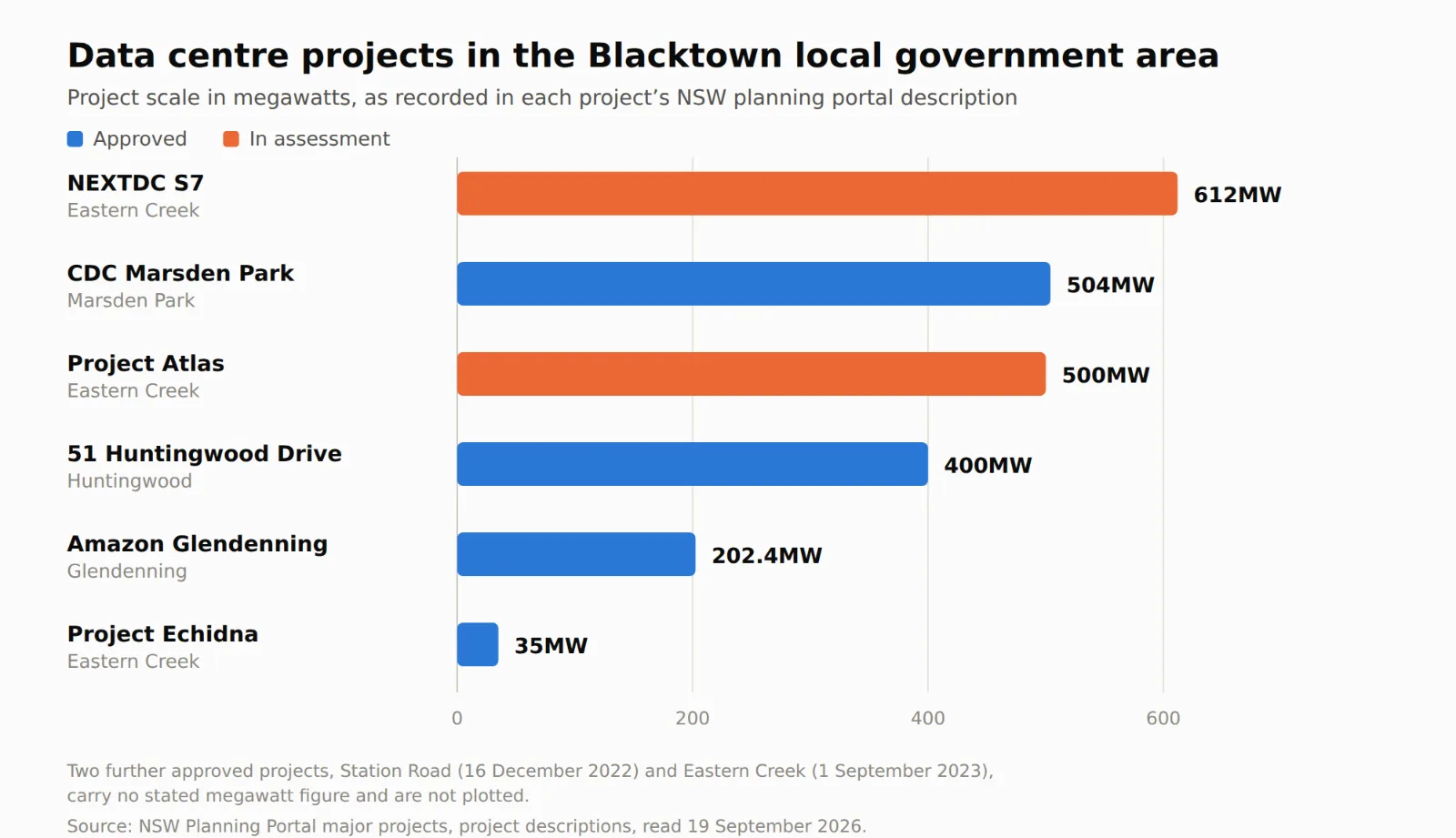
Five other data centre projects in the council area carry a stated power figure on the planning portal, three of them approved. CDC's Marsden Park campus was approved on 27 November 2025 at 504MW, six four-storey buildings with a 720MW substation at a reported A$3.1 billion. The 51 Huntingwood Drive project was approved at 400MW on 15 September 2023, and Project Echidna at Eastern Creek at 35MW on 5 April 2024.
Two larger projects are still in assessment, both at Eastern Creek. NEXTDC's S7 is described at 612MW and Project Atlas at 500MW.
Project | Megawatts | Status |
|---|---|---|
NEXTDC S7, Eastern Creek | 612MW | In assessment |
CDC Marsden Park | 504MW | Approved 27 November 2025 |
Project Atlas, Eastern Creek | 500MW | In assessment |
51 Huntingwood Drive | 400MW | Approved 15 September 2023 |
Amazon Glendenning | 202.4MW | Approved 14 September 2026 |
Project Echidna, Eastern Creek | 35MW | Approved 5 April 2024 |
Source: NSW Planning Portal major projects, project descriptions.
Approved projects in the council area with a stated power figure come to 1,141.4MW, and the two in assessment add a further 1,112MW. Two more approvals, the Station Road expansion on 16 December 2022 and the Eastern Creek expansion on 1 September 2023, carry no stated power figure.
97 diesel generators back up the site
The site has 97 diesel generators for backup, drawing on 2.736 million litres of fuel held in underground tanks. Incoming power reaches the campus on an underground 132kV connection. The application does not name a cooling technology, leaving it to final design, and that choice sets the power each data hall can support, and with it whether the halls can run AI data centre densities.
Water demand of 49.05 million litres a year
The application puts water demand at 49.05 million litres across a full year. AWS reports using 0.10 litres of water per kilowatt hour at its Sydney data centres, a measure called water use effectiveness, against an industry average of 0.84. Its Australian sites run free-air cooling, which uses outside air instead of evaporating water, for 95.5 per cent of the year.
Water pricing for data centres is under review in New South Wales. Premier Chris Minns has asked the pricing regulator IPART to examine what data centres pay for water, which will set what a campus of this size pays once it opens.
Blacktown council raised the view from nearby homes
The council's written submission named two grounds: the outlook from homes on adjoining streets, and a heritage item at Rooty Hill. The three buildings would stand about four times the height of the single-storey warehouses they replace. Under the state significant development pathway a council lodges a submission and the department decides, and the department assessed both grounds before approving the campus.
The department approved Goodman's A$1.365 billion Project Apollo at Macquarie Park on 4 September 2026 and Project Pluto at Guildford West on 23 July 2026. The NSW government published data centre guidelines on 17 August 2026, which set what the department expects on energy, water, noise and community engagement.
What to watch
The conditions. The signed consent and the assessment report are published on the project page, and they set out what the department required on visual impact, noise, water and construction hours.
The connection. Endeavour Energy is assessing peak demand of about 235MW, and the connection determines when each of the three stages can be switched on.
The standards it gets built under. The 2027 data centre standards would apply to most of Australia's approved pipeline, and a campus consented in 2026 and built in three stages falls inside it.