At a glance
AirTrunk is nearing a deal to sell its Johor data centre in Malaysia to investors including pension fund KWAP, at a valuation of about US$2 billion, Reuters reported.
The report came two days after Sydney-founded AirTrunk was reported to have postponed its US$1.5 billion Singapore REIT float, with a listing now aimed for early 2027.
Bloomberg reported AirTrunk had considered lifting the REIT's offered yield to about 6% from 5.5% before postponing it.
Private buyers are still active: Asian data centre mergers and acquisitions reached US$21.3 billion so far in 2026, on track for a record, according to deal-data provider Dealogic.
AirTrunk is close to selling its Johor data centre in Malaysia to a group of investors that includes KWAP, the pension fund for Malaysia's public servants, Reuters reported on 15 October 2026, citing two people familiar with the matter. The deal values the asset at about US$2 billion. Reuters first reported US$1 billion and has since corrected the figure. Blackstone declined to comment and KWAP said it was not in a position to comment.
AirTrunk, the hyperscale operator founded in Sydney in 2015, is owned by Blackstone and the Canada Pension Plan Investment Board, after their 2024 buyout. On 13 October it emerged that the company had postponed the Singapore real estate investment trust (REIT) float it had been exploring since late 2025. AirTrunk has put its public float on hold while it nears a private sale to a pension fund, days after Australian AI infrastructure company Firmus withdrew its ASX float and turned to private investors.
AirTrunk has sought Johor partners since 2025
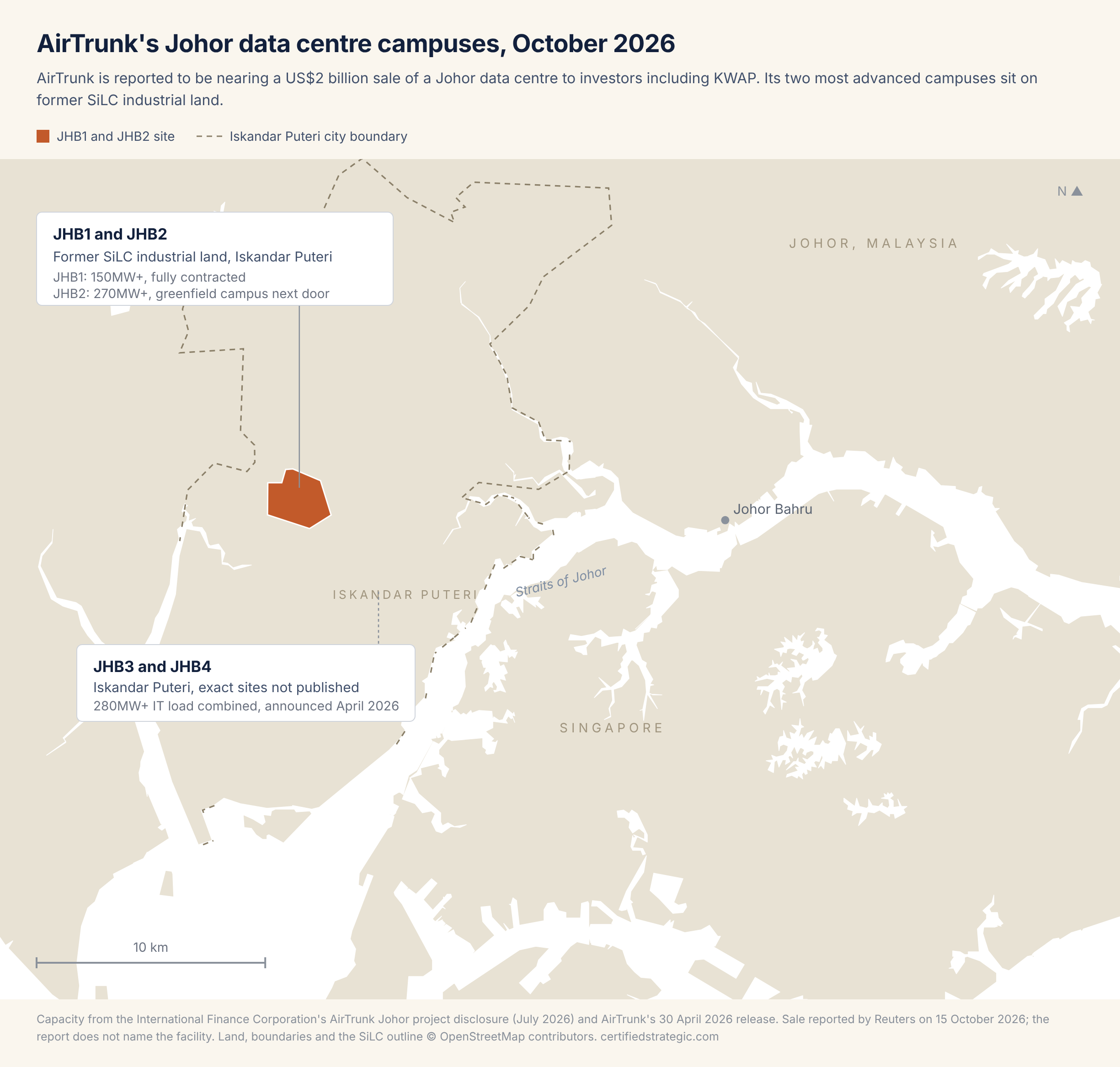
The Australian Financial Review reported in October 2025 that AirTrunk had hired Citi and Malaysian bank CIMB to find capital partners for its 150MW Johor facility, according to trade publication The Tech Capital. JHB1 and JHB2 are the furthest along of AirTrunk's four Johor campuses in Malaysia's Johor and Kuala Lumpur data centre corridor. The International Finance Corporation, the World Bank's private-sector lending arm, describes JHB1 in its project disclosure as a "150+ MW fully contracted hyperscale data center" and JHB2, next door, as a greenfield campus of more than 270MW. JHB2, designed to a power usage effectiveness of 1.37, closed US$2.325 billion of green financing in July.
The Reuters report names neither the facility nor whether the buyers are taking the whole asset or a stake. JHB1 is rated at more than 150MW, so if it is the asset, a US$2 billion valuation works out to no more than about US$13.3 million a megawatt.
Buyers are paying for campuses with signed tenants
AirTrunk has committed about US$6.8 billion to its four Malaysian campuses, which will carry more than 700MW of IT load, it said on 30 April 2026 when it announced JHB3 and JHB4 in Iskandar Puteri, with more than 280MW between them. It said its existing Malaysian capacity of more than 420MW was "almost 100% contracted".
US 10-year Treasury yields posted their sharpest quarterly rise this century in the quarter to September, and investors are taking a closer look at whether projected revenues can support growing debt burdens, bankers told Reuters. A banker who advises data centre investors said valuations can vary widely depending on whether they rest on existing customer contracts or future projections. A fully contracted campus such as JHB1 can be priced off rent its tenants have signed, while listings that rest on revenue projections have had a harder run. KWAP has said it wants private markets to make up 30% of its portfolio, up from 12.3% in 2023, Asia Asset reported.
NEXTDC and Firmus are also building in Malaysia
NEXTDC opened KL1 in Petaling Jaya, near Kuala Lumpur, on 14 May 2026. The campus is designed for 65MW of IT capacity under what NEXTDC called an A$1 billion long-term investment.
Firmus said on 8 September 2026 that OpenAI will contract dedicated AI compute from two of its Malaysian sites as anchor customer. Firmus has not disclosed where the sites are or how much capacity they will carry, and lists seven AI factory sites across Australia, Singapore, Indonesia and Malaysia in its release.
The Singapore REIT moves to 2027
AirTrunk had planned to launch the REIT in September or October, raising about US$1.5 billion in a trust valued at about US$15 billion, Reuters reported on 13 October after The Wall Street Journal first reported the delay. It has not set a new date but aims to complete the listing by early 2027, according to Reuters.
Bloomberg reported on 14 October that AirTrunk had considered offering investors a yield of about 6%, up from the 5.5% it first had in mind, and that Singapore's main REIT index has fallen 12% since late July. A US$1.5 billion float would be Singapore's biggest IPO since 2017, as we reported in July.
Two of three pulled or paused listings are Australian-founded
Reuters named three AI infrastructure listings pulled or paused in the week to 15 October: the AirTrunk REIT, Firmus and SoftBank-backed SB Energy. Firmus pulled its ASX float on 9 October and is in talks with existing investors on a private round, Bloomberg reported.
Equity raised by data centre companies stands at US$5.4 billion so far in 2026, down 4.6% on the same period of 2025, Reuters reported. Mergers and acquisitions involving Asian data centres have reached US$21.3 billion, on track for a record year and more than double the US$10 billion recorded in all of 2025, according to Dealogic. Bain Capital has received final bids for at least 40% of its pan-Asian platform Bridge Data Centres, in a deal that could value it at about US$5 billion, Reuters reported.
What to watch
The KWAP signing. A signed sale would confirm the buyer group, the asset and whether it is a full sale or a stake. A collapsed deal would weaken the case that private capital is still paying for contracted data centres.
The REIT relaunch. A float in early 2027 at or near US$1.5 billion would show the public market reopening to AirTrunk. A higher yield or a smaller raise would show the cost of the delay.
More stake sales. Bain Capital's sale process for at least 40% of Bridge Data Centres is the next test of what private buyers pay for operating Asian data centres. If rates stay high, selling stakes in contracted campuses to pension funds is a likelier source of capital for operators than new listings.
Firmus's private round. The size and price of the round will show what private investors pay for an Australian AI infrastructure company after it withdrew its float.