
RBA staff expect A$115bn more data centre investment by 2028
By Winston Su, Editor · · Add us as a preferred source on Google
At a glance
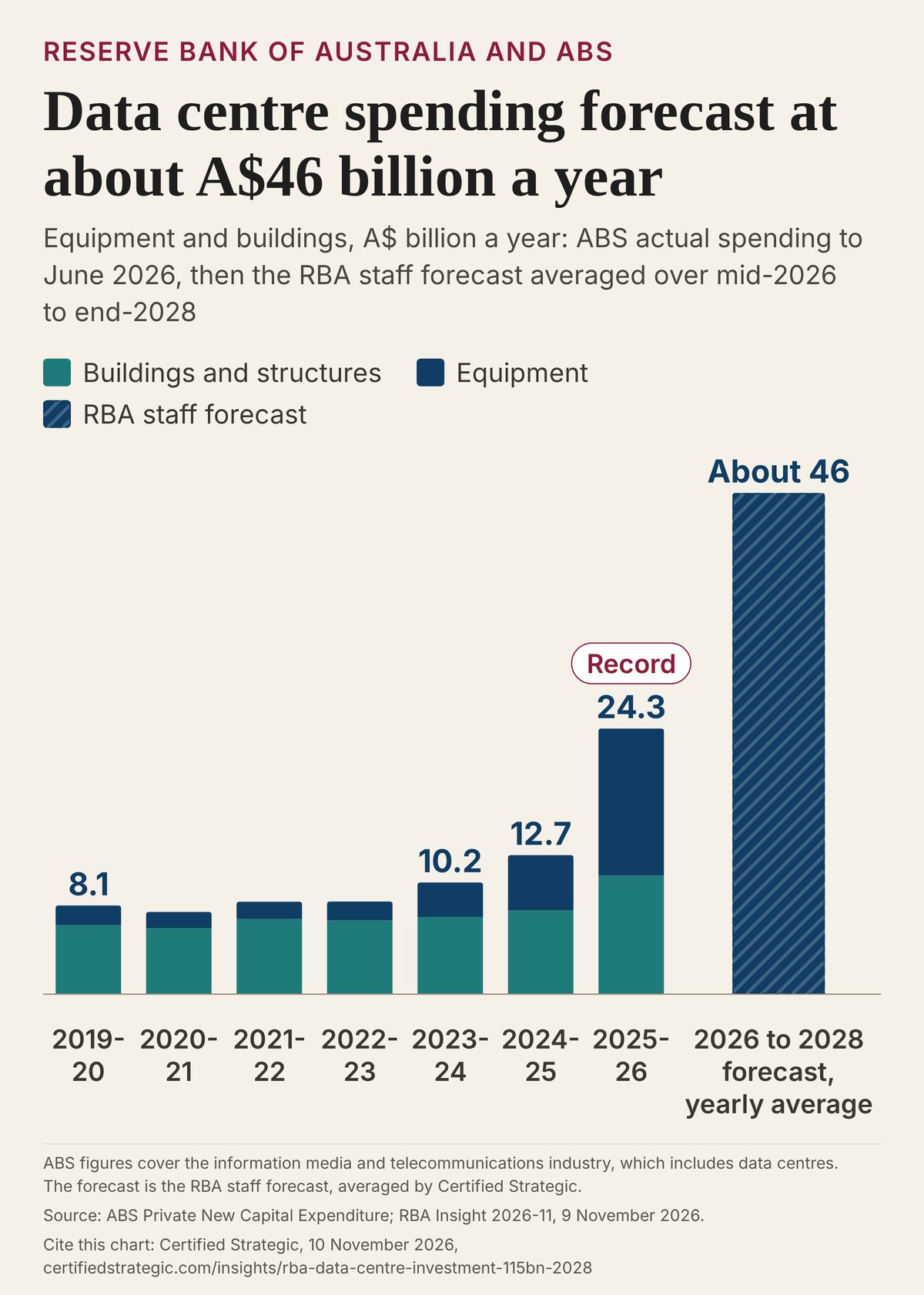
Reserve Bank of Australia staff expect a further A$115 billion to be invested in Australian data centres between mid-2026 and the end of 2028.
That is almost 2 per cent of GDP a year before imports, and the note compares spending at the end of 2028 with the early years of the mining boom.
Investment has grown about tenfold in three years, and the note assumes about 70 per cent of the spending is on imports.
Businesses and groups the RBA talks to report grid access as the main constraint on new data centres, particularly in the cities.
Demand for data centre roles has more than doubled since mid-2025, and the note says estimates would be materially higher if Australia became a big exporter of computing.
Reserve Bank of Australia staff expect a further A$115 billion to be invested in Australian data centres by the end of 2028. The forecast is in Data Centre Investment in Australia, a staff note published on 9 November 2026 by Katie Alexander, Iris Day, Christopher Finnegan, Connor Thrall and Zoe Zhou. It counts spending from mid-2026 in real terms, which strips out inflation, and leaves out the power lines and generation built to serve the sites.
The A$115 billion equals almost 2 per cent of GDP a year before imports.
The note calls the build-out "a meaningful increase in Australia's stock of productive capital". The main constraint its liaison contacts report is access to electricity network infrastructure, particularly in metropolitan areas. We expect projects that already hold a grid connection to be first to turn that spending into operating capacity, ahead of sites still waiting on network upgrades.
It is the second RBA staff note on the sector in seven weeks. The first, Data Centre Financing in Australia, counted at least A$35 billion raised in 2026 and found no evidence that finance was holding investment back, as we reported on 29 September.
Investment has grown about tenfold in three years
RBA staff estimate total data centre investment has grown about tenfold over the past three years, based on the Australian Bureau of Statistics capital expenditure survey. The building makes up about a quarter of the cost. Servers, storage and networking equipment make up about three-quarters, and are largely imported, "typically from Asian economies including Taiwan and South Korea".
The note assumes about 70 per cent of the investment is imported, inside the 50 to 80 per cent range of outside estimates. On that basis, data centres directly added up to around 0.2 percentage points to annual GDP growth over the past year, after the offset from imports.
That 70 per cent is close to the figures already in the market. Treasury's advice to the Treasurer, released on 31 August, put about two-thirds of data centre spending down to imports. Macquarie Data Centres chief executive David Hirst put mechanical and electrical equipment at about 70 per cent of build cost at the Australian Financial Review Property Summit in September.
The ABS capital expenditure survey had counted a record A$24.3 billion of equipment and building spending in the information media and telecommunications industry, which carries data centres, in the year to June 2026, as we reported in September. Spread evenly over two and a half years, the RBA forecast averages about A$46 billion a year, almost twice that record pace. Both are in real terms, but the ABS total is actual spending across a whole industry, while the RBA figure is a staff forecast for data centres alone.
Data centre spending lifts the RBA's business investment outlook
The November Statement on Monetary Policy revised the RBA's business investment outlook up "significantly, largely driven by data centre-related investment". The RBA Board raised the cash rate by 25 basis points to 4.85 per cent on 3 November. Its statement said business investment growth is forecast to be stronger in the near term, "including data centre-related investment".
Sarah Hunter is the RBA's Assistant Governor (Economic). She cited the note in a speech to the UBS Australasia Conference in Sydney on 9 November, the day the note was published. "In the near term, the positive shock to aggregate demand set against the economy's current supply capacity will put some upward pressure on inflation," she said. Over the long run, she expects AI's effect on inflation to be "broadly neutral".
Worldwide, more demand for investment, potentially as global savings fall, "could push up the neutral rate of interest", Hunter said. She defined it as "the rate that balances demand and supply of savings globally".
Australian businesses stand to win about A$35 billion of the work
On the note's own 70 per cent import assumption, about 30 per cent of the A$115 billion, roughly A$34.5 billion, would be spent with Australian businesses. That is our arithmetic on the RBA's figures. The note traces where that domestic spending goes using the national input-output tables, which map how each industry buys from the others. It warns the tables show where the work happens, not whether it is extra work. In an economy running close to capacity, much of the labour and material might be drawn from other uses.
Building and civil engineering contractors take a large share, along with the trades they subcontract. Their suppliers take a similar share, from engineering and design firms to makers of cement and fabricated metal, lenders, freight companies and wholesalers.
Firms associated with data centre developments "continue to report particularly buoyant conditions", according to the liaison box in the November Statement.
Network connections are the main brake on city projects
In some locations, a new data centre connection needs transmission and distribution upgrades first, which can push back the date a project starts operating, the note says. The note cites Transgrid's 2026 Transmission Annual Planning Report on this point, which we covered in September.
In Melbourne, Jemena suspended parts of its 66kV line works for NEXTDC's M3 campus in September, and NEXTDC cut its FY27 guidance on 21 October after the next increase in grid supply moved to FY28. M3's capacity remains under contract, subject to the customer's rights. NEXTDC is still building the data halls.
Across the National Electricity Market, the market operator AEMO had counted 17 data centre projects and 9GW of maximum connection capacity in its connection process at 30 June 2026, as we reported in August. Not every announced project will go ahead. The note cites AEMO figures showing 36 per cent of projects in its development pipeline were cancelled between 2025 and 2026.
Contacts told the RBA that operators have increased their demand for renewable power purchase agreements over the past year. Some credit that demand with supporting renewable projects that may not otherwise have gone ahead. Other operators prefer contracts with well-advanced projects, so they may compete for existing supply rather than add new generation.
A data centre can typically be built faster than new renewable generation can come online, contacts report, and some suggest that gap may put upward pressure on wholesale electricity prices for a time. The note says that would match US evidence, though effects vary by grid. Few liaison contacts report water as a significant constraint across the eastern states, and developers are designing sites to run at higher temperatures with more water-efficient cooling.
Demand for data centre roles has more than doubled since mid-2025
Demand for roles supporting data centres has more than doubled since mid-2025, according to SEEK data cited in the note. Many firms in the RBA's liaison program report that finding workers is not yet a constraint on data centre construction. Several contacts from the wider construction industry told the RBA the ramp-up is adding to shortages in some specific skills.
Electricians, plumbers, air conditioning technicians and site supervisors can move between data centre jobs and other building work. Strong demand and a focus on fast delivery have made data centre projects "a top bidder" for those workers, contacts told the RBA.
New South Wales and Victoria carry most of the data centre activity. The note says their smaller construction pipelines and larger construction capacity should keep competition for those trades more subdued than if the build were in Queensland, Western Australia or South Australia.
Powering Skills Organisation plans training for the energy trades. Its 2026 workforce update puts data centres at 13,000 of the 72,000 extra electrical and mechanical trades workers Australia needs by 2030, as we reported in September.
Spending by 2028 matches the early stages of the mining boom
The note compares the build with the mining boom of the mid-2000s to the early 2010s. Both booms are concentrated by industry and by state: Western Australia and Queensland for mining, and New South Wales and Victoria for data centres.
The central staff forecast has data centre investment at around 2 per cent of GDP by the end of 2028, which the note calls "comparable to the early stages of the mining boom but well below its peak".
China's demand for resources drove the mining boom. The boom lifted commodity prices, exports and tax revenue. The data centre build answers global demand for computing, and the current outlook assumes Australian sites mostly serve demand at home.
Compute exports would push the estimates materially higher
Most outside estimates assume Australian data centres will largely serve domestic demand, according to the note. Estimates "would be materially higher if Australia were instead assumed to become a significant exporter of compute services". The November Statement puts the RBA forecast "in line with recent baseline external projections", but "below projections that assume Australia becomes a significant regional hub for data centres".
In August, the industry body Data Centres Australia published research by Mandala valuing AI computing exports at up to A$4.1 billion a year. IREN's Boris Dangubic told the same AFR summit that most of the processing in the new sites will be for American technology companies, and argued that makes it an export business like mining.
If Australian sites mostly meet local demand, the note says, they may replace computing services the country would otherwise import.
Measure | Figure | What the note says |
|---|---|---|
Growth in data centre investment | About tenfold over three years | Based on the ABS capital expenditure survey |
Further investment, mid-2026 to end-2028 | A$115 billion in real terms | Data centres alone, excluding supporting infrastructure |
Size against the economy | Almost 2% of GDP a year | Gross; the net effect is smaller after imports |
Share of investment imported | About 70% assumed | Outside estimates range from 50% to 80% |
Direct addition to annual GDP growth, past year | Up to around 0.2 percentage points | After the offset from imports |
Data centre share of NEM electricity use | About 3% in 2025/26 | AEMO estimate |
Forecast share of NEM electricity use | 7.5% to 17.1% by 2035/36 | Oxford Economics for AEMO |
Demand for data centre roles | More than doubled since mid-2025 | SEEK data |
Projects in AEMO's pipeline cancelled | 36% between 2025 and 2026 | Given as an example that not all announced projects proceed |
Source: Reserve Bank of Australia, Data Centre Investment in Australia, RBA Insight 2026-11, 9 November 2026. RBA staff estimates and the outside figures the note cites. The PDF edition gives the GDP growth figure as up to around ¼ percentage point.
What to watch
ABS capital expenditure survey, 26 November: the September quarter figures show whether data centre equipment and building spending is running at the pace the RBA forecast implies.
NEXTDC annual general meeting, 20 November: NEXTDC has promised the outcome of its capital expenditure review by the meeting. Its new development projects and land acquisitions have been on hold since 21 October.
Draft AI laws, end of 2026: the federal draft due for public consultation is reported to carry a ban on suburban data centres and a renewable energy requirement. The note says forecasts also depend on regulatory settings.
Keep reading the market
Get The Strategic Brief in your inbox every Thursday.
The leading Australian data centre and AI infrastructure newsletter.
Your Next Read
Australian data centres raised A$35bn in 2026, mostly in bank loans

More new power is queued for Australia's grid than it runs

Asia Pacific family offices favour AI deals over infrastructure
Latest Headlines
NEXTDC's Scroggie apologises over M3 poles, says he has a power fix
10 Nov 2026SA premier says a gigawatt of new power by 2027 is out of reach
10 Nov 2026Goodman and Digital Realty confirm 9.9% stake in NEXTDC
9 Nov 2026AirTrunk drops 140MW Mars Road data centre in Lane Cove West
6 Nov 2026IREN results: US$4bn goal slips to 2027 on Microsoft change
6 Nov 2026
Interested in reaching this audience? Advertise with us.