At a glance
SUBCO will build SM-1, an 850km fibre network over land between Sydney and Melbourne, with at least 96 fibre pairs and service due in June 2028.
SM-1 gives AI data centres in Melbourne a SUBCO-owned land route to Sydney, where SUBCO's APX East cable leaves for California in late 2028.
Slattery's HyperOne planned land fibre between Sydney, Canberra and Melbourne in 2021, and SUBCO later called its SMAP sea cable the first stage of HyperOne.
Telstra's Aura network and Vocus are also adding fibre on the corridor, which Vocus says carries roughly 40 per cent of Australia's long-haul data traffic.
SUBCO sold 10 of SMAP's 16 fibre pairs before that cable carried traffic, and SM-1's first buyers are still to be named.
Australian cable company SUBCO said on 13 October 2026 that it will build SM-1, an 850km fibre network running over land between Sydney and Melbourne. SUBCO links the two cities by sea through its SMAP cable. Its customers also want a second path over land, and for that SUBCO has so far bought capacity from another carrier.
SM-1 will give SUBCO a land route of its own between Sydney and Melbourne by June 2028, alongside its SMAP cable at sea. The announcement comes five years after SUBCO founder Bevan Slattery set out plans for new land fibre between the two cities under another company, HyperOne. Slattery says Sydney and Melbourne hold the "overwhelming majority" of Australia's data centre capacity and cloud infrastructure. Telstra and Vocus are also adding fibre between the two cities.
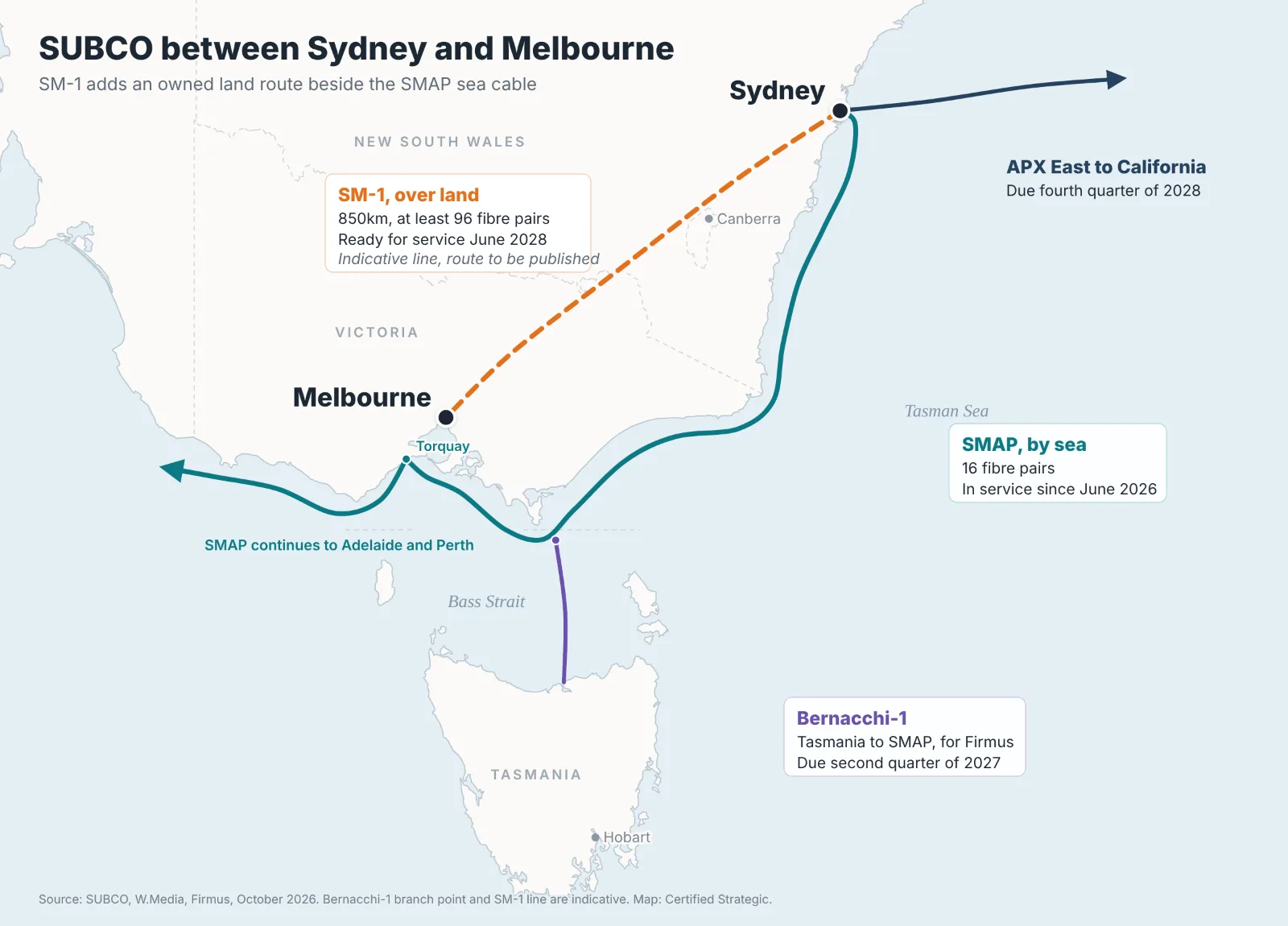
SM-1 will carry at least 96 fibre pairs over 850km
A fibre pair is two strands of glass, one carrying traffic in each direction, and the number of pairs is the industry's measure of how big a route is. SM-1 will have at least 96.
SUBCO has issued survey notices, which tell landholders on the route that surveyors are coming. It expects to have the required permits in place, with construction starting immediately, W.Media reported on 13 October. The route will connect cable landing stations, the buildings where subsea cables come ashore. It will also reach carrier-neutral data centres, which are open to any network, and the cloud on-ramps in both cities, where a customer plugs directly into AWS, Microsoft or Google rather than going over the public internet.
"SM-1 gives our customers a purpose-built, high-capacity terrestrial path that complements our subsea network and ensures they have the infrastructure to scale without constraint," Slattery said. SUBCO said in its LinkedIn announcement that SM-1, as a new build, has been designed for the newest optical equipment and for the generations that follow. SUBCO has not yet published the route, the cost or the customers.
SUBCO has bought land capacity from another carrier since March
Customers that move large volumes of traffic between cities buy two physically separate paths, so that a single cut from a bushfire, a ship's anchor or an excavator cannot take both down. SUBCO's first path between Sydney and Melbourne is SMAP, its 5,000km cable along the seabed from Sydney to Melbourne, Adelaide and Perth, which entered service on 25 June 2026 with 16 fibre pairs and can be traced on the SMAP map.
For the second path, SUBCO said in a release on 8 January 2026 that it had secured 12 terabits a second of carrying capacity over land between the two cities from a carrier it did not name, due to go live in March. On 17 March 2026 SUBCO said its Sydney to Melbourne route now spans two geographically independent paths, one at sea and one on land, on what it called "Australia's busiest corridor".
Slattery said in that March release that "SUBCO's strategy has been to own and operate diverse assets and deliver them as a single, fully integrated offering", and SM-1 gives SUBCO a land route it owns, rather than one it buys from another carrier.
HyperOne planned land fibre between Sydney and Melbourne in 2021
Slattery announced HyperOne in February 2021 as a A$1.5 billion fibre network of more than 20,000km around Australia. Its first phase was a 2,300km loop of land fibre linking Sydney, Canberra and Melbourne, and in December 2021 HyperOne said construction of that phase had begun, with completion expected by December 2022. Victorian contractor UGC-5DG was hired in March 2022 to build one of two legs between Melbourne and Sydney.
By July 2022 HyperOne had finished detailed design of its first segments, about 2,200km of route across its Sydney to Melbourne legs, and sent more than 2,200 property access notices to landholders. Slattery said the design work had found "a number of additional route options", iTnews reported on 1 July 2022.
Slattery's next build between the two cities was at sea, under SUBCO. When SMAP's build contract took effect in August 2023, SUBCO said the cable "marks the first stage of construction of HyperOne", and HyperOne's website still describes the network as "Connecting every state and regional Australia with 20,000 km+ of new fibre". SM-1 takes Slattery's companies back to a land route between Sydney and Melbourne, the link HyperOne planned as part of its first phase.
We expect SM-1 to be followed by another SUBCO land route, because SUBCO called SMAP the first stage of HyperOne and HyperOne's plan still covers every state.
Telstra runs two Aura paths between Sydney and Melbourne
Telstra has built two land paths between the two cities on Aura, the national fibre network it is laying between the capital cities. Its coastal route opened in October 2025, and a second, central path through Canberra was listed among Aura's finished routes by October 2026, so customers can buy two separate routes from one carrier.
Microsoft is Aura's foundation partner, and Google, AWS and Firmus also hold long-term contracts on Telstra's network. On 30 September 2026 Telstra infrastructure chief Steven Worrall said a further Aura contract, with an AI company he did not name, was multiples of the Google deal. AWS, Microsoft and Google each run cloud regions, clusters of data centres serving a market, in both Sydney and Melbourne, and AI services increasingly run across several data centres joined by long-distance fibre.
Vocus, which announced its own A$500 million Sydney to Melbourne route on 30 June 2026, says the corridor carries roughly 40 per cent of Australia's long-haul data traffic and "will be undersupplied in the near future without new investment". Its route, due in 2029, lays fibre inside ducts, pipes that let more cable be pulled through later without digging again, with room for up to 3,456 fibre pairs.
Route | Builder and scale | Service |
|---|---|---|
Aura coastal route | Telstra | October 2025 |
SMAP, by sea | SUBCO, 16 fibre pairs | June 2026 |
Aura central path, via Canberra | Telstra | Built by October 2026 |
SM-1, over land | SUBCO, 850km, at least 96 fibre pairs | Due June 2028 |
Ducted route | Vocus, up to 3,456 fibre pairs, about A$500m | Due 2029 |
Source: Telstra, 21 October 2025; Light Reading, 8 October 2026; SUBCO, 25 June 2026; W.Media, 13 October 2026; Vocus, 30 June 2026.
SM-1 links Melbourne's AI build to Sydney's cables out of Australia
The subsea cables in service from Victoria connect to other Australian states. Until international cables come ashore there, data from Melbourne bound for the United States or Asia travels to Sydney or Perth first. Google's Honomoana and Datagrid's Tasman Ring are planned to change that, the Tasman Ring at Torquay in 2029.
Melbourne is also where new AI capacity is being switched on. Firmus said in August 2026 that its AI cluster at CDC's Brooklyn campus had been handed over and was running a customer's AI models. It is also underwriting Bernacchi-1, SUBCO's cable linking Tasmania to the mainland through SMAP, due in the second quarter of 2027.
In September 2026 Firmus took up to 150 terabits a second on APX East, the SUBCO cable that leaves Sydney for California in the fourth quarter of 2028. By the end of 2028 SUBCO will own cable from Tasmania and Melbourne to Sydney and on to California: Bernacchi-1 across Bass Strait, SMAP by sea and SM-1 over land to Sydney, and APX East across the Pacific.
For data centre operators, SM-1 adds another owner of fibre between the two cities, which gives customers in carrier-neutral data centres more choice when they buy two routes from different carriers. As of its 17 March update, SUBCO's network reached 11 data centres in the two cities, including NEXTDC, Equinix and AirTrunk sites in Sydney and Equinix, NEXTDC and Canberra Data Centres (CDC) sites in Melbourne.
SUBCO sold most of SMAP before it carried traffic
SUBCO said on 8 January 2026, more than five months before SMAP entered service, that 10 of its 16 fibre pairs were sold, four were reserved and two remained for sale. Slattery put that demand down to large cloud companies, carriers and AI compute providers, the same kinds of buyers signing long-term contracts with Telstra on Aura.
We expect SUBCO to name a customer for SM-1 before construction finishes in 2028, because it sold most of SMAP's fibre pairs before that cable carried traffic.
What to watch
The route. SUBCO has not said which way SM-1 will run, whether inland along the Hume Highway, through Canberra or elsewhere. The path decides how long data takes to travel and how far SM-1 sits from other fibre between the two cities, which is the separation customers pay for when they buy a second route.
Permits. The dates SUBCO's permits are granted will show how much of the 20 months to June 2028 is left for the build.
The first SM-1 customer. A named buyer will show whether the cloud, carrier and AI customers that took most of SMAP are taking SUBCO's land route too.
Canberra. HyperOne's original loop ran through Canberra, and SUBCO has not said whether SM-1 will reach it.
The buildings at each end. SUBCO says SM-1 will reach cable landing stations, carrier-neutral data centres and cloud on-ramps. Whether that includes Melbourne's newer campuses, with planning applications at Mickleham and Campbellfield to the north and Clyde North to the south east, will shape how much of the city's next wave of demand SM-1 can reach.