At a glance
Firmus has secured up to 150 terabits a second of dedicated capacity on SUBCO's APX East cable, for 25 years.
The 3 September agreement is an investment of approximately US$300 million and starts when the cable does, in the fourth quarter of 2028.
Bevan Slattery put the capacity Australia's AI factory buildout would need by 2028 at 75 to 150 terabits a second in January, for a pipeline he sized at 3GW.
A roughly 20 per cent fall in per-amplifier power draw lets APX East run about 13,000 kilometres and skip the Hawaii landing trans-Pacific cables have traditionally used.
Rosenfield ties Australian AI exports directly to the cable, and both companies rest the case on capacity and resilience more than on latency.
Firmus signs for 25 years of capacity to California
Firmus, the Sydney-headquartered company building AI factories across Australia and Asia, will be the cornerstone customer on APX East, SUBCO's planned express submarine cable between Australia and the United States, running Sydney to California. Firmus's 3 September announcement says it "will make an approximately US$300 million investment and secure up to 150 terabits per second (Tbps) of dedicated capacity over 25 years on APX East". The cable is due in service in the fourth quarter of 2028.
When SUBCO announced APX East in January, founder Bevan Slattery put the international capacity Australia's AI factory pipeline would need by 2028 at 75 to 150 terabits a second. One customer has now taken the top of that range as its own ceiling.
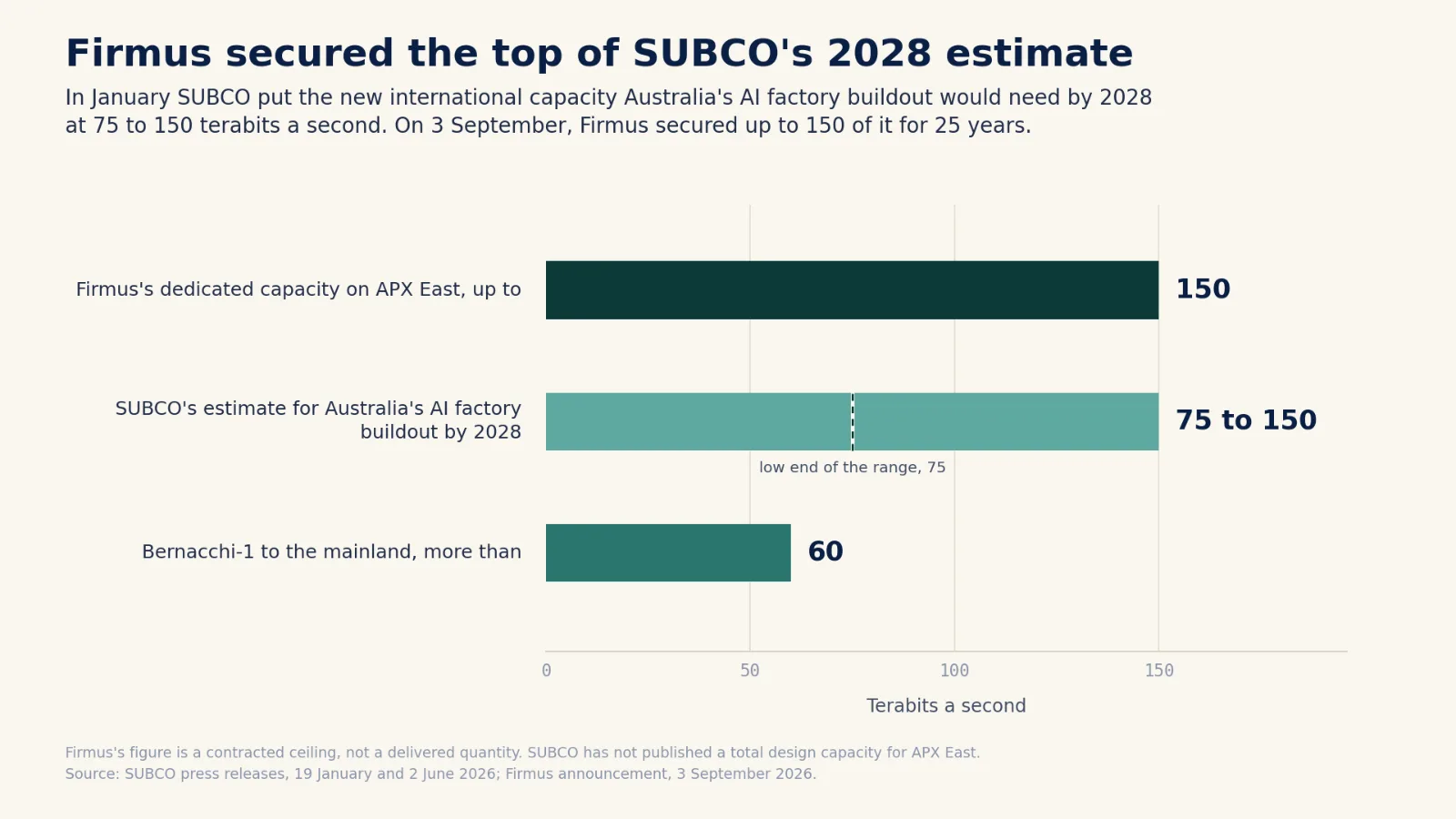
SUBCO put the 2028 requirement at 75 to 150 terabits a second
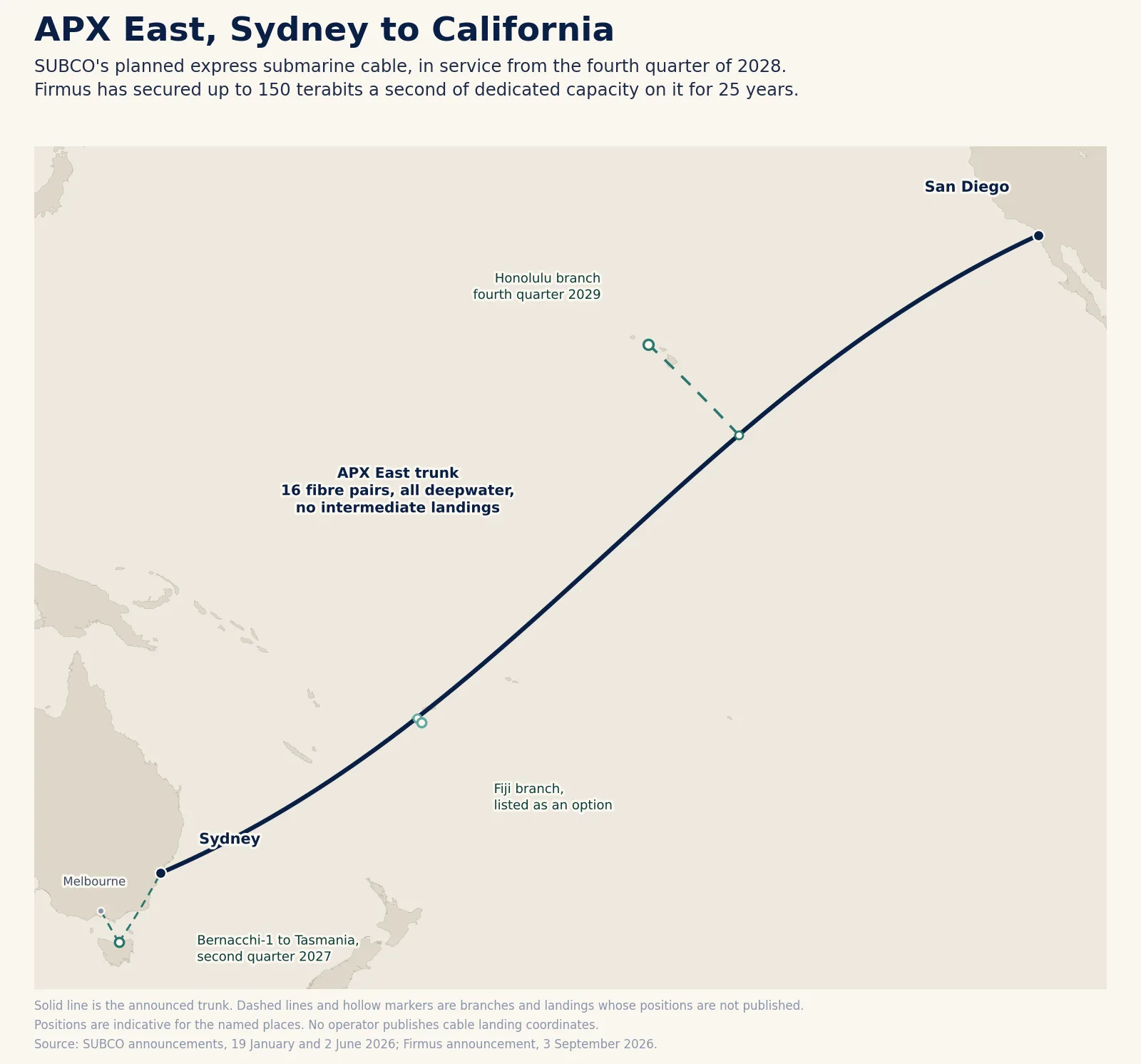
SUBCO develops and operates submarine cables, including the INDIGO systems to Asia and the SMAP hypercable along Australia's southern coast. It announced APX East on 19 January 2026 as a 16 fibre pair express route between Sydney and California, designed as a single continuous optical path with no intermediate landings that can be powered from one end if the other fails. Light Reading and Submarine Networks both put the US landing at San Diego. The route avoids shallow-water transits between its two landings, which keeps it clear of the seabed where fishing gear and anchors do most cable damage, and away from the permits a shallow crossing needs. Fiji is listed as an optional branch.
Slattery's case for the cable was the AI buildout rather than consumer traffic. "Hyperscalers and neoclouds are looking to deploy 3GW of AI factories in Australia between now and 2028," he said in January. "This is going to need between 75Tb-150Tb of international capacity to deliver those tokens to the world." In the same release he said "the longest lead item for Australia isn't going to be power, land, data centers or chips, it's going to be international connectivity at AI scale".
Defence Minister Richard Marles told the 2026 Shangri-La Dialogue that "around ninety-nine percent of Australia's internet traffic flows through just fifteen subsea cables". SUBCO describes APX East as the country's first sovereign-owned international hypercable, and eight months after Slattery published his estimate it has a customer against it.
APX East runs about 13,000 kilometres end to end
SUBCO puts the system at about 13,000 kilometres. In a conversation with Rosenfield that Firmus published on its own channel on 3 September, Slattery said improvements in subsea system efficiency have cut power consumption per amplifier by about 20 per cent, and w.media reported the same figure. That margin is what allows a path of this length with no intermediate landing, and SUBCO's January release says the system can run on power fed from a single end in a fault condition.
Hawaii is the traditional waypoint for cables out of Australia, and Southern Cross NEXT has run Sydney to Los Angeles without calling there since July 2022. Hawaiki routes Sydney to Oregon via Hawaii, and Telstra's Endeavour and the original Southern Cross network both land there. Southern Cross NEXT skips it but branches to Fiji, Tokelau and Kiribati along the way. APX East is designed with no intermediate landing at all, and its Honolulu branch is scheduled for the fourth quarter of 2029 as an addition to the trunk.
SUBCO markets the route as the lowest latency path to the United States. Firmus chapters that stretch of the video "Latency, agentic AI and where real time actually matters", and the two put real-time latency in the device, in a self-driving car or a robot, rather than on the ocean crossing. Covering the same conversation, w.media recorded the two companies focusing on capacity and connectivity "as opposed to positioning latency as a defining requirement for AI workloads". Slattery put the case on the corridor instead, describing existing international routes as "tired and overbuilt" and short on resilience.
US$300 million against a build reported at A$700 million
SUBCO has not published a construction cost for APX East. Light Reading reported the project at A$700 million, or US$471 million, in January. Submarine Networks records US$500 million. Firmus's approximately US$300 million sits against those two figures, on a cable that will not carry traffic for more than two years.
Firmus has anchored two SUBCO systems since June. In June it underwrote Bernacchi-1, the Tasmanian branch off SMAP that will carry more than 60 terabits a second from the second quarter of 2027. The APX East release calls Firmus a cornerstone customer taking dedicated capacity and describes the money as an investment, and it does not say which of the two the US$300 million buys.
Firmus is one of the neocloud companies in Australia that rent out GPU computing, and it contracts long on the inputs it does not build. It leases space in other operators' data centres in Australia for its Melbourne compute while it builds its own campuses in Tasmania. Its South Australian power sits under a 12-year, 600MW supply agreement with Gunvor, more than half of whose initial firming comes from a long-term offtake on the Koolunga battery. The cable capacity runs 25 years.
Tim Rosenfield, co-CEO of Firmus, put the purchase in export terms. "AI is fast becoming one of Australia's next major export industries, but that opportunity will only be realised if we invest in the infrastructure that underpins it," he said. In the video he went further, saying that without APX East and without the capacity Firmus has taken on it, "there is no exporting of tokens". Firmus titles that chapter of its own video "Without APX East, there is no token export", which makes it the company's stated position rather than a remark in passing. Australia already has trans-Pacific paths in Southern Cross NEXT, Hawaiki and Telstra's Endeavour, so his claim is about capacity and control rather than the absence of a route. Data Centres Australia and Mandala have valued AI compute exports at up to A$4.1 billion a year by 2030.
The Sydney landing sits outside the declared protection zones
SUBCO describes the APX East landing as "north of Sydney's existing cable protection zone, fully diverse from all announced systems". A protection zone is the instrument that makes anchoring, seabed trawling and dredging offences over a cable route, with the prohibited activities set out in each declaration. Australia has three, two off Sydney and one off Perth.
The count has not moved since 2007, though ACMA extended the Southern Sydney zone in October 2025 to take in Google's Tabua landing at Maroubra. Vocus has asked the regulator for four more, at Darwin, Port Hedland, Maroochydore and Christmas Island. A landing at APX East's scale outside the declared zones would sit on ordinary seabed unless ACMA declared a new one. That declaration is not a condition of laying or operating the cable. It decides whether the route is protected on the Sydney approach, where two of Australia's three declared zones already sit.
What to watch
Financial close is the near-term marker. A cornerstone customer committing approximately US$300 million over 25 years changes what a project of this size can raise, and route survey and supply contracts through 2027 will show whether the fourth-quarter 2028 date holds.
No other Australian operator has announced capacity on APX East. Slattery's January range covered 3GW of Australian AI factories, and Firmus has taken a ceiling equal to the top of it, which makes the next disclosed customer the test of whether the cable is filling with Australian demand or being sold offshore.
ACMA is the third thing to watch. The Tabua extension shows the regulator will move the regime to cover a new landing when asked, so whether it opens consultation on the APX East landing during 2026 is a fair read on how the sovereign-route argument is landing in Canberra.
SUBCO has published APX East's fibre pair count and its route. A total design capacity for the system is still to come, and that figure is what would show how much of the cable 150 terabits a second represents.