At a glance
Australia runs 1.4GW of data centre capacity against a 21.6GW development pipeline, on the DC Byte figures Schneider Electric presented in Melbourne.
DC Byte's forecast for 2030 went from 3.2GW in April to 3.9GW in August, a 22 per cent move in four months with no published explanation.
NVIDIA costed a full modular build at about 4,500 on-site hours per megawatt against 12,000, and 85 per cent fewer licensed-electrician hours.
Tanya Monro, Australia's Chief Defence Scientist, told the second morning's plenary that Australia's success comes from focus rather than from scale.
Residents ask what a data centre does, why it sits on that block and what living beside it is like, and delegates raised those three between sessions rather than from the floor.
Informa ran Data Center World Australia and The AI Summit Australia together at the Melbourne Convention and Exhibition Centre from 7 to 9 September 2026. Certified Strategic was in the room for the plenary and keynote sessions on both conference mornings, and the afternoon sessions described below are taken from the published programme.
Data Centres Australia published its economic case with the consultancy Mandala on 25 August 2026, and national cabinet took up mandatory standards for the industry the next day. The conference opened a fortnight later.
Schneider Electric, NVIDIA and Mistral AI each brought a technical case with new numbers behind it, and the case the sector makes for itself in public is the one Data Centres Australia and Mandala published in August: investment, pipeline, jobs, and the correction of claims about household power bills and drinking water. Residents near a proposed site ask three other things. What the building does, why it sits on that block of land, and what living beside it is like. Craig Scroggie of NEXTDC keynoted the first conference morning on building Australia's AI-ready infrastructure, after the operator's NEXTDC FY26 results, and the Excellence Awards ran in Melbourne that evening.
DC Byte's Australian forecast moved 22 per cent in four months
Marc Garner, Schneider Electric's global president for cloud and services providers, sized Australia at 1.4GW of operational capacity against a 21.6GW development pipeline, more than fifteen times what is running, with 3.2GW forecast by 2030 and 5.4GW of large-scale projects moving through the National Electricity Market's connection queue, the waiting list for a grid connection. He put the annual opportunity at A$142 billion. He also mapped 800 volt direct current distribution from sub-megawatt sidecar units in 2026 to 9MW solid-state transformer units at the far end of the curve, which changes what is an AI data centre at the level of the electrical room.
Those three Australian figures are the ones the capacity database DC Byte published with Data Centres Australia in the Australian Data Centre Forecast Report in April 2026. The report Data Centres Australia released with Mandala on 25 August 2026 carries DC Byte's revised numbers, 1.6GW operational and 3.9GW by 2030, so the same database moved its own 2030 forecast by 22 per cent in four months.
Measure | DC Byte, April 2026 | DC Byte, cited 25 August 2026 |
|---|---|---|
Operational capacity | 1.4GW | 1.6GW |
Capacity by 2030 | 3.2GW | 3.9GW |
Source: Certified Strategic Editorial, from the Australian Data Centre Forecast Report Issue 1, Data Centres Australia with DC Byte, April 2026, the figures Schneider Electric presented on 8 September 2026, and The Economic Contribution of the Data Centre Industry in Australia, Data Centres Australia and Mandala, 25 August 2026.
Neither document carries a note explaining the revision, and a reader tracking data centres in Australia meets a different national number depending on which of the two they saw last.
NVIDIA costed a modular build at 4,500 on-site hours a megawatt
Jared Carl, NVIDIA's global AI data centre lead, argued schedule now decides the economics. A full modular build compresses a hall, the room that holds the racks, to 12 to 18 months, which his slide put at about 36 per cent faster than a conventional on-site build and worth seven to nine months of earlier revenue per hall. On-site hours fall to about 4,500 per megawatt from 12,000, licensed-electrician hours by 85 per cent, and capital cost by 8 per cent per megawatt. His slide put vendor value capture rising from about US$3.5 million a megawatt to about US$7 million on full-stack modular, and modular above 30 per cent of live capacity by the end of 2028. He sourced the figures to SemiAnalysis, 29 July 2026.
His power chart ran 1,000MW into a gigawatt AI factory and 600MW out as AI output, with about 40 per cent of the input lost along the way: roughly 20 per cent to facility power and cooling, 10 per cent to inefficient rack power and 10 per cent to failures and restarts.
An 85 per cent cut in licensed-electrician hours is a scheduling change rather than a cost one in a market where the electrician shortage and the data centre skills shortage are both live. Carl's watch-outs are the ones an Australian developer meets first: six to nine month schedules that compress commissioning, an equipment maker's margin on scope a conventional build would have bought at installed cost, a throughput ceiling set by factory capacity, and vendors describing very different scopes under one label.
Mistral AI told enterprises their moat is their own data
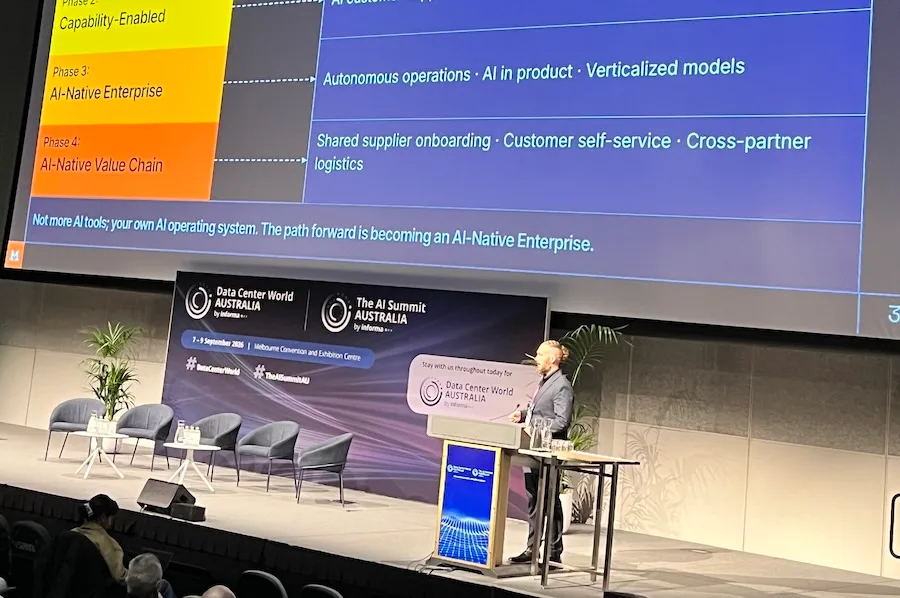
Corentin Petit, Mistral AI's global solutions director, opened the second morning with a four-stage maturity model: AI-assisted, capability-enabled, AI-native enterprise, AI-native value chain. Most enterprises sit at stage one, on chatbots, retrieval, document search and copilots. Stage three, where autonomous operations and AI inside the product live, he put as the new competitive baseline.
His closing slide ran four lines: your competitive moat is your data, ungoverned AI is existential risk, sovereignty is a board-level concern, and whose moat is your vendor building. On that slide sovereignty is a board's question about its own supplier, put in the language of procurement rather than of national policy.
Tanya Monro put focus ahead of scale
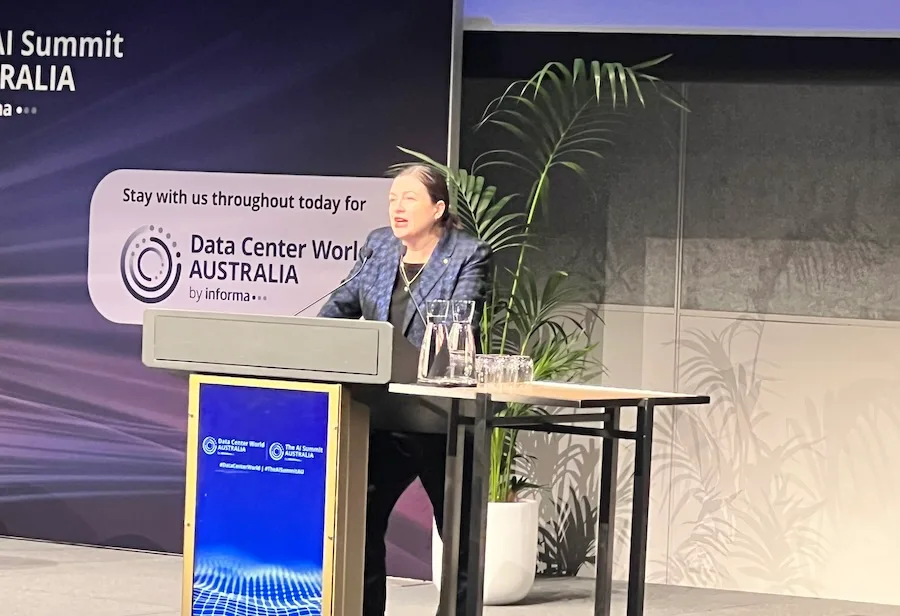
Preparing for the Future: AI and Defence, at 9.35am on 9 September 2026. She built it on insight, judgement, and institutions strong enough to turn one into the other. She named decision superiority as the goal, and said machines amplify human judgement while the responsibility for it stays human.
Monro put the order as focus, then scale, then impact, and said Australia's success comes from focus rather than from scale. She described the national constraint as connection rather than capability: the depth of talent is here, and the work is joining it to the problems the country faces. She named underestimating ourselves as a cultural habit worth breaking, spoke with visible enthusiasm for what lies ahead, and asked what the compute is for.
Service, place and neighbour
Residents near a proposed site ask what the building does, why it sits on that block, and what living beside it is like. Service, place, neighbour. Those are the questions being put at council meetings around the country, and Certified Strategic has tracked the way they move, from water through 2025 to noise from August 2026 and on to benefit distribution and land use.
None of the three reached a microphone at the sessions Certified Strategic attended. They ran through the conversation between delegates instead, while what came off the stage stayed on investment, jobs and the correction of the power bill and water claims. Our June analysis of data centres and social licence found the argument had already moved from environment to benefit distribution, and closed on social licence being the lever operators hold.
Where those answers sat on the programme
The service answer sat on the AI Summit side of the programme. Andrew Watson, deputy commissioner and chief data officer at the Australian Taxation Office, presented the office's AI work on 9 September, Rhys Weekley of Australia Post sat on the executive AI literacy panel the day before, and Tripadvisor and DHL gave case studies on what the compute does once it is switched on. That is what a data centre does, described by the people whose work runs inside one.
Place asks why this site and not another: what the land did before, how far the nearest homes sit from the fence, and what stays behind after the build. A panel on 9 September took the siting question from the operator's side, under the title Site Strategies: Keeping Australia Competitive.
The neighbour answer had its own sessions. Amy Marks, senior vice president for innovation and sustainability at Compass Datacenters, gave an international keynote on overcoming community concerns on the afternoon of 8 September, and the panel titled Data Centers Are Good Neighbours followed it, with Vantage Data Centers' senior vice president for public policy John Stephenson, CDC Data Centres chief strategy officer Dr Jack Dan, Belinda Comninos of the planning consultancy Astrolabe Group and Bronwen Clark, chief executive of the National Growth Areas Alliance, which represents the councils in the corridors where the campuses go. Greg Boorer, CDC's founder and chief executive, keynoted at 11.25am on 9 September under the title Building Australia's Digital Future: Growth, Communities and National Prosperity, and Microsoft's data centre academy at Victoria University appeared on the 8 September talent panel.
What to watch
The New South Wales energy department's consultation on data centre connections and cost recovery closes at 5pm on 14 September 2026. Submissions on the draft terms of reference for the pricing regulator IPART's review of data centre water charges close on 2 October 2026, with the review itself to follow. The next issue of DC Byte's Australian forecast report is where a reconciliation of the 3.2GW and 3.9GW figures for 2030 would appear.