At a glance
Anthropic has run a confidential tender for up to 1.4GW of Australian data centre capacity, a build reported at up to US$15 billion, about A$21.6 billion.
CDC Data Centres is the reported frontrunner for around 500MW; a decision is expected in the coming weeks and may be split across several operators.
Anthropic wants at least 1GW operational by the end of 2027, which makes local delivery record the draft’s tiebreaker.
Our hypothetical draft mixes global leaders with the Australian architects, builders and engineers that AirTrunk, NEXTDC and CDC already utilise.
Anthropic’s compute runs across Google TPUs, AWS Trainium and NVIDIA GPUs, which makes the silicon the trickiest pick on the board.
A reported tender, a hypothetical team
Delivered on the reported timeline, Anthropic’s Australian campus would be one of the largest private engineering programs the country has attempted, and quite possibly the fastest at this scale. The tender runs to 1.4GW of capacity, a build reported at up to US$15 billion, with at least 1GW due to be live by the end of 2027. That compresses close to a decade of the data centre sector’s normal build rate into roughly eighteen months, and across more than one site at once.
And it is real. Anthropic has issued a confidential request for proposals to a shortlist that includes CDC Data Centres, AirTrunk, NEXTDC, IREN and Stack Infrastructure. Initial proposals went in during March, shortlisted bidders met Anthropic executives in Canberra in April, and a decision is expected in the coming weeks, potentially split across more than one provider. The search follows the memorandum of understanding Anthropic signed with the Australian government in April.
The team to deliver it is ours to invent, so we built a draft board: a global pick and a local pick for each of twelve positions, from operator, land and architecture through cooling, the build, power and silicon, for an AI data centre campus at this scale.The rule for the draft is simple: pick the best in the world and lean on the Australian firms the majors already use.
The draft board
Position | Global pick | Local and incumbent pick |
Operator and colocation | Stack Infrastructure | CDC Data Centres |
Land and development | ESR | Goodman Group |
Master planning and architecture | Gensler | Greenbox (Woolpert) and HDR |
Interiors, workplace and amenity | HOK | Woods Bagot and Hassell |
MEP and critical systems | Introba | Aurecon and NDY |
Cooling | Vertiv, LiquidStack and TTK | CDC LiquidCore and Seeley International |
Main contractor | DPR Construction | Multiplex, FDC and A W Edwards |
Programme and cost management | Turner and Townsend | Aurecon |
Grid and power | GE Vernova | Transgrid and Neoen |
Silicon | NVIDIA (GB300 and Vera Rubin) | Google TPU (with Broadcom) and AWS Trainium |
Servers and integration | Dell Technologies | Supermicro |
Networking and storage | NVIDIA Spectrum-X and Arista | VAST Data |
Source: Public project records and firm disclosures, July 2026. The delivery record behind each pick is in the sections below.
The operator and the ground
The operator slot sits closest to the reported facts. CDC Data Centres is the reported frontrunner for roughly 500MW, and its sovereign, government-grade posture, contracted-capacity scale and closed-loop LiquidCore cooling, which CDC says uses no water for primary cooling, fit an Anthropic campus almost too neatly, which is why our board keeps it in the marquee slot. We would run NEXTDC and AirTrunk as co-hosts on the remaining capacity, because a split award is exactly what has been reported, and both bring proven hyperscale delivery. CDC, NEXTDC and AirTrunk all rank among Australia's top data centres by operational scale. IREN and Stack Infrastructure, both named in the reported shortlist, round out the colocation options. NEXTDC’s Western Sydney pipeline and AirTrunk’s Melbourne and Sydney campuses give Anthropic optionality across states. For land, Goodman Group is the obvious anchor, holding one of the largest global data centre land banks, much of it in Sydney and Melbourne, and the balance sheet to move at pace, with ESR as the global counterpart.
On the board:
CDC Data Centres — operator, marquee slot
NEXTDC — co-host operator
AirTrunk — co-host operator
IREN — shortlisted operator
Stack Infrastructure — shortlisted operator
Goodman Group — land and development
ESR — land, global counterpart
Design, from the shell to the fit-out
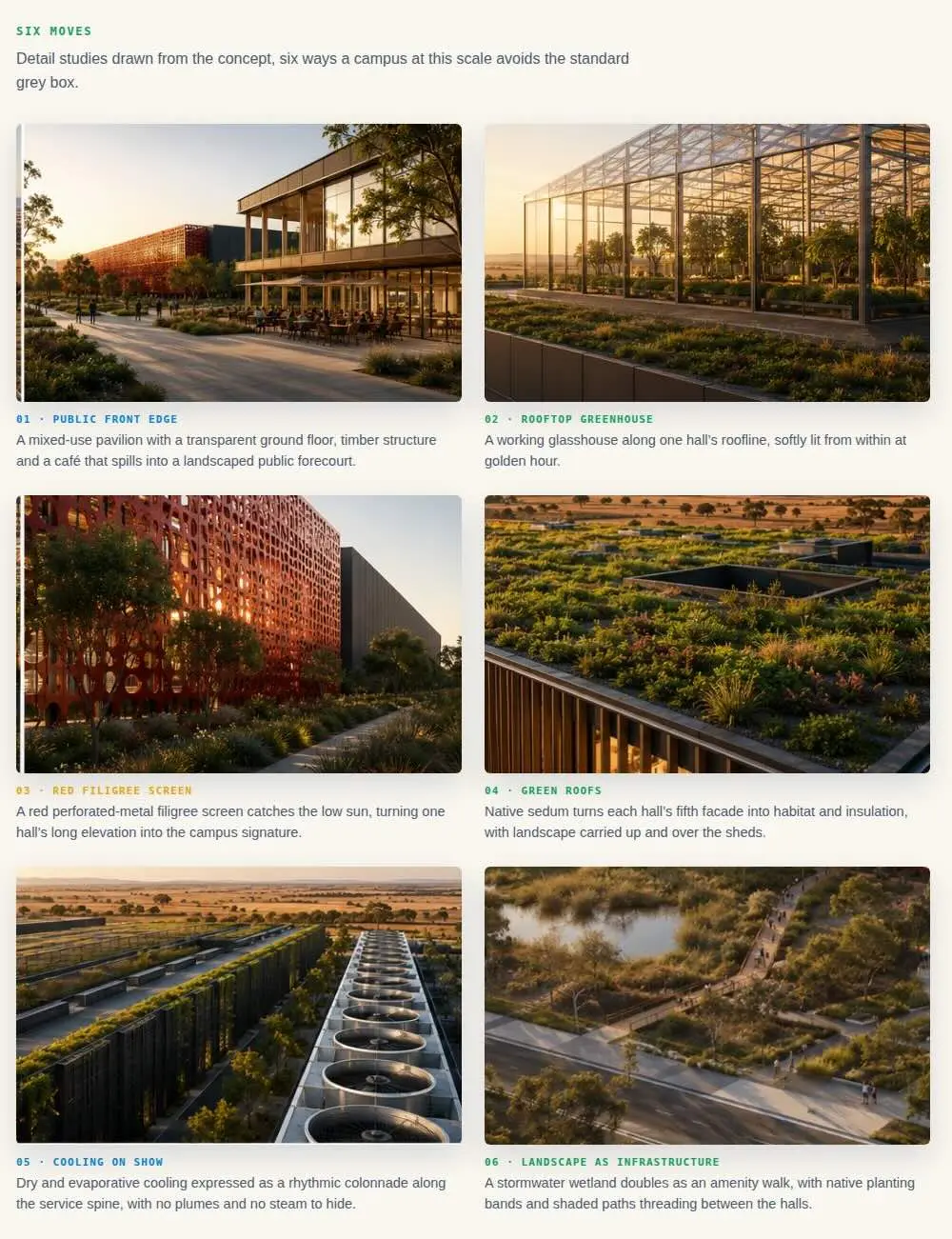
For the architecture we would draft the firms already shaping the Australian sector: Greenbox, now part of Woolpert, and HDR, who between them designed NEXTDC’s S-series in Sydney and its red-filigree Melbourne halls, with DEM carrying AirTrunk’s work. Gensler is the global name for master planning at campus scale. The newer idea is that a 1.4GW campus does not have to be a windowless shed. If Anthropic wants the mixed-use, publicly legible model that Equinix built at PA10 in Paris, with a green roof and rooftop greenhouse, then interiors and amenity become a position in their own right. We would draft Woods Bagot, who designed AirTrunk’s Sydney headquarters, alongside Hassell and ASPECT Studios on landscape, with HOK as the global option. On engineering, Aurecon and Norman Disney and Young (NDY) have the local critical-systems record, backed by Introba’s global data centre practice. The cooling slot pairs CDC’s LiquidCore with Seeley International’s evaporative know-how, LiquidStack for direct-to-chip liquid at Blackwell and Rubin densities, and French specialist TTK’s high-sensitivity leak detection wrapped around the liquid loops. NEXTDC this week opened a direct liquid cooling demonstration environment with Vertiv, SRA Solutions, Dell Technologies, Castrol ON, NVIDIA and MODL, so the local bench is already tooling for exactly these densities.
On the board:
Greenbox and HDR — architecture
DEM — architecture, AirTrunk
Gensler — master planning
Woods Bagot and Hassell — interiors and amenity
ASPECT Studios — landscape
HOK — global design option
Aurecon and NDY — engineering and critical systems
Introba — global engineering practice
CDC LiquidCore, Vertiv, LiquidStack, Seeley International and TTK — cooling
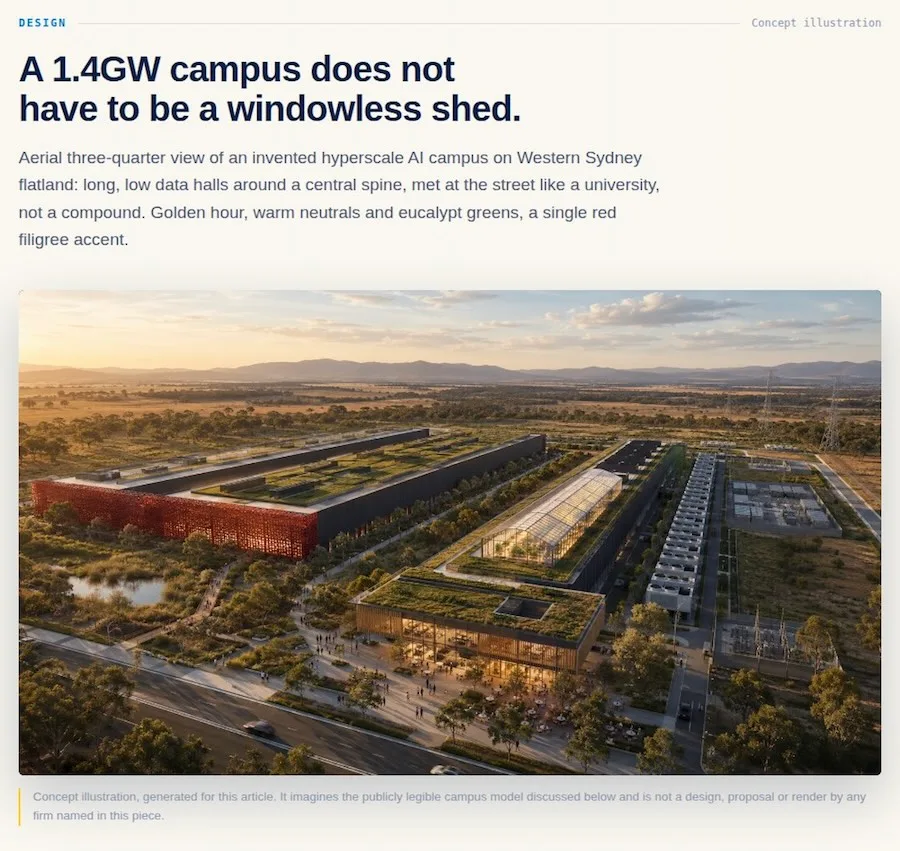
Concept illustration, generated for this article. It imagines the publicly legible campus model discussed below and is not a design, proposal or render by any firm named in this piece.
The build
This is where the Australian bench is deepest. Multiplex has delivered three data centres for NEXTDC, including the S3 Sydney campus, and A W Edwards has built for AirTrunk at SYD1 and fitted out its global headquarters, so either could carry an Anthropic package on record alone. We would draft Multiplex as head contractor on the flagship Sydney site, FDC and Kapitol Group on parallel packages to compress the programme, and A W Edwards on the Melbourne build. DPR Construction is the global name we would bring in for hyperscale sequencing experience, with Turner and Townsend or Aurecon holding independent programme and cost management across the multi-site rollout. On a build targeting 1GW live by the end of 2027, running these packages in parallel rather than in sequence is the only way the timeline holds.
On the board:
Multiplex — head contractor, flagship Sydney site
FDC — parallel packages
Kapitol Group — parallel packages
A W Edwards — Melbourne build
DPR Construction — global hyperscale sequencing
Turner and Townsend — programme and cost management
Power and water
Power is the hardest constraint on a build this size: Anthropic needs firm, largely renewable supply at gigawatt scale, which makes grid connection the gating item. We would draft Transgrid and the relevant network operators for connection, Neoen and Squadron Energy for renewable power purchase agreements, and battery firming from the likes of Tesla Megapack or Fluence to hold the load steady, with GE Vernova on grid-scale equipment. Water is the reputational lever, so the campus should lean on closed-loop and recycled-water cooling from the start, the same approach that sits behind how Australian operators already handle energy and water.
On the board:
Transgrid — grid connection
Neoen — renewable power purchase agreements
Squadron Energy — renewable power purchase agreements
Tesla Megapack — battery firming
Fluence — battery firming
GE Vernova — grid-scale equipment
The silicon and the stack
The compute is the standout pick, because Anthropic runs Claude on three chip platforms at once. It trains and serves the models across Google’s TPUs, Amazon’s Trainium and NVIDIA’s GPUs, so the Australian campus is unlikely to be a single-vendor hall. Google, with Broadcom co-designing the TPUs, is bringing well over a gigawatt of Anthropic capacity online in 2026 under a deal worth tens of billions. Amazon’s Project Rainier already runs more than a million Trainium2 chips, and up to 5GW of new compute is agreed. For an Australian sovereign build we would still draft NVIDIA’s GB300 and Vera Rubin for the merchant-silicon halls, integrated by Dell, which is delivering Macquarie Data Centres’ sovereign NVIDIA AI Factory, with Supermicro as the second source. Networking goes to NVIDIA’s Spectrum-X and Arista, storage to VAST Data, which already underpins Sharon AI’s sovereign backbone, and connectivity to Vocus and SubCo on the subsea and terrestrial links.
On the board:
NVIDIA — GB300 and Vera Rubin GPUs
Google TPU — incumbent platform
AWS Trainium — incumbent platform
Dell Technologies — servers and integration
Supermicro — servers, second source
Arista — networking
VAST Data — storage
Vocus and SubCo — connectivity
What to watch
Anthropic’s decision lands within weeks, and it will not read like a fantasy draft. The award may be split across CDC, NEXTDC, AirTrunk and others, and the capacity may land in stages rather than at once. Sovereign certification will shape who can host the highest-security workloads. Our roster is a showcase of the talent this country and the world can put on the field, not a prediction of the contract.