At a glance
EonFibre, the fibre business One New Zealand set up in 2024, launched Zone Direct on 12 October 2026, a service linking new data centre campuses in New Zealand to customers in Australia, Asia and the US.
It covers the six zones that Invest New Zealand, the government's investment agency, markets for data centres: North Waikato, Taupō, Taranaki, Manawatū, South Canterbury and Central Otago.
The route to Australia runs over Tasman Global Access, which EonFibre co-owns and which lands at Narrabeen on Sydney's northern beaches.
Two more trans-Tasman cables are due by 2029: Southern Cross's SX Tasman Express to Sydney and Datagrid's Tasman Ring to Torquay.
EonFibre is selling a route from New Zealand's data centre zones to Sydney
EonFibre launched Zone Direct on 12 October 2026 for data centre developers, hyperscalers, neoclouds and carriers considering New Zealand. It gives developers a connectivity brief for each of the six zones, assesses candidate sites during selection, and can design, build and run the campus network. Raglan is the nearest international cable landing for all six zones, from 41km for North Waikato to 930km for Central Otago in a straight line.
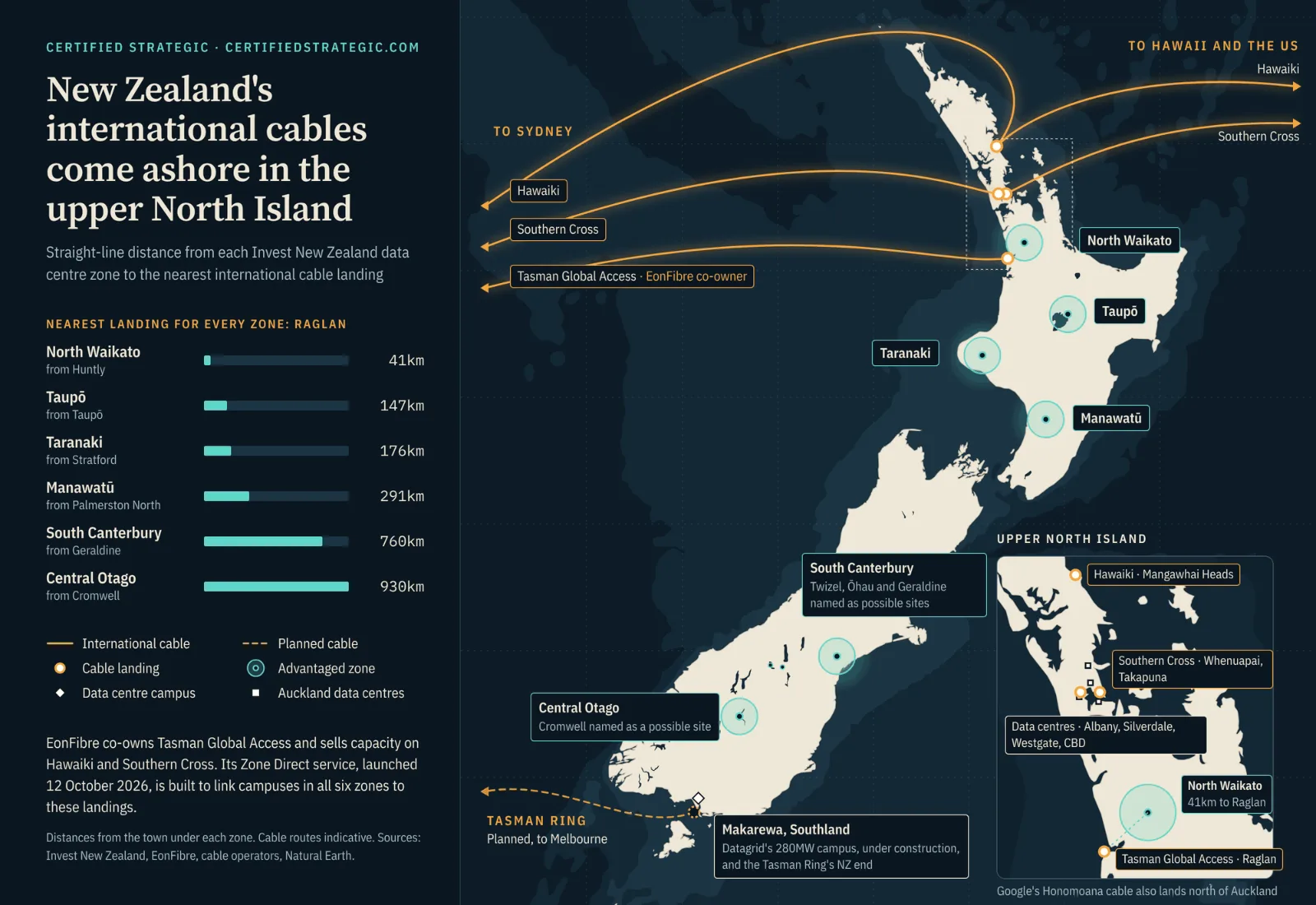
Chief executive Richard Mooney said EonFibre can "deliver the service end to end, from the campus to Sydney or the United States." The Sydney leg is Tasman Global Access, the 2,288km cable Spark, Telstra and Vodafone, now One New Zealand, built and put into service in March 2017. It runs from Ngarunui Beach in Raglan to Narrabeen Beach in Sydney. EonFibre also sells capacity on Hawaiki and Southern Cross, which both link New Zealand with Sydney.
New Zealand has a gigawatt of data centre connection projects with Transpower
New Zealand's colocation market runs to about 208MW. Datagrid has begun construction on its Makarewa campus near Invercargill, whose first stage is designed for 280MW.
BCG's August 2026 report puts New Zealand's potential at more than 1GW of new compute capacity over five years and, citing grid operator Transpower, reports 11 data centre connection projects at assessment or design, totalling 1GW. New Zealand votes on 7 November 2026, and National and Labour both ask data centres to bring their own power.
Invest New Zealand chose the six zones for lead time to power, access to high-voltage infrastructure and backhaul fibre, the domestic links into the national network. Zone Direct adds route options and latency to Sydney and the US for each zone, alongside the power case Invest New Zealand makes for them. Mooney said EonFibre wants to be involved "while sites are still being chosen, to enable efficiencies across the development and operational process."
Two more trans-Tasman cables are due by 2029
Southern Cross has contracted Alcatel Submarine Networks and OMS Group for SX Tasman Express, a Sydney to Auckland cable with 16 fibre pairs and 400Tbps of added capacity, scheduled for completion in 2028. Datagrid's Tasman Ring will run from Invercargill to Torquay, with backhaul to Melbourne, and targets service in 2029. Both add to the roughly 15 subsea cables that carry almost all of Australia's international internet traffic.
Telstra builds Aura ahead of demand on the Australian side
EonFibre is One New Zealand's fibre business, and Telstra has taken a similar route in Australia. Telstra Digital Infrastructure has built about 9,000km of a planned 14,000km Aura Network, and Microsoft and Google have secured capacity on it, according to iTWire. Chief executive Steven Worrall says its role is to put the infrastructure in place ahead of demand, and Telstra also holds long-term network contracts with AWS and Firmus. Where Aura is new fibre, Zone Direct packages EonFibre's existing national routes and cable capacity for zones where campuses are still being planned.
What to watch
The first Zone Direct customer. A named developer would show which of the six zones moves first and how much capacity it will need into Sydney.
SX Tasman Express. Completion in 2028 would add another Sydney to Auckland system.
The southern route. Datagrid's Tasman Ring would give Melbourne its own cable to New Zealand's South Island.