The argument: the capacity is there, the visibility is not
Neara’s software builds an engineering-grade model of an entire power network and runs physics simulations across it. On that basis the company estimates up to 10GW of latent capacity already sits unused in NSW’s distribution network. That figure cuts against the prevailing read of the grid, where a connection queue measured in gigawatts and rising power bills frame the problem as one of raw scarcity.
That figure is the spine of a piece Gooch published on 4 June 2026, arguing that the answer to Australia’s data centre problem is “right in front of us”. The prevailing assumption, he writes, is that the only path to more capacity runs through new transmission. Neara’s case is that a large share of the capacity developers are queuing for already exists, in networks that have never been measured precisely enough to release it.
The framing matters because the binding constraint on Australian data centres is increasingly the connection queue rather than the power behind it. As we set out in our read of the Climate Council’s Clouded Future report, Transgrid has fielded data centre connection enquiries for more than 14GW, close to the entire NSW peak winter load, with a large share judged speculative. AEMO’s adviser Oxford Economics put the same dynamic in a ratio we covered in our analysis of AEMO’s 5.4GW pipeline: six of every seven requested megawatts never materialise. NSW’s own Investment Delivery Authority drew the line in dollars, endorsing 15 projects worth A$51.9 billion while setting aside roughly A$40.7 billion of proposals as premature or speculative.
Neara's technology and customers
Neara builds what it calls a physics-enabled digital twin of a network. Machine learning constructs a 3D model of every tower, pole, line and substation, plus the vegetation and terrain around them, and physics-based simulation then tests how that network behaves under load, weather and new connections. Utilities use it to find where assets are at risk, where maintenance should be prioritised, and where spare capacity is hiding.
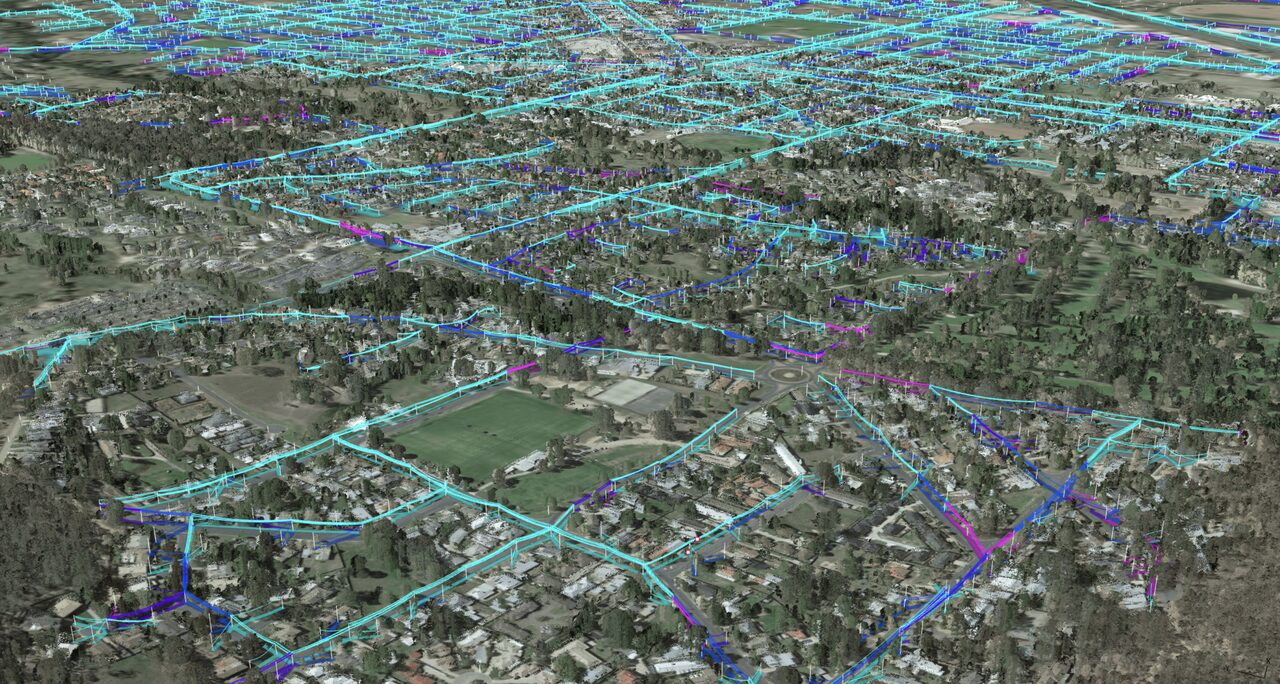
A Neara digital twin of an urban distribution network, with every pole, line and substation modelled in 3D. Image: Neara.
The company was founded in Sydney by Daniel Danilatos, its chief executive, with Jack Curtis as co-founder and chief commercial officer. Its A$90 million Series D, led by global growth investor TCV, closed in February 2026 at a A$1.1 billion valuation and made Neara one of the few Australian software companies to reach unicorn status. Neara says its platform is now used by close to 90% of Australian network utilities, among them Essential Energy, Endeavour Energy, Ausgrid, AusNet, Powercor and SA Power Networks, alongside Southern California Edison and CenterPoint Energy in the United States and ESB Networks, Scottish Power and HEDNO across Europe.
For data centres, the relevant capability is locating where a utility’s network has spare capacity a developer could connect into.
Q&A with Tom Gooch, Neara’s Vice President of Commercial
What follows is an edited transcript of our exclusive Q&A. Tom Gooch’s answers appear in quotes; our independent analysis follows.
Could you give us a quick description of what Neara does?
“Neara is a physics-enabled digital twin for critical infrastructure networks. We use machine learning to build an engineering-grade 3D model of an entire network, every tower, pole, line and substation, plus the vegetation and terrain around them, and then run physics-based simulations to solve complex challenges. We let a utility see, with precision and at scale, where their network has spare capacity, where it’s at risk, and what targeted investments would generate material improvements.”
Your recent piece said the answer to Australia’s data centre problem is “right in front of us.” What did you mean?
“The prevailing narrative is that we’re out of capacity, so the only path forward is through new transmission infrastructure. That framing skips a step. There’s significant latent capacity already sitting in our existing networks. Our modelling estimates up to 10GW in NSW’s distribution network alone, more than the entire output of the Central-West Orana REZ.”
“The technology to find and unlock this capacity already exists and is working today. We have performed this analysis for some of our customers. So the answer isn’t another decade-long megaproject. It’s collaboration and data transparency between developers, networks and governments to use capacity we already have.”
--
CS Analysis: Neara’s February 2026 funding coverage put roughly 10GW of unused capacity across Australia’s distribution networks, drawing on analysis from about three years earlier; Gooch now places that 10GW in NSW alone. Latent headroom in the distribution network does not directly connect a 350MW hyperscale campus, which joins at transmission, so the case is strongest for mid-scale facilities and the second tier of operators and weaker for the gigawatt precincts driving the headline pipeline.
If the capacity is already there, what is actually holding things up?
“The network needs to have a mature digital model of their assets in Neara and be willing to reconsider the capacity of their network. Some networks in Australia are just starting their journey on Neara. There also need to be developers willing to innovate in the way they connect to the network. Success requires both. This is changing rapidly, but it does take time for everyone to coordinate.”
--
CS Analysis: Reconsidering a network’s capacity is partly an engineering trade rather than free headroom. Conservative thermal ratings and contingency margins exist for reliability and safety. Higher-fidelity modelling can show that some of that margin is recoverable, quantifying the trade-off rather than removing it. How much of the 10GW becomes usable in practice then depends on each network's tolerance for operating closer to its limits.
Neara is Australian but works with networks all over the world. What are other countries getting right that we could learn from?
“Overseas networks are already using this technology to do the analysis upstream, building prioritised shortlists of viable sites and sharing them with developers before the flood of applications arrives. The pay-off is improved enquiries that have already factored in the network’s view of capacity and suitability. It isn’t a different or more advanced technology than what we have here. It’s a willingness to share data and coordinate earlier in the process.”
You talk about developers, networks and governments sharing information instead of working in the dark. What does it look like when that goes well?
“Networks know where capacity lies dormant, developers know what is available at the click of a button, and regulators and parliament know what approvals make sense. When that information sits in one shared view instead of three or four silos, the siting work happens upstream.”
“Networks can prioritise a shortlist of genuinely viable sites and put it in front of developers, so they receive fewer but far higher-quality applications that already account for the network’s own view of capacity. That frees senior engineers to deploy capital on real upgrades rather than triaging speculative enquiries, gives developers a dramatically compressed connection timeline, and reduces friction for communities, who often end up with better local grid reliability as ageing infrastructure gets upgraded in the process.”
For our readers, the operators, investors and people building this industry, what is the one thing you would want them to take away?
“This arrangement could be deployed within months on certain networks in Australia. We don’t have to wait for a deus-ex-machina to solve this problem for us. The technology is here. We just need to apply it.”
What this means for operators and investors
For developers, the practical signal is that the network a project connects to matters as much as the site itself. A data centre proposed against a utility that has matured its model in Neara, and is willing to publish a view of where capacity sits, faces a different connection timeline than one filed blind into the queue. That is a due-diligence question worth asking before land is committed. The grid connection, not the headline megawatt number, is the binding gate, the constraint the NSW data centre consultation paper and its five planning principles are written to address.
The shared-view model Gooch describes is also close to what the industry is already inching toward. Our interactive Sydney and Melbourne maps overlay the data centre pipeline against grid capacity and substations in a single picture, the same consolidation of three siloed views Neara is selling to networks. The open question through the second half of 2026 is which Australian distribution networks move from starting their digital model to publishing a capacity view developers can act on, and whether the NSW Legislative Council inquiry, reporting 30 September, picks up data transparency as a lever rather than treating new build as the only answer.
Key takeaways
Neara, the Sydney-founded grid digital-twin company valued at A$1.1 billion after a A$90 million Series D in February 2026, models spare capacity in existing power networks.
Neara’s modelling estimates up to 10GW of latent capacity in NSW’s distribution network alone, a single-vendor figure Certified Strategic treats as a claim to test rather than an audited measurement.
The bottleneck Tom Gooch describes is coordination and visibility between developers, networks and governments, not raw scarcity.
The fix is strongest for mid-scale facilities, because distribution-layer headroom does not directly connect transmission-scale hyperscale campuses.
Gooch says a handful of mature Australian networks could act within months, while broader coordination plays out over years.