At a glance
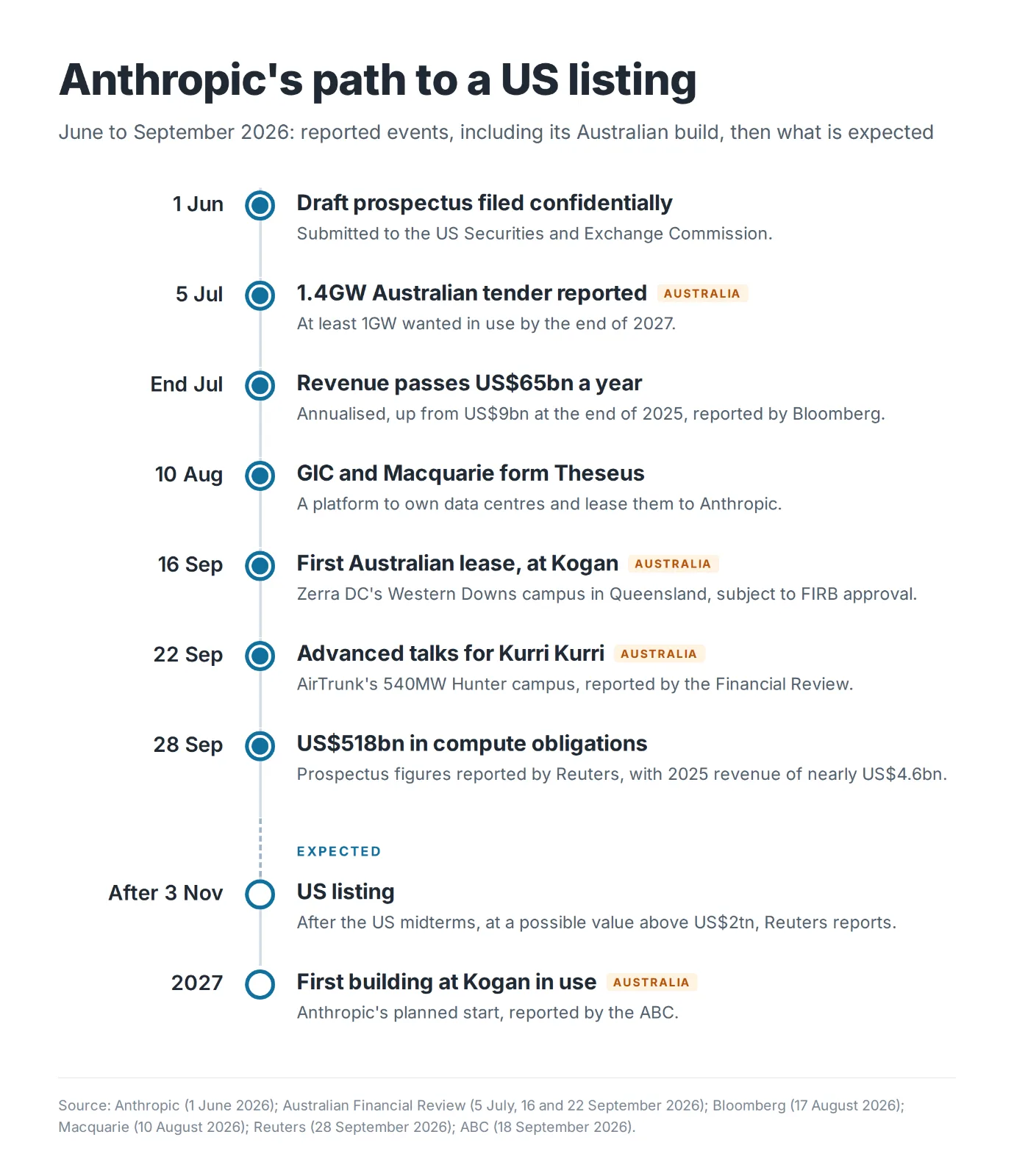
Anthropic's IPO prospectus shows US$518 billion of cloud, computing and infrastructure obligations in coming years, Reuters reported on 28 September 2026.
At NVIDIA chief Jensen Huang's estimate of US$50 billion to US$60 billion to build a gigawatt, that sum would build 8.6GW to 10.4GW of AI data centres, about six times Australia's operating fleet.
Revenue in 2026 was running at more than US$65 billion a year by the end of July, Bloomberg reported, up from US$9 billion at the end of 2025.
Compute spending tripled in 2025 while revenue grew 12-fold, cutting compute from about US$6.40 per dollar of revenue in 2024 to about US$1.60.
Kogan in Queensland holds Anthropic's first Australian lease, due to start in 2027, against a tender for at least 1.4GW of Australian capacity.
Anthropic plans to spend US$518 billion on cloud, computing and infrastructure obligations in coming years, according to its IPO prospectus, Reuters reported on 28 September 2026. The prospectus reports revenue of nearly US$4.6 billion for 2025, and by the end of July 2026 the Claude developer's revenue was running at more than US$65 billion a year, Bloomberg reported. Anthropic confidentially submitted a draft registration statement to the US Securities and Exchange Commission on 1 June 2026, and Reuters has reported the listing is likely to follow the US midterm elections in November.
In September Anthropic signed its first Australian data centre lease, at Singapore developer Zerra DC's Western Downs Digital Park at Kogan, near Dalby in southern Queensland. At NVIDIA chief executive Jensen Huang's estimate of US$50 billion to US$60 billion a gigawatt, US$518 billion would build 8.6GW to 10.4GW of AI data centres, about six times the 1.6GW operating across Australia, and Australia is competing with the United States, the United Kingdom and the Nordics for Anthropic's leases.
US$518bn would build 9 to 10GW at Huang's cost estimate
Huang told a G20 ministerial meeting in September that it costs between US$50 billion and US$60 billion to build a 1-gigawatt facility. Divided by that range, US$518 billion comes to between 8.6GW and 10.4GW of AI data centre capacity. Australia's operating fleet is 1.6GW, according to a report by the consultancy Mandala for Data Centres Australia published on 25 August 2026.
The range is a ceiling on scale rather than a count of capacity. The obligations are payments to cloud providers and landlords spread over years, so the same capacity is paid for more than once, and the prices carry the providers' margins. The dollars secure less capacity than they would build.
For comparison, Amazon raised its 2026 capital spending guidance to about US$220 billion on 30 July, the largest budget of the four US hyperscalers, which together plan US$720 billion to US$745 billion in 2026. Those are single-year budgets, and Anthropic's US$518 billion runs over several years. OpenAI told investors in February 2026 it expects compute spending of around US$600 billion through 2030, CNBC reported, after chief executive Sam Altman cited commitments of about US$1.4 trillion over eight years in November 2025.
Anthropic's announced deals account for a fraction of the total. It committed to buy US$30 billion of Microsoft Azure compute in November 2025 and to contract up to 1GW of further capacity on NVIDIA systems, and in the same month pledged US$50 billion for US data centres built by the AI cloud company Fluidstack. Google's October 2025 deal, worth "tens of billions of dollars", gives Anthropic up to one million of Google's TPU chips and "well over a gigawatt of capacity coming online in 2026". Amazon and Google, two of the hyperscalers in Australia, are also investors in Anthropic.
Revenue ran at US$65bn a year by July 2026
Anthropic's annualised revenue passed US$65 billion at the end of July 2026, up from US$9 billion at the end of 2025 and US$47 billion in May, Bloomberg reported on 17 August. As recently as early 2025, Anthropic expected revenue of just US$12 billion in 2027, the Financial Review reported on 28 September. Investors expected US$100 billion to US$120 billion by the end of 2026, according to the Financial Times. At the July run rate of US$65 billion, US$518 billion is about eight years of revenue. At the top of the year-end range it is a little over four.
The prospectus figures Reuters reported are for 2025. Anthropic spent US$7.33 billion on compute and infrastructure that year, Reuters reports, three times its 2024 bill and more than half of US$12.65 billion in total operating expenses, while revenue grew 12-fold to nearly US$4.6 billion. On those multiples, 2024 compute spending comes to about US$2.4 billion against revenue of about US$380 million, or about US$6.40 of compute for every dollar earned. In 2025 the figure was about US$1.60.
The operating loss widened to US$8.06 billion in 2025, from US$2.98 billion. The reported net loss of about US$42 billion includes a charge of roughly US$34 billion that Reuters says reflects a rise in the estimated value of financing that could later turn into Anthropic shares. Anthropic held US$20.28 billion in cash, cash equivalents and short-term investments at 31 December 2025. Nearly a quarter of 2025 revenue came from two customers, and the prospectus warns that many of its largest clients are not locked into long-term contracts.
Reuters reports the listing could value Anthropic at more than US$2 trillion, more than double its own estimate of US$965 billion in May and above the US$1.77 trillion SpaceX was valued at when it listed in June.
Australia holds one signed lease and a 1.4GW tender
Anthropic would use Kogan as an AI data centre running Claude for users rather than training models, the ABC reported on 16 September, and the lease is subject to Foreign Investment Review Board approval. The company plans to start using the first building in 2027 and to seek long-term power purchase agreements with renewable energy suppliers, the ABC reported two days later. The four buildings in Zerra's application to Western Downs Regional Council total 1.44GW, on a regional site well outside the cities where most data centres in Australia are built.
On 22 September the Financial Review reported Anthropic in advanced talks to anchor AirTrunk's 540MW Kurri Kurri campus in the NSW Hunter, with nothing yet formalised, and people briefed on its plans said at least four Australian leases were due to be announced in the following weeks. Both follow a July tender for at least 1.4GW of Australian capacity, which asked for at least 1GW in use by the end of 2027 and scored bidders first on their ability to raise capital.
The company behind a 1.4GW Australian tender has US$518 billion of compute obligations, revenue running at more than US$65 billion a year and held US$20 billion of cash at the end of 2025. The figures point to four consequences for Australia.
The tenant is large enough to finance against. Developers bidding for Anthropic's capacity, including AirTrunk, can put those figures to lenders.
The equity has to come from somewhere. Anthropic leases rather than owns, and in the United States GIC and Macquarie Asset Management formed Theseus Infrastructure to own the buildings and lease them to it. A 1.4GW Australian programme will need equity partners of that kind, and the listing would add public shareholders to the capital behind the tenant.
The power has to be new. Anthropic has told Parliament's AI committee that data centres it leases in Australia will add new generation and pay the full cost of their grid connections, preferring long-term power purchase agreements with wind, solar and storage projects. Each Australian lease brings offtake for generation developers.
Australia is competing for its share. Anthropic's US$50 billion programme with Fluidstack is building sites in Texas and New York, and the company is sounding out 20MW to 30MW deals in the United Kingdom and the Nordics. Kogan has to clear FIRB and council to start in 2027. OpenAI confidentially filed for its own US listing in June, and Altman has since paused it until 2027, calling an earlier float "ill-advised", the Financial Review reported. Its Sydney arrangement with NEXTDC for the S7 campus at Eastern Creek was a memorandum of understanding as at 1 September 2026.
Seven co-founders will control 50.1 per cent of the vote
Anthropic will list as a public benefit corporation under Delaware law, which lets its board weigh investors' interests against wider public benefit, Reuters reported in a separate exclusive. A Founder LLC made up initially of seven co-founders, including chief executive Dario Amodei and president Daniela Amodei, will hold Class F stock carrying 50.1 per cent of the total voting power on key corporate matters, including the election of some board directors. The arrangement begins to phase out, over a transition period, once two or fewer co-founders or their successors remain. The co-founders have pledged 80 per cent of their personal Anthropic equity to charitable causes, and Dario Amodei received nearly US$18 million in 2025, largely through stock and option awards.
About 80 of the 261 pages in the prospectus's main body are risk factors, Reuters reported in a third exclusive, including a warning that advanced AI could pose "catastrophic or existential risks to humanity". Earlier in September Anthropic said about 6 per cent of the computing power it used for AI research in a sample week in July went to safety work. It released its Opus 5.5 model in September, and a US judge in August blocked the Pentagon's temporary blacklisting of the company.
What to watch
The public filing. Anthropic's registration statement, known as an S-1, becomes public when it files openly with the SEC, and will show when the US$518 billion falls due and how much capacity it secures. It is also likely to carry Anthropic's first reported revenue figures for 2026.
The Australian leases. A signed Kurri Kurri agreement, a capacity figure for Kogan, and the further leases the Financial Review reported on 22 September.
The Kogan approvals. The FIRB decision on the lease and Western Downs Regional Council's assessment of Zerra's application, both ahead of a 2027 start.
An Australian AI listing. Firmus is preparing an ASX float reported at up to A$7 billion, a local listed route into AI factories.