At a glance
Telstra put a new AI Impact measure worth 5 per cent on its FY27 bonus scorecard, reaching target when eight of 11 AI initiatives hit their own targets.
The 11 initiatives cover data platforms and technology foundations as well as the customer-facing applications built on them.
Customer engagement accounts for 56 per cent of Telstra's AI processing, ahead of software development on 24 per cent and network on 12 per cent.
Executive pay consultancy Pearl Meyer found 58 of about 2,500 United States companies put AI into an executive bonus plan in 2026.
Telstra scores the measure for the first time in its FY27 remuneration report, due around August 2027, the first check on whether the initiatives are delivered.
Eight of 11 AI initiatives set Telstra's FY27 bonus target
Telstra lodged its 2026 annual report on 13 August 2026. The remuneration report inside it adds a measure called AI Impact to the short-term incentive scorecard, the annual scorecard senior staff are paid against, for the 2027 financial year. It carries 5 per cent of the scorecard and rests on a portfolio of 11 AI initiatives. The Australian Financial Review reported on 16 August 2026 that the change makes Telstra one of the first major Australian companies to link executive pay to the value artificial intelligence adds.
Telstra says the 11 initiatives cover "both AI transformation use cases and the technology foundations needed to scale AI safely, responsibly and efficiently". The 11 take in data platforms, migration work and governance tooling as well as customer-facing applications. At the same results Telstra put a nine-year cash payback on the Aura fibre network.
Executives need four of the 11 initiatives to earn anything from the measure, eight to earn it at target, and all 11 for the maximum. AI Impact carries the same 5 per cent weighting as the sustainability measure.
Measure | FY26 weighting | FY27 weighting |
|---|---|---|
Cash earnings before interest and tax | 20% | 20% |
Operating leverage | 20% | 20% |
Underlying return on invested capital | 20% | 20% |
Episode Net Promoter Score | 10% | 5% |
Strategic Net Promoter Score | 10% | 10% |
RepTrak reputation score | 10% | 10% |
Sustainability | 5% | 5% |
People engagement | 5% | 5% |
AI Impact | none | 5% |
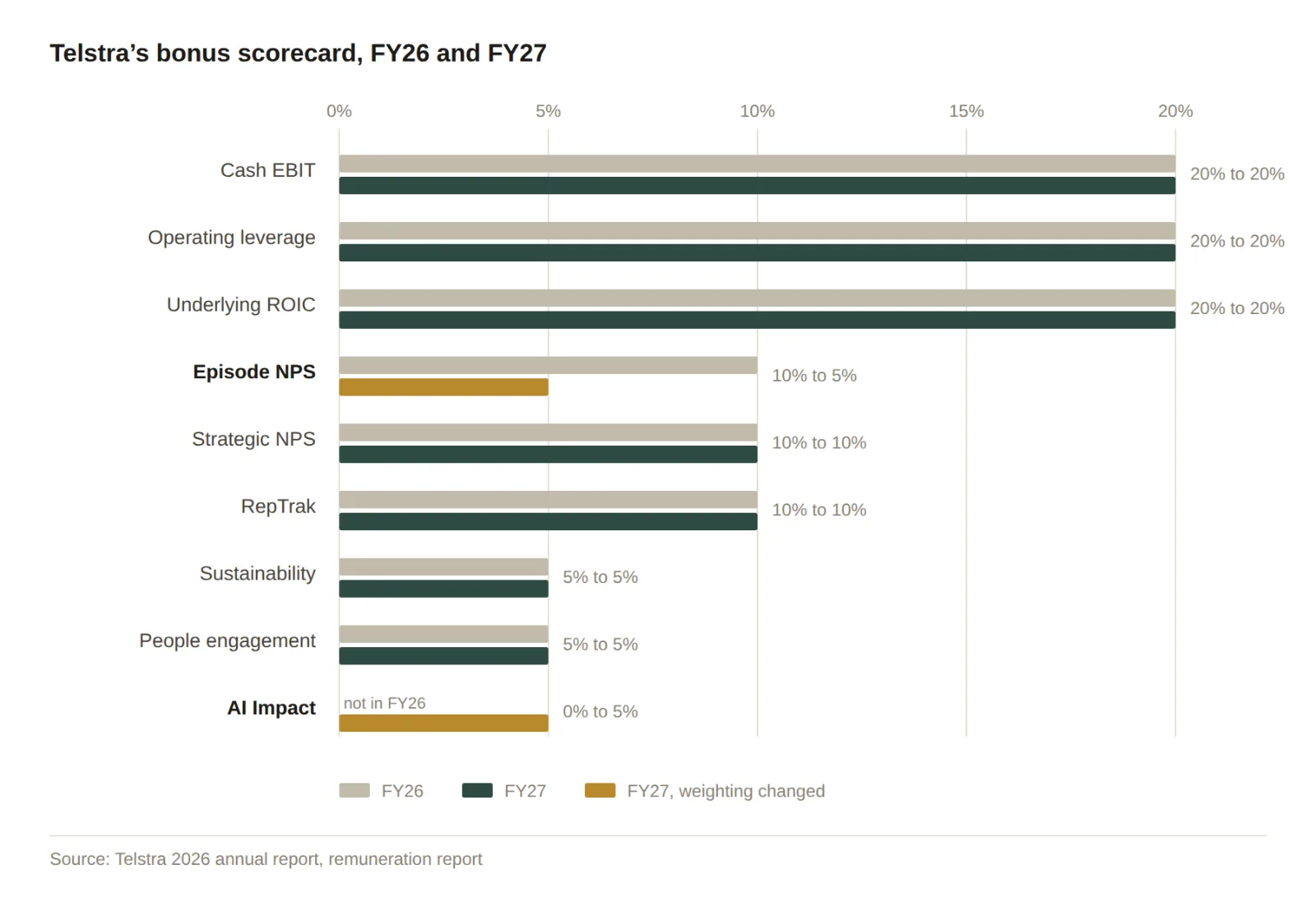
Source: Telstra 2026 annual report, remuneration report. Episode Net Promoter Score measures satisfaction with a single interaction; Strategic Net Promoter Score measures overall sentiment toward the brand. RepTrak is a reputation measurement firm.
The measure applies beyond the executive team. Telstra says the scorecard "is relevant for variable remuneration outcomes across the majority of the company". Telstra describes AI Impact as "the only change from FY26", though one existing weighting also moved: Episode Net Promoter Score, one of the two Net Promoter Score measures, halved to 5 per cent.
Customer engagement takes 56 per cent of Telstra's AI use
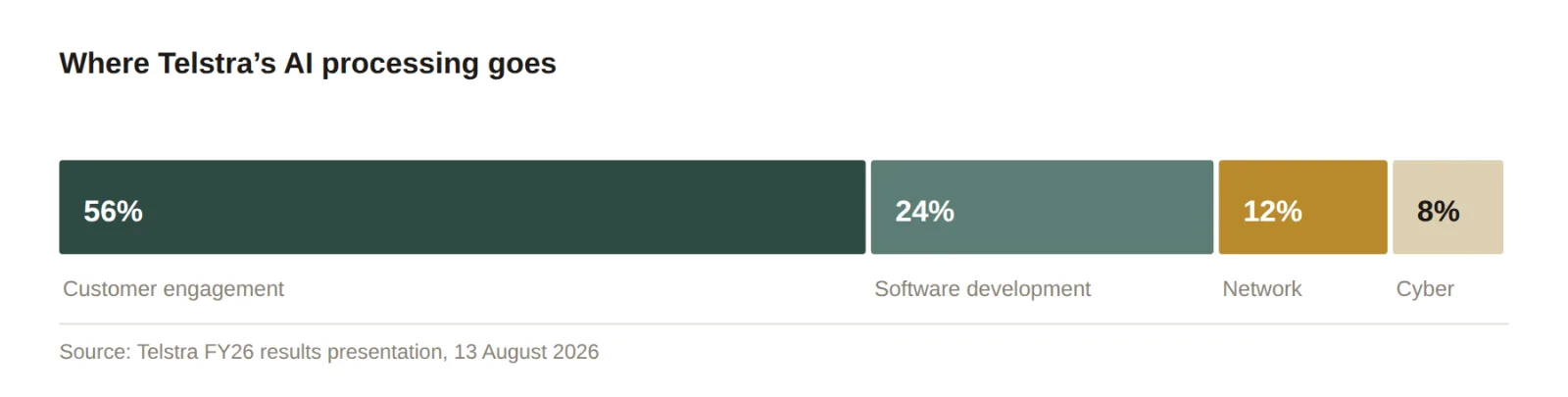
Customer engagement took 56 per cent of Telstra's token consumption, group executive for network, product and technology Kim Krogh Andersen told analysts at the FY26 results on 13 August 2026. Tokens are the units of AI processing a company is billed for. That 56 per cent covers Telstra.com, the My Telstra app and employee-facing use. Software development took 24 per cent, network 12 per cent and cyber 8 per cent.
Krogh Andersen had raised AI running costs six months earlier. He told the technology publication iTnews on 19 February 2026: "This has been very critical for software but it's [now] even more critical for AI. We believe that, if we don't get that foundation right, we will actually see the run cost of AI outperform the benefits of AI." Chief financial officer Michael Ackland put the same point to analysts at those half-year results, flagging the risk that software licensing, cloud cost and payments to AI providers "offset your benefits".
Telstra built a company-wide control plane, a single system for monitoring and managing its AI models. In April 2026 it called the platform "the next frontier" and said it was "currently building and testing the control plane in our non-production environment". Chief executive Vicki Brady told the FY26 results it had been implemented, giving "a central view of how AI is being used across the business to help us control costs, monitor adoption, optimise performance, manage risks". Telstra cut its data platform count by 15 during FY26, to 17, against an eventual target of three.
Telstra's enterprise-wide AI role reports to the general counsel
Dayle Stevens holds a newly created enterprise-wide AI role at Telstra, reporting to group general counsel Lyndall Stoyles, who also holds corporate affairs, risk and legal. The Data & AI function reports into Krogh Andersen's technology group instead, where Joanna Knox was named to the Data & AI executive role with an expanded remit. Both changes were reported on 2 June 2026.
Telstra's AI Risk Oversight Council independently reviews higher-impact AI systems before deployment, its Data & AI Academy has trained more than 20,000 employees, and an AI register logs every system, built in-house or by a partner. Telstra and Accenture opened a Silicon Valley hub in May 2025 to incubate priority projects.
42 per cent of Australian organisations have a chief AI officer
Technology services group Datacom commissioned the research house Omdia to survey 507 Australian IT and business leaders in April and May 2026, and published the findings as a white paper, The emerging role of the chief AI officer in Australia. It found 42 per cent of organisations already have a chief AI officer or equivalent, and 47 per cent named a clear mandate from the chief executive or the executive team as the condition that decides whether the role delivers. Forty-three per cent of respondents said the role should sit below the executive table.
Datacom's director of artificial intelligence, Lou Compagnone, wrote the research and gave her own view of the role in an interview with Certified Strategic published on 19 August 2026. She said the title "almost doesn't matter", so long as the person holds "a seat at the executive table and they can create influence across the organisation", and that the role "has to be [about] transformation and not just sit within tech". She describes it as "a very horizontal role" spanning strategy, governance, technology and people, and said: "If it's really stuck in just group IT, they're going to be thinking about it just from a technology perspective, and not actually all the adoption that needs to wrap around it." Her fuller case is in chief AI officers need authority, not just a title.
Pearl Meyer counts 58 US companies with AI in incentive plans
Pearl Meyer reviewed about 2,500 annual pay filings from listed United States companies in 2026. It found 58 of them, 2 per cent, had put AI into an executive bonus plan. Twelve per cent of the 58 used a specific AI measure. The rest embedded AI in broader goals or assessed it qualitatively. Willis Towers Watson, a global advisory firm, looked at 2025 filings and found 5.9 per cent of S&P 500 companies disclosed any AI-related measure. It says boards should ask whether AI goals are "measurable, auditable and appropriate to disclose".
Deutsche Telekom, the German telecommunications group, discloses AI in board pay on a different basis. Its 2025 pay report lists data and AI as a personal goal for several board members, left to the supervisory board's judgement at year end, with no separate weighting or threshold disclosed for the AI goal.
The Australian Bureau of Statistics reported on 25 June 2026 that 12 per cent of Australian businesses used AI in 2024-25, rising to 35 per cent among large businesses and 38 per cent in information, media and telecommunications. The Productivity Commission's December 2025 inquiry report notes that "investments required for AI adoption may be challenging to measure". It cites research by Jobs and Skills Australia, the Australian Government's labour market agency, finding that 57 per cent of the ASX 200 companies that mentioned technology investments in their 2024 annual reports mentioned AI.
What to watch
What the FY27 report has to show. The 2026 remuneration report gives the number of initiatives and the ground they cover without naming them individually. The FY27 report, due around August 2027, discloses the outcome against the eight-of-11 target.
What the measure now sits over. Telstra and Accenture announced a seven-year data and AI joint venture on 15 January 2025, which the business news service Capital Brief reported at about A$700 million. The Silicon Valley hub runs through it, and the venture's remit covers modernising Telstra's data and AI platforms.
What enterprise buyers ask for. Compagnone told Certified Strategic that "storage sovereignty means very little without inference sovereignty", pointing to "the difference between where data is stored and where it is processed" and to demand for "models running on Australian-controlled infrastructure so both the data and the compute stay within the sovereign boundary". Asked who decides where an AI workload runs, she said the starting question is what the workload requires, "is it latency, data sensitivity, sovereignty, compliance and so on", and that "this needs to happen when use cases are being defined and prioritised, not after a proof of concept succeeds". Her full answers run in her Q&A on where AI workloads should run. NEXTDC created a sovereignty seat on its executive team in June 2026, and AEMO's connection queue holds 9GW of data centre load.