At a glance
CPP Investments, which manages Canada's national pension fund, paid US$1.3 billion for about 51% of Nordic data centre platform atNorth on 2 September 2026.
Commonwealth Superannuation Corporation bought 48% of Canberra Data Centres in 2016 and holds 12.04% after selling down in 2020 and 2025.
AustralianSuper's two data centre investments are A$2.5 billion in Vantage Data Centers EMEA and A$2.2 billion in DataBank in the United States.
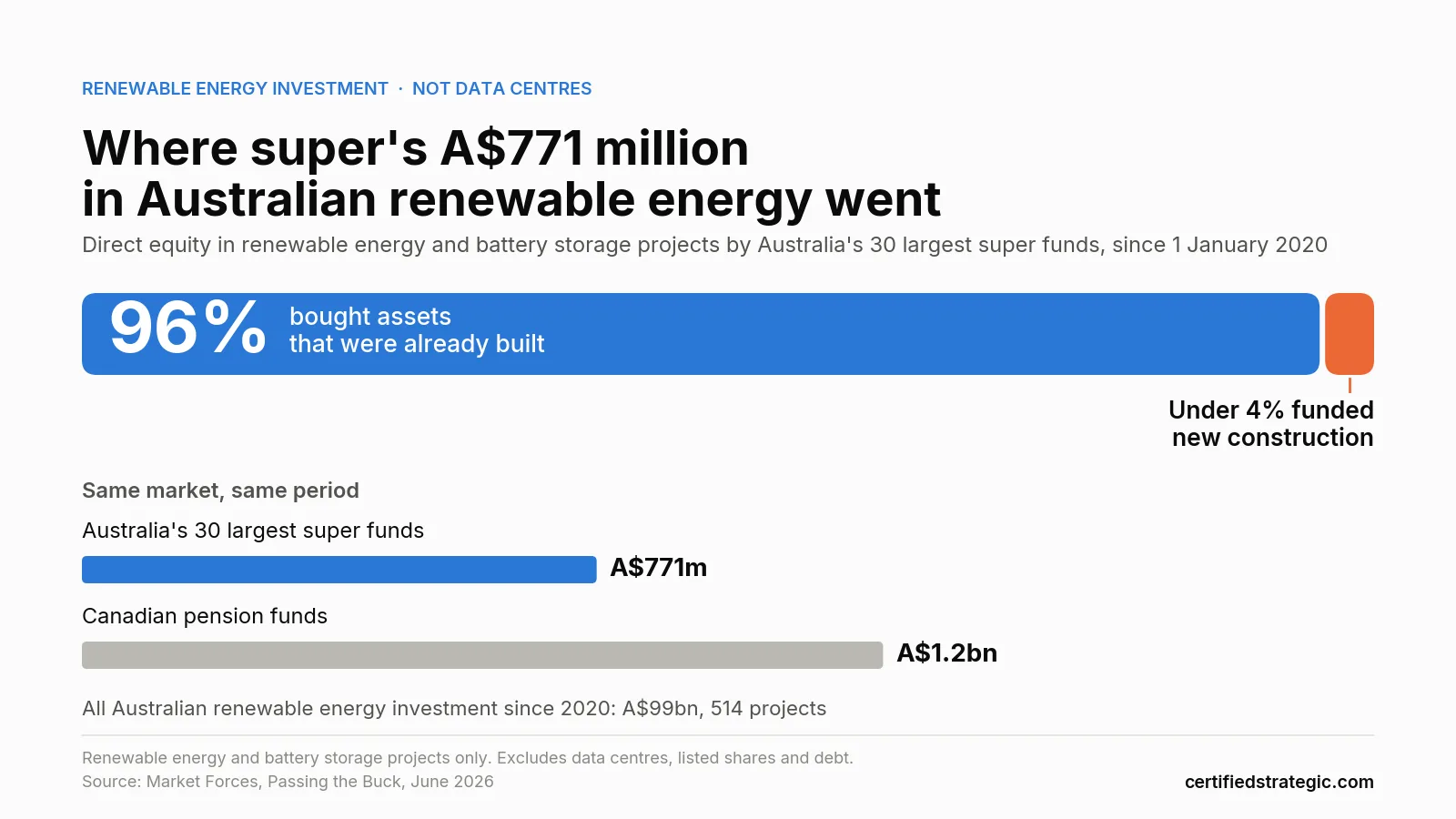
Six of Australia's 30 largest super funds have invested directly in Australian renewable energy projects since 2020, and 96% of that money bought existing assets.
Treasury consulted on the superannuation performance test between 7 May and 19 June 2026, and the Treasurer has named energy among the assets the test discourages.
On 2 September 2026, Canada's public pension fund took control of a data centre platform spanning all five Nordic countries. CPP Investments paid US$1.3 billion for about 51% of atNorth in a US$4 billion transaction. Equinix took about 34%, seller Partners Group kept about 10% and management stayed invested, and European and Canadian lenders underwrote a US$4.1 billion debt package to fund the purchase and the build-out. atNorth runs eight operating data centres and is developing new sites in Sweden, Finland, Norway and Denmark.
CPP Investments manages retirement savings for Canadian workers against obligations that run decades out, and it buys infrastructure to hold it. Alexandre Roussas, chief executive of Pure Core, which develops data centre infrastructure in Europe, put it plainly in a LinkedIn post on the deal: "Pension capital doesn't chase growth stories. It buys duration." In his reading, Nordic data centre platforms are being priced the way pension funds price toll roads and airports.
Australian superannuation funds held A$4.4 trillion at March 2026, and Climate Energy Finance puts the Australian data centre pipeline at A$150 billion by 2030. If Canadian retirement money is taking control of Nordic data centre platforms to hold them, is Australian retirement money doing the same here?
To find out, we mapped the pension and superannuation stakes on the registers of AirTrunk and CDC, the two Australian operators publishing the largest capacity figures, and traced every data centre investment Australian super funds have disclosed. We then checked the same funds' record in Australian renewable energy, where the investment has been counted project by project, and tested whether superannuation regulation stands in the way. Throughout, we separated buying equity in an established operating business from funding a single site through construction.
Australian superannuation has owned data centres since 2016, starting with Canberra Data Centres, and has bought them as established operating platforms, most of them in Europe, the United States and the wider Asia-Pacific. In Australia, CPP Investments holds 12% of AirTrunk. In CDC, the Future Fund holds 34.55%, almost three times the 12.04% held by Commonwealth Superannuation Corporation, and the Future Fund is a sovereign wealth fund that pays no members. Australian renewable energy, a separate investment stream, shows the same preference: 96% of what the largest funds invested directly in projects bought assets that were already built. And no rule keeps super out of Australian data centres, but the government concedes its performance test discourages the long-dated, poorly benchmarked investment that construction needs, and Treasury has consulted on changing it.
The Future Fund holds 34.55% of CDC against CSC's 12.04%
Commonwealth Superannuation Corporation (CSC), which manages the retirement savings of Australian government employees and Defence personnel, took 48% of Canberra Data Centres in May 2016 alongside New Zealand infrastructure investor Infratil, which took a matching 48%.
CSC has sold down twice since, in January 2020 and February 2025, both times mainly to the Future Fund, the Commonwealth's sovereign wealth fund. In the second sale, Infratil also took a small slice under pre-emptive rights, at an equity value of A$13.7 billion for the whole company.
Infratil's filing on that sale puts Infratil on 49.75%, the Future Fund on 34.55% and CSC on 12.04%, with CDC management holding the rest. CSC says it was the first Australian superannuation fund to recognise data centres as critical infrastructure, and puts its return since 2016 at about 43% a year before fees. It says it kept the remaining stake to support the business and its management team. Infratil's most recent independent valuation put CDC's midpoint at A$18.5 billion at 30 June 2026.
Vantage EMEA, DataBank and Switch hold the Australian fund money
AustralianSuper, which describes itself as the country's largest superannuation fund, had more than A$410 billion under management at 31 December 2025. In September 2023 it signed an A$2.5 billion deal with DigitalBridge for a significant minority stake in Vantage Data Centers EMEA, a figure DigitalBridge put at EUR1.5 billion. In October 2024 it agreed to invest A$2.2 billion in DataBank, a United States operator with more than 65 data centres across 27 markets.
Aware Super reached the sector through the same partner, DigitalBridge, putting a reported US$500 million into Nevada hyperscale operator Switch in 2023 and, in January 2026, US$300 million into the Skyline joint venture that indirectly owns Vantage Data Centers APAC. IFM Investors, the manager owned by a group of Australian industry superannuation funds, holds 37.2% of Switch at 30 June 2026, from the US$11 billion take-private it ran with DigitalBridge in December 2022.
Investor and asset | Amount | Date |
|---|---|---|
IFM Investors, Switch Inc (United States) | 37.2% stake at 30 June 2026 | December 2022 |
Aware Super, Switch Inc (United States) | US$500 million (reported) | July 2023 |
AustralianSuper, Vantage Data Centers EMEA | A$2.5 billion (EUR1.5 billion) | September 2023 |
AustralianSuper, DataBank (United States) | A$2.2 billion | October 2024 |
Aware Super, Skyline JV, owner of Vantage Data Centers APAC | US$300 million | January 2026 |
Source: AustralianSuper, Aware Super, DigitalBridge and IFM Investors releases.
Aware Super's digital infrastructure book runs beyond A$6 billion, more than a quarter of the infrastructure portfolio inside a A$210 billion fund, and takes in fibre and telecommunications as well as the two data centre positions. Its head of infrastructure, Mark Hector, says the Asia-Pacific remains underrepresented on data centre capacity per head of population and needs up to 20GW by 2030.
Vantage Data Centers APAC runs assets in Australia, Japan, Taiwan, Malaysia and Hong Kong, so Aware Super's Skyline holding reaches Australian capacity through a platform holding company. Each of the five positions is equity in an operating business with its own development pipeline.
John Pearce, chief investment officer of the A$166 billion UniSuper, explained the fund's preference for operating data centre assets in July 2026: "Getting involved at building a data centre today at a project level, do you really want to own that data centre in seven years' time if you can't flip it?" He named technology obsolescence, power constraints and the prospect of regulatory intervention over blackouts, and said the fund holds listed equity in Goodman and NEXTDC, operators with sites and power already secured.
Six of 30 funds have invested directly in Australian renewable energy
Renewable energy is a separate investment stream from data centres, but it is the stream that will power them, and it is where the same funds' behaviour has been counted project by project, by climate finance campaign group Market Forces, which campaigns for faster divestment from fossil fuels. Its June 2026 analysis covers direct investment by Australia's 30 largest superannuation funds in renewable energy and battery storage since 1 January 2020, drawn from the RenewMap and Green Street Infrastructure project databases. It counts equity in projects, and excludes listed shareholdings and debt.
It found A$99 billion invested across 514 projects, of which the 30 funds accounted for A$771 million, and over 96% of that A$771 million went to acquisitions of existing assets. Six funds made an identified direct investment: Aware Super, Cbus, HESTA, NGS Super, Prime Super and Rest. Market Forces set that against A$1.2 billion from Canadian pension funds in the same market over the same period.
Chalmers says the test discourages investment in energy and housing
No rule stops a superannuation fund from investing in an Australian data centre. The sole purpose test in the Superannuation Industry (Supervision) Act governs why benefits are paid rather than what a fund buys, and the prudential regulator APRA's investment governance standard requires liquidity plans, valuation policies and stress testing without capping any asset class. APRA's own guidance states that infrastructure is acceptable in a diversified portfolio.
The government has conceded that its own performance test shapes where funds put their money. Trustees are measured each year against benchmark indices, and Treasury's consultation paper of 7 May 2026 says the test creates incentives to manage to those indices by minimising tracking error, and discourages investment in assets that are poorly represented in them. Treasurer Jim Chalmers said on 8 May 2026 that the test discourages investment in areas like housing, energy, venture capital and start-ups, and that the government would be improving, modernising and reforming it rather than watering it down or replacing it. The consultation closed on 19 June 2026 and no outcome has been published.
Unlisted infrastructure is benchmarked to the MSCI Australia Quarterly Private Infrastructure Fund Index, which Treasury's paper describes as mainly power, airports and other transport infrastructure with some exposure to renewable energy. The Association of Superannuation Funds of Australia's submission calls the unlisted benchmarks high hurdles for investment, and warns that one of the options in Treasury's paper could weigh on the investment case for "immature asset classes or greenfield developments".
Construction is where the data centre pipeline and the generation behind it both need financing, and the capital that takes construction risk moves when revenue is contracted. Australian generation reaching final investment decision during 2025 came to 2.1GW against 4GW of approvals, and Investor Strategy News reported on 4 September 2026 that bankable long-dated offtake from a creditworthy counterparty has been the scarce input. The national data centre standards agreed by National Cabinet on 26 August 2026 could make hyperscalers that counterparty, depending on how the energy requirement is written.
What to watch
The Treasury outcome, and whether energy carries data centres with it. The paper put four options on the table: adjusting benchmarks for emerging and alternative assets, assessing risk-adjusted returns, reviewing the benchmarks regularly, and extending the test to more products. The Treasurer named energy, housing, venture capital and start-ups when he announced the review, so the question here is whether generation contracted to an AI data centre is treated as energy.
STACK APAC, and whether IFM buys it. Blue Owl Capital's Asia-Pacific data centre platform, which includes three Australian facilities Bloomberg put at 792MW, is in market at a reported US$25 billion to US$30 billion. Bloomberg reported in June 2026 that IFM Investors was among the parties evaluating it, alongside the BlackRock-backed AI Infrastructure Partnership, KKR, Brookfield and DigitalBridge, and Macquarie was later reported to be considering a bid. IFM's decision will show what Australian industry superannuation money will pay for an Australian platform.
The energy requirement, and how it is drafted. The Commonwealth has said it will legislate the national data centre standards in early 2027, and Queensland and the Northern Territory have sought room for state-owned generation to supply data centres. The drafting will settle what counts as new generation and how any exemption for state-owned generators works, and those definitions set what a contracted megawatt hour is worth across the life of a twenty-year asset. That is the number a pension fund prices a construction commitment off, and the number that decides whether Australian retirement money funds the next campus as well as the ones already running.