At a glance
Treasurer Jim Chalmers released the 2026 Intergenerational Report on 21 September 2026, naming AI as one of five transitions shaping the economy to 2065-66.
Treasury writes that in Australia the AI investment boom is "currently most pronounced in physical infrastructure", citing a data centre pipeline worth more than A$150 billion by 2030.
Spending on buildings and structures in the sector that includes data centres reached about A$11.6 billion in 2025-26, nearly double the 2023 level.
A dedicated section on data centres puts their electricity use at an estimated 44TWh, a tenth of grid demand, by 2049-50.
The energy chapter restates that the AI standards will require large data centres to buy new renewable capacity and offer flexibility to the grid.
Treasury names AI one of five transitions to 2065-66
Treasurer Jim Chalmers released the 2026 Intergenerational Report (IGR) on 21 September 2026, Treasury's projection of the Australian economy and budget out to 2065-66. The report adds a new part on five major transitions: artificial intelligence, geopolitical fragmentation, the energy transition, an ageing population, and an industrial base moving further towards services.
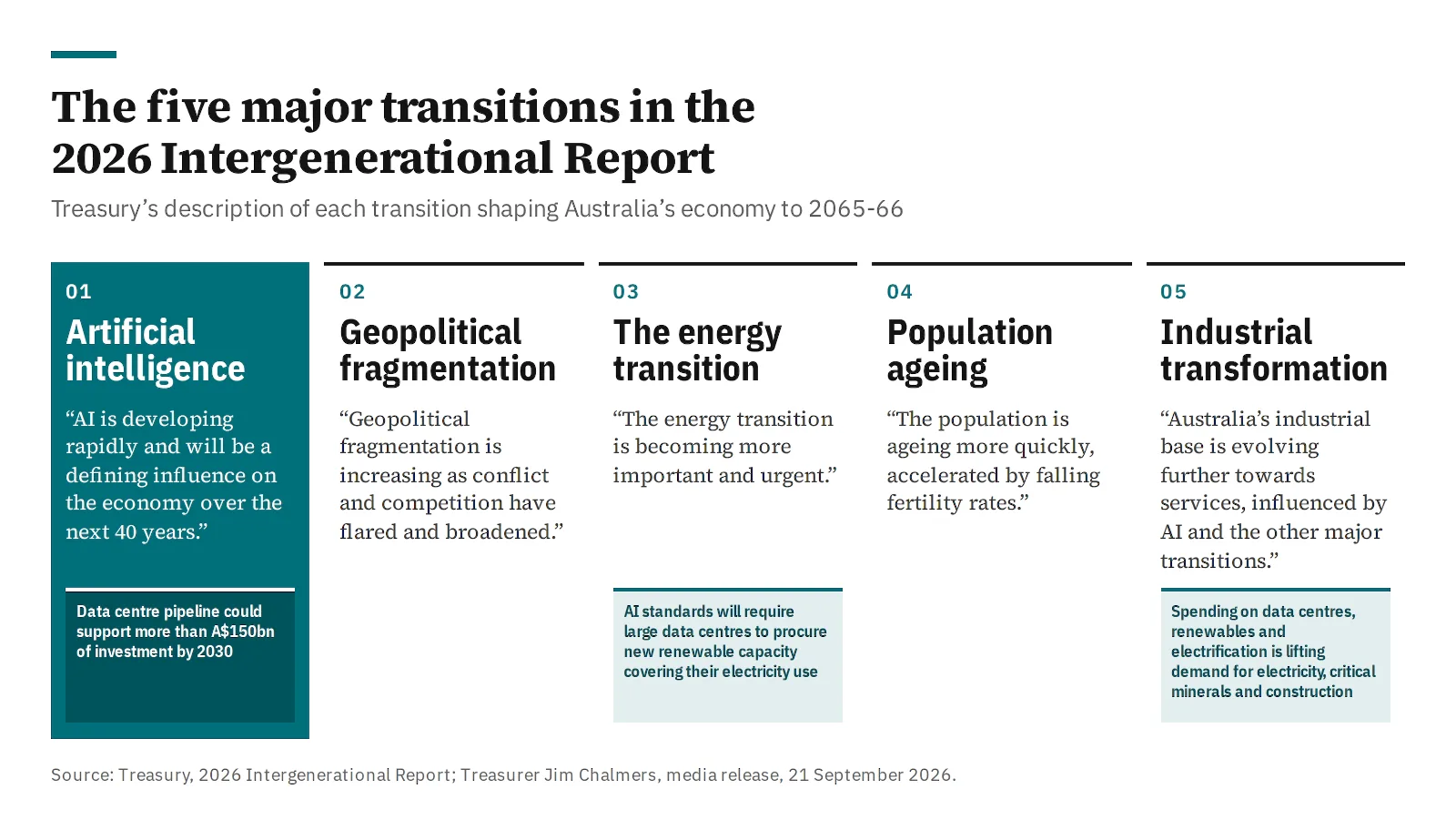
"Advances in AI represent the most dramatic change since the last IGR in 2023," Chalmers said in his media release. The report cites the Productivity Commission's estimate that AI could lift multifactor productivity in Australia by at least 2.3 per cent over 10 years, and says only 10 per cent of Australian businesses have so far adopted AI in ways they would describe as significant.
Treasury writes that "in Australia, the impacts of the AI investment boom are currently most pronounced in physical infrastructure", and gives data centres a dedicated section setting out the electricity, water, land and workers they will need.
Construction spending in the data centre sector has nearly doubled since 2023
New capital expenditure on buildings and structures in the Information Media and Telecommunications sector, which includes data centres and related infrastructure, reached about A$11.6 billion in 2025-26, on Australian Bureau of Statistics figures. Treasury puts that at nearly double the level at the time the last report was released in 2023. As in Treasury advice to the Treasurer released on 31 August 2026, the report expects around one-third of data centre investment to flow directly into domestic economic activity, with much of the equipment imported.
Treasury calls Australia "a leading destination globally for data centre investment" and cites industry estimates, from Commonwealth Bank research, that the pipeline of data centres in Australia could support more than A$150 billion of investment by 2030, equal to 5 per cent of current nominal GDP. It credits Australia's "location, land, energy and water" for making the country an attractive destination for the investment.
Globally, the report puts capital expenditure by the five largest hyperscale cloud providers at A$230 billion in 2023, forecast to reach A$1.131 trillion in 2026. Treasury expects data centre construction to "increase competition for capital and resources and add to demands for skills".
Treasury sets out the electricity, water and workers data centres need
The report's section on data centres, headed "Data centre growth will increase demand for key inputs", draws its figures from the Australian Energy Market Operator (AEMO) and from economics consultancy Mandala.
Input | Figure in the report | Source cited |
|---|---|---|
Electricity | 15TWh by 2029-30 (7% of market demand), 44TWh by 2049-50 (10%) | AEMO 2026 Electricity Statement of Opportunities |
Water | 5.5GL a year (under 0.5% of current use), rising to 17GL by 2030 | Mandala, November 2025 |
Jobs | More than 9,000 supported to date, a further 18,930 through to 2030 | Mandala, August 2026 |
Source: 2026 Intergenerational Report, Treasury, 21 September 2026.
AEMO's 2026 Electricity Statement of Opportunities has data centre consumption growing 32 per cent a year to 15TWh by 2029-30, which the report puts at 7 per cent of National Electricity Market demand. The report estimates growth then slows to 5 per cent a year over the following two decades, reaching 44TWh by 2049-50. Treasury expects the extra demand to support further renewables investment and more efficient use of the grid, and warns that if it is not properly managed it risks placing pressure on generation and network capacity.

Data centre water demand of 5.5 gigalitres a year is less than half a per cent of current water use, on the Mandala figures Treasury cites. Treasury notes that newer cooling technologies can cut water use but often raise energy demand, a trade-off that depends on location, cooling technology and operating practice.
Construction has directly and indirectly supported more than 9,000 data centre jobs to date, on Mandala's estimate. The report also says large facilities need land with access to transmission, fibre, transport and cooling infrastructure, and that planning with the states and territories is "essential" for construction to contribute to regional infrastructure, local workforces and industry.
The energy chapter restates the AI standards
The report names the increase in projected energy demand from data centres as "a key development since the publication of the Government's Net Zero Plan". It notes the Australian Energy Market Commission (AEMC), which writes the national electricity rules, is considering rule changes on how the additional network costs of new data centre demand are recovered.
The report says the AI standards the government announced on 15 July 2026 will require large data centres to "procure new renewable electricity capacity that covers their electricity use" and to contribute flexibility services alongside new generation and firming capacity. Treasury modelling cited in the chapter finds industrial demand flexibility could cut projected wholesale electricity prices by around 20 per cent by 2050, relative to its baseline.
The AI chapter says the government is working with the states and territories to set minimum requirements for large AI data centres on energy, water and location. AI training infrastructure would face additional expectations on national security, safety and support for domestic skills and research. First ministers agreed at National Cabinet on 26 August 2026 to develop the mandatory standards and legislate in early 2027. The report also records the memoranda of understanding the government signed with Anthropic and Microsoft in April 2026.
What to watch
Legislation for the AI standards in early 2027, the timetable first ministers agreed on 26 August 2026, which will set the renewable supply and flexibility requirements the report describes.
The AEMC's decision on network costs for data centres, which the report ties to how the extra load affects other electricity customers.
AEMO's 2027 Electricity Statement of Opportunities, the next update to the 15TWh forecast the report relies on.