At a glance
European data centre supply is set to reach 13GW by the end of 2026, with colocation at 8.7GW and hyperscaler self-build at 4.3GW.
CBRE recorded 685MW of new supply in the June quarter, almost treble the March quarter, and 433MW of it went outside Frankfurt, London, Amsterdam, Paris and Dublin.
Take-up held at 260MW, and markets other than those five accounted for 55 per cent of Continental European demand.
Signings for AI-focused colocation reached 420MW in the first half against 89MW a year earlier, with the majority contracted in the Nordics.
Prior-year pre-lets made up about 77 per cent of take-up in the five biggest markets, up from 67 per cent across 2025.
CBRE published its European data centre figures for the second quarter on 17 August 2026. Total European supply is set to reach 13GW by year end, split between 8.7GW of colocation and 4.3GW of hyperscaler self-build. The self-build segment is on course for its seventeenth consecutive year of double-digit growth at 22 per cent.
CBRE names a lack of available power as the primary reason for Europe's supply and demand imbalance, and says providers are responding by building where power is easier to get.
CBRE recorded 685MW of new supply, almost treble the March quarter
Colocation operators delivered 352MW in the June quarter against 239MW in March, with a further 333MW of hyperscaler self-build. Of the 685MW total, 252MW went to the five largest markets and 433MW went everywhere else.
Paris took no new supply at all. Amsterdam took 12MW, Frankfurt and Dublin 52MW each, and London 136MW.
Market | Q2 2026 new supply | 2026 forecast |
|---|---|---|
London | 136MW | 249MW |
Frankfurt | 52MW | 95MW |
Dublin | 52MW | 84MW |
Amsterdam | 12MW | 54MW |
Paris | 0MW | 143MW |
Rest of Europe | 433MW | 1,507MW |
Source: CBRE Europe Data Centres Figures Q2 2026.
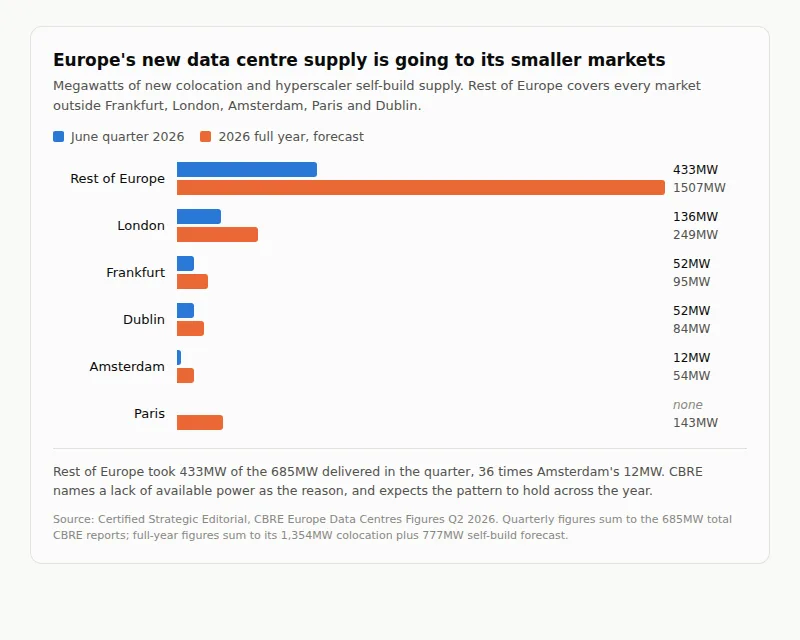
CBRE reads the shift as a move towards parts of the continent with an abundance of available power, with operators also expanding next to existing clusters.
AEMO counted 17 data centre projects and 9GW in the transmission connection process at 30 June 2026, with New South Wales at 52 per cent and Victoria at 31 per cent. South Australia appeared for the first time at 17 per cent. Europe's 433MW is capacity delivered. Australia's regional projects are mostly announcements that have yet to reach the connection queue.
Take-up held at 260MW and moved to smaller markets
Demand was virtually unchanged from the March quarter, and it moved between markets. Markets other than the five largest accounted for 55 per cent of Continental European take-up, against a roughly even split three months earlier.
Groningen in the northern Netherlands recorded more than five times Amsterdam's take-up and has emerged as an alternative to the supply-constrained Amsterdam market. Brussels and Barcelona also grew, as did Norway. CBRE's summary is that demand is now driving a range of non-core markets where scalable power is more readily available, often at a lower energy cost than in the five biggest markets.
Signings for AI-focused colocation reached 420MW across the first half of 2026, against 89MW in the same period of 2025. The majority of the capacity contracted by neoclouds, the GPU cloud specialists that rent compute to AI developers, is in the Nordics, where lower-cost renewable power is more abundant. The same tenant class is active here, and every arrangement neocloud providers in Australia have signed with an operator so far covers capacity that has yet to be built. CBRE also notes that providers have grown more comfortable with the covenants neoclouds bring, a marked change from two years ago when reticence prevailed.
Colocation vacancy fell to just below 8 per cent in the five biggest markets
Vacancy across the five largest markets declined from 8.3 per cent in March to just below 8 per cent, while the European rate overall was unchanged because availability rose in smaller markets. CBRE forecasts vacancy across the rest of Europe reaching 19 per cent by the end of 2026, on the reasoning that those markets hold more enterprise stock, which is harder to let in its entirety.
There is effectively no wholesale supply in Europe. Frankfurt's wholesale vacancy closed the quarter at 4.6 per cent, the lowest of the five.
CBRE's own count puts Sydney at 4.5 per cent, tighter than Europe's five biggest markets, in its Global Data Center Trends 2026 of 17 June 2026. Cushman & Wakefield, on its own base, puts it at 2.2 per cent at 30 June against 917MW operating, which is about 20 megawatts of spare capacity across 51 facilities. The CS directory of data centres in Australia includes every HCF Certified Strategic facility and enclave. The two are not interchangeable. Perth is the only Australian market carrying a rate near the rest-of-Europe forecast, at 34.3 per cent on 27MW in service.
Three-quarters of European supply met commitments signed earlier
More than three-quarters of the colocation supply delivered in Europe in the first half of 2026 met commitments signed in 2025 or earlier, up from 67 per cent across 2025. The rest of Europe ran at about half. CBRE's explanation is that hyperscalers and neoclouds need compute either near a cloud availability zone or close to a user's production site, and use the pre-let to reserve supply where the options are limited.
Australia contracts ahead too, on a different measure. Cushman counts 2.44GW of Australian capacity signed before construction, 61 per cent of the national pipeline and the highest share in Asia Pacific. The European figure is a share of take-up and the Australian one a share of pipeline, so the two are not the same measure, but both describe markets where capacity is spoken for years before it is switched on.
Frankfurt has absorbed 762MW since 2021
CBRE's market focus for the quarter is Frankfurt, which has recorded more take-up between 2021 and 2026 than any other European market and now holds the lowest vacancy on the continent. Its position, connectivity and depth of data centre labour keep demand coming despite the difficulty of building there.
Providers routinely wait years for the power and permits needed to build and operate in the city, and a recently introduced energy efficiency law has added reporting obligations, with some operators forced to re-design data centres already under construction. Take-up is forecast at 118MW for 2026 against 160MW in 2025, and new supply at 71MW against 241MW. CBRE expects Frankfurt to eventually overtake London as Europe's leading colocation market, with more supply due there in 2027 and 2028 than in Amsterdam and Dublin combined.
Frankfurt waits on generation and permits. Australia waits on transmission, which AEMO puts at about two years from application to energisation for a large new load.
What to watch
CBRE's third-quarter figures, for whether the 420MW of AI signings in the first half was a step change or a pull-forward.
Paris, which took 7MW in the first half and which CBRE still forecasts will reach a record 138MW by year end on hyperscaler, sovereign cloud and sovereign AI demand.
Dublin, where operators are holding off on investment pending a legal challenge to the Commission for Regulation of Utilities brought by a consortium of ecology groups, due to be heard in May 2027.
Whether Groningen, Brussels and Barcelona hold their share of take-up as new supply opens in the larger markets.
AEMO's Quarterly Energy Dynamics for the September quarter, due late October 2026, for whether South Australia holds its 17 per cent share of the Australian connection queue.
Corrected 2 October 2026: an earlier version described 208 sites as certified.