At a glance
The US government lifted the export controls on Anthropic’s Claude Fable 5 and Claude Mythos 5 on 30 June 2026, eighteen days after a 12 June directive forced Anthropic to disable both models for every user worldwide.
Fable 5 returns to users globally, including Australia, from Wednesday 1 July, on the Claude Platform, Claude.ai, Claude Code and Claude Cowork. Access on AWS, Google Cloud and Microsoft Foundry follows.
Mythos 5, the same underlying model with cyber safeguards lifted, has been restored only to a set of US organisations, following US government approval on 26 June. International Glasswing partners, Australia included, do not yet have it.
Anthropic’s Australian compute track ran through the dispute untouched, with CDC reported as front-runner for a 500MW contract and SunCable solar talks live.
What the 30 June reversal restores, and what it leaves in place
On 30 June 2026 the US government lifted the export controls it had placed on Anthropic’s two most capable models on 12 June. Anthropic confirmed the reversal the same day and set Fable 5 to return globally from 1 July. Commerce Secretary Howard Lutnick, who had signed the original directive, cleared the model after what Anthropic describes as two weeks of joint work with the government to analyse and approve it.
The reversal is not symmetrical. Fable 5, the general-use model that Australian buyers could reach through the standard Claude plans, comes back for everyone. Mythos 5, the higher-capability tier that runs the same weights with the cyber safeguards removed, has been restored only to a set of US organisations, following a separate US government approval on 26 June. Anthropic says it continues to coordinate with the government to expand Mythos 5 to the broader set of domestic and international Glasswing partners. Until that happens, the Australian critical-infrastructure operators who joined Project Glasswing in early June sit outside the restored cohort.
The availability risk we reported on 13 June, when a US national-security order locked the country out of both models three days after launch, has now resolved for Fable 5 and hardened for Mythos 5.
Fable 5 returns to Australia on the standard plans from 1 July
Fable 5 is available to users globally from Wednesday 1 July on the Claude Platform, Claude.ai, Claude Code and Claude Cowork. For Pro, Max, Team and select Enterprise plans, Anthropic is including Fable 5 for up to 50 per cent of weekly usage limits through 7 July, after which it moves to usage credits. Standard Enterprise seats bill all Fable 5 use through credits from the start. Anthropic says it will re-enable access on AWS, Google Cloud and Microsoft Foundry as quickly as possible, which matters for Australian enterprises that consume Claude through a hyperscaler contract rather than direct.
For an Australian operator or agency, the practical effect is that the general-access route to Mythos-class capability, open for three days in June before the directive closed it, reopens on 1 July with no allied restriction attached. Fable 5 was released on 9 June with the strongest safeguards Anthropic says it has applied to any model, a set of classifiers that divert sensitive cybersecurity, biology and chemistry queries to Claude Opus 4.8. Those safeguards are what made it exportable. They are also what separate it from the Mythos 5 tier that remains US-held.
Mythos 5 stays inside the United States, and the Glasswing cohort waits
The Australian angle sits in the tier that did not fully come back. Mythos 5 is the model Anthropic restricts to Project Glasswing cyberdefence partners, and by Anthropic’s account it can find and exploit software vulnerabilities better than any other model and better than all but a small number of expert human researchers. That capability is why it is gated, and why its return is being staged through US government approvals rather than switched back on globally.
The 26 June approval covered US organisations only. The Australian operators added to Glasswing in the early-June expansion, drawn from power, water, healthcare and communications, are the same asset classes Australia regulates under the Security of Critical Infrastructure Act 2018, and they were offered the Mythos 5 upgrade on 9 June. That upgrade is still frozen for them. On Anthropic’s stated position they keep the earlier Mythos Preview tooling they already run, so the operational hit is the loss of the stronger successor rather than the loss of a live capability.
The precedent from our June coverage stands unchanged at the top tier. The original directive carried no Five Eyes exception, and the restoration so far carries no allied carve-out either. Access to Anthropic’s highest-capability cyber model now runs through a US approval process that reaches domestic partners first and international partners on a timeline the US government controls. For Australian agencies weighing reliance on US frontier AI for national-scale functions, that is the structural read: the general tier is a commercial product, and the frontier cyber tier is an instrument of US policy.
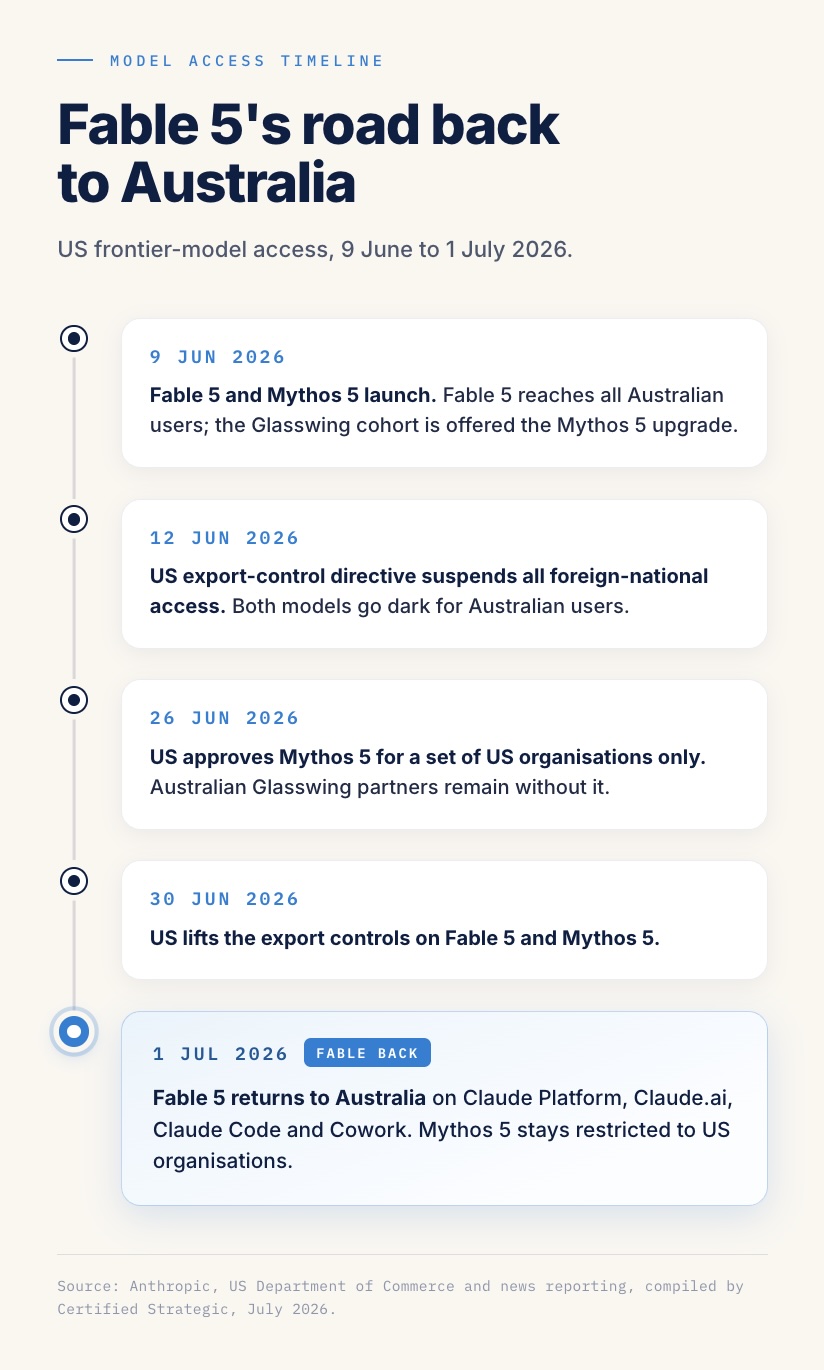
Anthropic released Fable 5 and Mythos 5 on 9 June 2026, with Fable 5 reaching all Australian users. The US export-control directive of 12 June suspended foreign-national access to both models. On 26 June the US approved Mythos 5 for a set of US organisations only, leaving Australian Glasswing partners without it. The US lifted the export controls on 30 June, and Fable 5 returned to users globally, including Australia, on 1 July, on the Claude Platform, Claude.ai, Claude Code and Cowork, while Mythos 5 stayed restricted to US organisations.
A new classifier blocks the bypass that triggered the export order
The 12 June directive followed a report from Amazon researchers who found a method of prompting Fable 5 so that it identified software vulnerabilities, and in one case produced code demonstrating how a vulnerability could be exploited. Anthropic’s account, now backed by two weeks of joint review, is that the technique surfaced no unique capability. Its testing found that less capable models including Claude Opus 4.8, GPT-5.5 and Kimi K2.7 could identify the same vulnerabilities, and that every model it tested could reproduce the single exploit demonstration, among them Claude Haiku 4.5, Sonnet 4.6 and several Opus versions. The behaviour was a borderline case for Fable 5’s safeguards, which block some low-risk defensive tasks out of caution.
Anthropic has trained a new safety classifier that targets the reported behaviour and blocks it in more than 99 per cent of cases, with blocked requests rerouted to Opus 4.8 and the user notified. Researchers at the US Department of Commerce’s Center for AI Standards and Innovation tested the old and new safeguards and, by Anthropic’s account, judged them strong. The trade-off is more false positives on routine coding and debugging, which Anthropic says it will keep tuning.
The episode produced two durable outputs beyond the fix. Anthropic is drafting a consensus jailbreak-severity framework with Amazon, Microsoft, Google and other Glasswing partners, scoring any bypass on four axes: how much capability it unlocks, how broadly it works, how easily it can be weaponised, and how discoverable the technique is. It has also committed to a deeper line to Washington under the 2 June executive order on advanced AI, including pre-release government access to national-security-relevant models, rapid sharing of safeguards and misuse patterns, and dedicated joint research backed by an Anthropic compute allocation. For allied governments, the framework is the part worth reading closely, because a US-led standard for when to restrict a model is the mechanism that will decide future foreign access.
Anthropic’s Australian build-out continued during the suspension
Anthropic’s Australian infrastructure activity continued while the models were suspended. In the same weeks, CDC was reported as front-runner for Anthropic’s 500MW Australian capacity contract, Anthropic was reported to be in advanced talks with SunCable over Northern Territory solar, and it appointed David Masters as head of policy for Australia and New Zealand. Its Australian Government work, including the first contract with the Fair Work Commission and an Australian Signals Directorate agreement, was not named in the US directive.
Anthropic’s infrastructure push and its access to the model tier run on separate tracks. The infrastructure relationship is a commercial and energy negotiation; access to Mythos-class models turns on US government decisions. An Australian data centre operator can secure Anthropic tenancy while an Australian critical-infrastructure operator still waits on the Mythos 5 upgrade. For providers positioning for sovereign AI tenancy, as set out in our neocloud market report, security of supply at the model layer now sits alongside power, certification and connectivity as a procurement question.
What to watch
The timeline for international Glasswing access. Anthropic says it is working to expand Mythos 5 to domestic and international partners. A named date, or the first Australian organisation confirmed on Mythos 5, would show the allied tier reopening.
The shape of the jailbreak-severity framework. Anthropic, Amazon, Microsoft and Google are drafting a common standard for judging model bypasses. Whether it hardens into the trigger for future export actions will determine how predictable foreign access becomes.
The 500MW award. CDC is the reported front-runner for Anthropic’s Australian capacity contract. A signed operator, a secured grid connection or a power purchase agreement would confirm the compute track has cleared the dispute and moved to commitment.
Australian agency posture. Whether the Cyber and Infrastructure Security Centre, Treasury or Systems of National Significance operators adjust their approach to US frontier models after watching a top-tier capability switch off and partially back on inside three weeks.