At a glance
7NEWS Spotlight put Australia’s data centre boom in front of a commercial prime-time audience on Sunday 12 July 2026, anchored on NEXTDC’s West Footscray site.
Following ABC’s Four Corners in June, it was the second national prime-time investigation of the sector, and the first to reach viewers who were not already tracking it.
The economic case holds: Westpac puts the build-out pipeline above A$155 billion, and Anthropic and OpenAI have both committed frontier-model demand on Australian soil.
The concerns worth answering are substantive: power, land use and social licence, not the horror-movie scoring.
The sector’s own answer is already forming, through community-benefit funds, bring-your-own-generation commitments and the government’s new project expectations.
A theatrical treatment of a real story
Channel Seven’s Spotlight gave its data centre investigation the full current-affairs treatment on Sunday night: the drone shots, the tense score, the voiceover asking more than once at what cost. The anchor was NEXTDC’s M3 site at West Footscray, where reporter Sarah Greenhalgh spoke with residents, including Sean Brown of the Citizens of Tottenham group, about construction disruption, diesel backup generators and property values. NEXTDC responded on the record that its generators run under established operational procedures, and that a June power interruption in the area was an external grid incident its backup systems handled.
The scoring was unnecessary, because the story underneath it was largely sound. Spotlight found a real subject and then dressed it as a thriller.
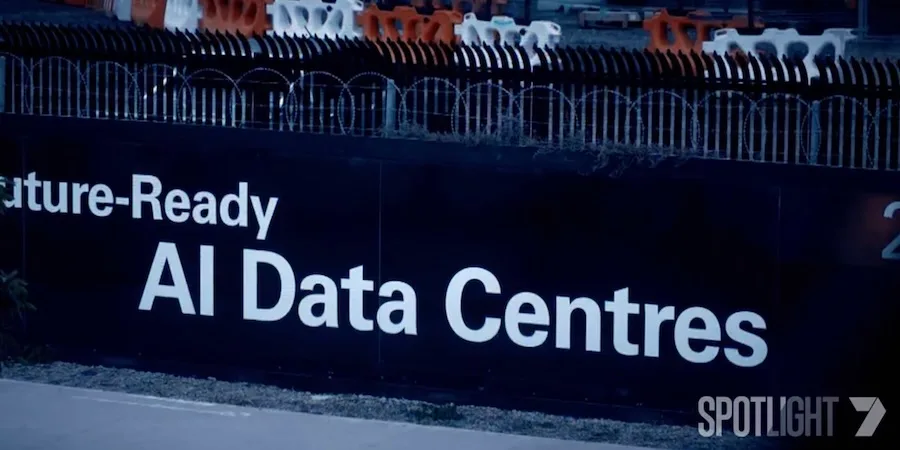
Credit: 7NEWS Spotlight - Inside Australia's AI Data Factories
The economics, and a genuine technology shift
The program’s optimism about growth was its soundest note. Westpac IQ, in a May 2026 bulletin by senior economist Pat Bustamante, puts Australia’s data centre investment pipeline above A$155 billion, about 5.6 per cent of a single year’s GDP. After stripping out the imported hardware that leaves the country, the bank models a net boost to GDP of around A$75 billion, worth 2.8 per cent of output, supporting on the order of 400,000 jobs while the build rolls out. Spotlight’s claim that the build-out is big and good for the economy is backed by the numbers.
The demand behind those figures is not hypothetical. Industry research by Mandala Partners, commissioned by operators including AirTrunk, AWS, CDC Data Centres and NEXTDC, has deployable capacity more than doubling from 1,350MW in 2024 toward 3,100MW by 2030, with the sector’s electricity use climbing from roughly 2 per cent of national demand toward 6 per cent. The Australian Energy Market Operator forecasts data centre consumption rising from about 4 terawatt hours in FY25 to 12 terawatt hours by FY30. OpenAI has an agreed memorandum of understanding with NEXTDC for a 550MW “Stargate” facility at its S7 site in Western Sydney, and Anthropic’s Australian tender has been reported at more than 1.4GW.
It was also right that the technology has changed. The buildings drawing scrutiny are a long way from the 2010 colocation halls full of lightly warm servers. They are AI factories, engineered around GPU density that runs from 14kW to beyond 200kW a rack, with liquid cooling designed into the slab, a shift we set out in our coverage of the NVIDIA GTC 2026 AI factory turn. Torrens University’s Professor Ali Mirjalili’s line on the program, that these are called factories because they manufacture intelligence, captured the change more usefully than the music did.
The concerns worth answering: power, land and social licence
Set the flourishes aside and the program raised questions that deserve a straight answer. Residents’ worries about siting heavy infrastructure close to homes, about diesel backup generators and air quality, and about construction disruption and property values, are real and predate the cameras. There are fair questions, too, about land use and the pace at which industrial land is being acquired for capacity that will fill over years rather than months, as with NEXTDC’s 169-hectare purchase at Lovely Banks in Geelong.
Social licence is the live policy question, and it is moving. A community-benefit fund for data centres is now being discussed, the Australian government has published its five Expectations for the sector, from bringing your own generation to covering transmission and benefiting local communities, and community campaigns have begun to succeed, with a Blue Mountains proposal withdrawn this month. The government made the same point on the program, that data centres should strengthen the grid they draw on rather than strain it. These are the questions that outlast the broadcast, and the sector is better served by answering them than by dismissing the program that raised them. The one claim that does not survive contact with the numbers is that data centres are quietly inflating household power bills: bills fell on 1 July 2026, and operators pay their own connection and network costs.
Anthropic’s ambitions raise a separate question
The program gestured at the larger AI ambitions behind the sheds, and those carry their own unresolved issue. Anthropic’s Australian build-out, reported at more than 1.4GW, depends on more than power and land. Its plans to train Claude on Australian data hinge on a text-and-data-mining exemption the Australian government has already declined once, ruled out in October 2025 in favour of licensing and disclosure. The infrastructure debate and the data debate are arriving together, and the second is the harder of the two.
What the episode is worth to the sector
Spotlight did the industry a quiet service. Following ABC Four Corners’ “The AI Race” on 8 June, it was the second national prime-time look at the AI and data centre boom, and the first to put the community frame in front of a mass commercial audience that was not tracking it. That audience now has the industry, and its genuine trade-offs, in view. The strongest answers are already forming: community-benefit models, bring-your-own-generation commitments, and the additionality-plus-flexibility template operators like Firmus are building in South Australia and Tasmania. An hour of prime time that leaves a mass audience curious about power, land and social licence is a net gain for the industry, whatever the framing.